Spaceflight Now Home


The Mission


Rocket: Ariane 5 ECA
Payload: DirecTV 9S & Optus D1
Date: Oct. 13, 2006
Window: 2056-2156 GMT (4:56-5:56 p.m. EDT)
Site: ELA-3, Kourou, French Guiana
Satellite feed: AMC 3, Transponder 23, C-band, 87° West

Cue Card

Mission Status Center


Spaceflight Now +


Premium video content for our Spaceflight Now Plus subscribers.

Soyuz moves ports
The three-man Expedition 14 crew of the International Space Station complete a short trip, flying their Soyuz capsule to another docking port in preparation for receiving a resupply ship.

 Undock | Re-dock

STS-39: Military maneuvers
Space shuttle Discovery's STS-39 flight, launched in April 1991, served as a research mission for the U.S. Department of Defense. An instrument-laden spacecraft for the Strategic Defense Initiative Organization was released to watch Discovery perform countless rocket firings and maneuvers, as well as canisters releasing clouds of gas. The crew tells the story of the mission in this post-flight film presentation.

 Small | Large

STS-37: Spacewalkers help Gamma Ray Observatory
Seeking to study explosive forces across the universe, the Gamma Ray Observatory was launched aboard shuttle Atlantis in April 1991. But when the craft's communications antenna failed to unfold, spacewalking astronauts ventured outside the shuttle to save the day. The rescue EVA was followed by a planned spacewalk to test new equipment and techniques. The crew of STS-37 narrate this post-flight mission film.

 Small | Large

Mars rover seen by orbiter
Dazzling images from Mars are revealed by scientists. The robotic rover Opportunity has reached the massive Victoria crater with its steep cliffs and layers of rock exposing the planet's geologic history. Meanwhile, the new Mars Reconnaissance Orbiter has photographed the rover and its surroundings from high above.

 PLAY

Become a subscriber
More video


BY JUSTIN RAY

Follow the launch of Arianespace's Ariane 5 rocket carrying the DirecTV 9S and Optus D1 communications spacecraft. Reload this page for the latest on the mission.

2142 GMT (5:42 p.m. EDT)

Today's launch was the fourth Ariane 5 flight in 2006. Next up will be early December liftoff of the WildBlue 1 broadband spacecraft and the AMERICOM 18 communications satellite aboard another Ariane 5 ECA rocket.

2132 GMT (5:32 p.m. EDT)

The Japanese antenna deployment experiment will be conducted over the next hour. Results, however, won't be announced live.

2130 GMT (5:30 p.m. EDT)

This marks the 26th successful launch of the Ariane 5 rocket and the 15th in a row.

2127 GMT (5:27 p.m. EDT)

Plus+31 minutes, 55 seconds. SPACECRAFT SEPARATION! The Optus D1 communications satellite has been released from the Ariane 5 rocket's upper stage, completing today's launch.

Built by Orbital Sciences, this Star 2-model satellite carries 24 Ku-band transponders for video, voice and data relay transmissions across Australia and New Zealand from geostationary orbit.

2126 GMT (5:26 p.m. EDT)

Plus+30 minutes, 42 seconds. The the barrel-like "Sylda" payload adapter between DirecTV 9S and the Optus D1 satellite has been jettisoned. This has exposed Optus for its upcoming release from the rocket.

2122 GMT (5:22 p.m. EDT)

Plus+26 minutes, 46 seconds. SPACECRAFT SEPARATION! The DirecTV 9S broadcasting spacecraft has been released from the Ariane 5 rocket's upper stage.

Built by Space Systems/Loral, this FS 1300-model satellite carries 52 Ku-band and 2 Ka-band transponders to provide direct-to-home television to subscribers across the U.S. from geostationary orbit.

2122 GMT (5:22 p.m. EDT)

Plus+26 minutes. Altitude is 881 km, velocity is 9.1 km/sec.

2120 GMT (5:20 p.m. EDT)

Plus+24 minutes, 47 seconds. The new cryogenic upper stage for Ariane 5 has just shut down to complete its burn for today's launch. The stage will prepare for deployment of the two satellite payloads a few minutes from now.

2120 GMT (5:20 p.m. EDT)

Plus+24 minutes. Altitude is 601 km, velocity is 9.27 km/sec.

2119 GMT (5:19 p.m. EDT)

Plus+23 minutes. Less than two minutes of propulsion remains in the upper stage. Altitude is 494 km, velocity is 9.1 km/sec.

2118 GMT (5:18 p.m. EDT)

Plus+22 minutes. Altitude is 404 km, velocity is 8.9 km/sec.

2116 GMT (5:16 p.m. EDT)

Plus+20 minutes, 30 seconds. Altitude is 297 km, velocity is 8.7 km/sec.

2116 GMT (5:16 p.m. EDT)

Plus+20 minutes. Just under five minutes remain in this firing of the upper stage.

2115 GMT (5:15 p.m. EDT)

Plus+19 minutes. Altitude is 228 km, velocity is 8.48 km/sec.

2114 GMT (5:14 p.m. EDT)

Plus+18 minutes, 15 seconds. Altitude is 203 km, velocity is 8.35 km/sec.

2112 GMT (5:12 p.m. EDT)

Plus+16 minutes. Trajectory and onboard systems remain normal.

2111 GMT (5:11 p.m. EDT)

Plus+15 minutes, 30 seconds. The vehicle is beginning its upward climb again. Altitude is 158 km, velocity is 7.9 km/sec.

2110 GMT (5:10 p.m. EDT)

Plus+14 minutes, 30 seconds. Altitude is 153 km, velocity is 7.7 km/sec.

2108 GMT (5:08 p.m. EDT)

Plus+12 minutes. Altitude is 155 km, velocity is 7.3 km/sec.

2106 GMT (5:06 p.m. EDT)

Plus+10 minutes, 30 seconds. The cryogenic upper stage motor continues to fire. Altitude is 158 km, velocity is 7.1 km/sec.

2105 GMT (5:05 p.m. EDT)

Plus+9 minutes, 10 seconds. The upper stage of the Ariane 5 ECA rocket is up and burning to accelerate the payload into geosynchronous transfer orbit.

2104 GMT (5:04 p.m. EDT)

Plus+8 minutes, 58 seconds. The main cryogenic stage's Vulcain engine has cut off and the spent stage has separated. It will fall back into the atmosphere prior to completing an orbit of Earth.

2104 GMT (5:04 p.m. EDT)

Plus+8 minutes. Coming up on main stage shutdown in about a minute. Altitude is 160 km, velocity is 5.6 km/sec.

2103 GMT (5:03 p.m. EDT)

Plus+7 minutes, 30 seconds. Altitude is 162 km, velocity is 5.0 km/sec.

2102 GMT (5:02 p.m. EDT)

Plus+6 minutes, 30 seconds. The rocket's climb has leveled out as designed. This temporary trajectory is needed in order to gain speed. Altitude is 163 km, velocity is 4.1 km/sec.

2101 GMT (5:01 p.m. EDT)

Plus+5 minutes. The main stage's Vulcain 2 engine continues to fire as it burns a mixture of liquid hydrogen and liquid oxygen rocket fuel. Altitude is now 151 km.

2100 GMT (5:00 p.m. EDT)

Plus+4 minutes. Ariane 5 is 131 km in altitude and traveling at 2.5 km/sec. All systems are reported normal.

2059 GMT (4:59 p.m. EDT)

Plus+3 minutes, 17 seconds. The protective payload fairing enclosing the payload has been separated from the Ariane 5.

2059 GMT (4:59 p.m. EDT)

Plus+3 minutes. Ariane 5 is 97 km in altitude and traveling at 2.1 km/sec.

2058 GMT (4:58 p.m. EDT)

Plus+2 minutes, 21 seconds. The solid rocket boosters have been jettisoned from the Ariane 5 rocket's core stage. The liquid-fueled Vulcain 2 main engine continues to fire to propel the vehicle and its satellite payload to space.

2057 GMT (4:57 p.m. EDT)

Plus+1 minute, 30 seconds. About one minute left in the burn by the solid rocket boosters. The boosters are providing 90 percent of the liftoff thrust.

2057 GMT (4:57 p.m. EDT)

Plus+60 seconds. The vehicle is on the proper trajectory as it rides the power of the twin solid rocket boosters and main stage liquid-fueled engine.

2056 GMT (4:56 p.m. EDT)

Plus+35 seconds. Pitch and roll maneuvers has been performed by the Ariane 5 vehicle to position itself on the correct eastward heading bound for geosynchronous transfer orbit.

2056 GMT (4:56 p.m. EDT)

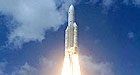
LIFTOFF! Liftoff of the Arianespace Ariane 5 ECA rocket launching a multi-national payload. And the vehicle has cleared the tower!

2055 GMT (4:55 p.m. EDT)

Minus-50 seconds. The vehicle is switching to internal power.

2055 GMT (4:55 p.m. EDT)

Minus-1 minute. A fast-paced series of events leading to launch will begin at Minus-37 seconds when the automated ignition sequence is started. The water suppression system at the launch pad will start at Minus-30 seconds. At Minus-22 seconds, overall control will be given to the onboard computer. The residual hydrogen burn flares will fire beneath the Vulcain engine at Minus-6 seconds to burn away any free hydrogen gas. At Minus-3 seconds, onboard systems take over and the two inertial guidance systems go to flight mode. Vulcain main engine ignition occurs at Minus-0 seconds with checkout between Plus+4 and 7 seconds. If there are no problems found, the solid rocket boosters are ignited at Plus+7.0 seconds for liftoff at Plus+7.3 seconds.

2054 GMT (4:54 p.m. EDT)

Minus-2 minutes. The Vulcain 2 main engine supply valves are being opened. And the ground valves for engine chilldown are being closed.

2053 GMT (4:53 p.m. EDT)

Minus-3 minutes. The scheduled launch time has been loaded into the rocket's main computer system. The main stage tank pressures should now be at flight level.

2052 GMT (4:52 p.m. EDT)

Minus-4 minutes. Pressurization is now underway for the main cryogenic stage's liquid oxygen and hydrogen tanks. Also, final pyrotechnic arming is starting.

2050 GMT (4:50 p.m. EDT)

Minus-6 minutes and counting. Liquid hydrogen and liquid oxygen supplies of the main and upper cryogenic stages are being verified at flight level. Also, the pyrotechnic line safety barriers are being armed.

2049 GMT (4:49 p.m. EDT)

Minus-7 minutes and counting. The Synchronized Sequence is starting. Computers are now in control of this final segment of the launch countdown to prepare the rocket and ground systems for liftoff. There are two computers running the countdown -- one aboard the Ariane 5 and a redundant one at the ELA-3 launch complex.

2046 GMT (4:46 p.m. EDT)

Minus-10 minutes and counting. All systems remain "go" for launch.

2042 GMT (4:42 p.m. EDT)

Minus-14 minutes and counting. Launch of the Ariane 5 rocket remains set for 2056 GMT. The countdown is headed to the Synchronized Sequence that assumes control of the clock in the final seven minutes to launch.

FRIDAY, OCTOBER 13, 2006

A heavy-lifting Ariane 5 rocket loaded with payloads from the U.S., Australia and Japan is scheduled for blastoff at 2056 GMT (4:56 p.m. EDT) today from Kourou, French Guiana.

The Arianespace booster will deploy the American DirecTV 9S direct-to-home broadcasting spacecraft and the Australian Optus D1 telecommunications satellites into geosynchronous transfer orbit from the Guiana Space Center on the northeastern shore of South America. Later, a large antenna experiment for the Japanese space agency will attempt to unfurl from the rocket's spent upper stage.

Today's available launch window extends an hour to 2156 GMT (5:56 p.m. EDT).

This will be the fourth Ariane 5 of 2006, and the vehicle will fly in the more-powerful configuration of the heavy-lift rocket family with the Vulcain 2 upgraded first stage main engine and the ECA cryogenic upper stage.

The final countdown began this morning at the Launch-Minus 11 hour, 30 minute mark. That was followed by a check of electrical systems. Fueling of the first stage and new cryogenic upper stage with super-cold load of liquid hydrogen and liquid oxygen is set to commence in the final five hours before liftoff time.

The countdown will enter the synchronized launch sequence about seven minutes prior to launch. Next will be a fast-paced series of automated events transitioning the rocket and payload to internal power, pressurizing fuel tanks, and taking systems to flight mode. The Vulcain engine will come to life, followed by ignition of the solid rocket boosters and liftoff.

The twin boosters will separate at 2 minutes, 20 seconds, and the payload fairing will be released at Plus+3 minutes, 14 seconds. The cryogenic first stage will exhaust its propellant supply at Plus+8 minutes, 56 seconds, followed six seconds later by the jettisoning. After separation, the cryo upper stage will ignite to begin its 15.5-minute burn to complete the Ariane 5's ascent, shutting down at Plus+24 minutes, 44 seconds.

DirecTV 9S deployment is set for 27 minutes into the mission. Optus D1 will be released at Plus+32 minutes.

Watch this page for live updates during the launch.

Copyright 2006 SpaceflightNow.com, all rights reserved.


Apollo Collage
This beautiful one piece set features the Apollo program emblem surrounded by the individual mission logos.
 U.S. STORE

STS-127 Patch
The official embroidered patch for shuttle Endeavour's flight to finish building Japanese section of the space station.
 U.S. STORE
 WORLDWIDE STORE


Hubble Patch
The official embroidered patch for mission STS-125, the space shuttle's last planned service call to the Hubble Space Telescope, is available for purchase.
 U.S. STORE
 WORLDWIDE STORE

Project Orion
The Orion crew exploration vehicle is NASA's first new human spacecraft developed since the space shuttle a quarter-century earlier. The capsule is one of the key elements of returning astronauts to the Moon.
 U.S. STORE


Fallen Heroes Patch Collection
The official patches from Apollo 1, the shuttle Challenger and Columbia crews are available in the store.
 U.S. STORE
 WORLDWIDE STORE

Columbia Report
The official accident investigation report into the loss of the space shuttle Columbia and its crew of seven. Includes CD-ROM.
 Choose your store:
U.S.

INDEX | PLUS | NEWS ARCHIVE | LAUNCH SCHEDULE
ASTRONOMY NOW | STORE

ADVERTISE

© 2009 Spaceflight Now Inc.