|

|

|
||||
|
|
||||
|
U.S. weather satellite finally escapes grasp of hard luck BY JUSTIN RAY SPACEFLIGHT NOW Posted: October 18, 2003 Leaving behind three difficult years of delays and disappointments, a seemingly jinxed U.S. military weather satellite finally enjoyed a reversal of fortune Saturday as it successfully soared into space.
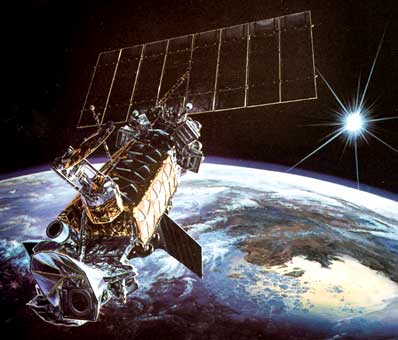
Foggy conditions cleared just in time to permit a clear view of the liftoff from Space Launch Complex-4 West at Vandenberg Air Force Base, California. Six-and-a-half minutes later, the satellite separated from the Titan 2's second stage while cruising on a sub-orbital trajectory. A solid-propellant kick motor attached to the satellite ignited to propel the craft into a stable orbit. The satellite's hydrazine-fueled thrusters then fired to circularize the altitude about 458 nautical miles above the planet. The safe and successful ascent gave satellite managers a happy ending to the nightmarish saga that played out for 33 months as the $450 million mission was postponed again and again by technical gremlins. "It's just a wonderful feeling and I really get closure to the last 33 months of trying to get F16 into the sky," Col. Randy Odle, the DMSP system program director, said in an interview a few hours after the liftoff. "The whole ascent phase of the mission went extremely well. We have been checking out the spacecraft ever since the launch and all of the spacecraft checkout is going nominally. It has just been a very positive day for the entire launch and satellite team." The mission was just 28 seconds away from blastoff in January 2001 before the being grounded three years by a chain of rocket and satellite problems. Saturday's countdown was the fifth in the mission's history. "It was a beautiful launch today. The Titan 2 booster performed superbly. It is just great to see the F16 satellite rocket into space," Odle said. "The last Titan 2 surely went out in fine style." The DMSP F16 craft, with its complement of eight instruments, will track clouds, storm systems and hurricanes around the world for weather forecasting, plus monitor ice and snow coverage, pollution and fires. The U.S. military has a constellation of two primary DMSP satellites and older backups working in space, giving meteorologists the information needed to generate forecasts that commanders and troops rely upon in strategic and tactical planning. "DMSP is in its fourth decade of service and continues to be an invaluable resource for successfully planning, executing and protecting military operations on land, at sea and in the air," said Odle.
"In Afghanistan and even some of the other conflicts in the past, I think what we have seen is the weather support to the both operations planning and operation execution is very, very key," Odle said. "We have gotten a lot of good comments from the leadership that without the weather data that DMSP provides, and in fairness the weather data provided by all of the weather satellite capabilities of the U.S. and our allies, just really makes a difference in deciding when to conduct an operation, whether to really conduct that operation and what kind of weaponry is best suited for that operation given the weather that we think we are going to encounter." It will take about 30 days to check out the DMSP F16 craft before it enters service. "That is really going to be proof in the pudding...Launch is only part of it -- it is a major part of it, but it's only the first stage of our mission success efforts," Odle said. "Once operational F16 will deliver unparalleled global weather and space environmental information in support of users worldwide. F16 will be the best DMSP satellite ever launched," he said. The Lockheed Martin-built satellite is the first to carry a larger, more sophisticated package of sensors and instruments known as the Block 5D-3 upgrade. Four instruments are new, two are modified from previous spacecraft and two remain unchanged. "We believe (the new sensors) are going to provide a lot more capabilities once calibrated. Their calibration effort will go for about 18 months beyond the launch date to fully calibrate these new science and information sensors. We believe those will help improve our models and certainly help improve forecasting and the weather capability support to the warfighters and other users," Odle said. The new satellite will replace DMSP F15, launched in December 1999, as the lead craft in the constellation's "mid-morning orbit." Each satellite crosses any point on the Earth up to two times a day and has an orbital period of about 101 minutes. The constellation provides a nearly complete global snapshot every six hours. "The Air Force Weather Agency is the user that takes information from our satellite, puts the products together and ships that out to other users worldwide. Another direct user of our information is the Navy," Odle explained. In addition, there are so-called "tactical terminals" deployed with military forces that allow leaders to receive weather data directly from the satellites as they pass overhead. "The terminals in theater allow for direct downlink of weather data without any delays," Odle said. The next DMSP satellite is slated to fly in April 2005 aboard a Boeing Delta 4 rocket from Space Launch Complex-6 at Vandenberg. The F18 spacecraft is scheduled for October 2007 aboard Lockheed Martin's Atlas 5 rocket from Vandenberg's SLC-3E. Two more DMSP's will follow through 2011. Saturday's flight was the final time a Titan 2 rocket will ever fly. Titan 2 is a decades-long program that began as a missile in the United States' arsenal against the Soviet Union, launched NASA's Gemini astronauts in the mid-1960s and in recent years carried smaller satellites into space.
The DMSP F16 mission used the 13th of the 14 refurbished Titan 2 ICBMs. That particular rocket was stationed on alert in a silo at McConnell Air Force Base in Kansas from 1967 to 1986. The Air Force had looked to find customers for the 14th and final converted vehicle, including the Missile Defense Agency possibly using it as a target for intercept testing, but no takers were found. With the Titan program coming to an end, time ran out for the last rocket to be used, officials said. The booster could be headed for the U.S. Air Force Museum at Wright Patterson Air Force Base in Ohio. "They're our focal point for disposal of an Air Force asset like this," said Col. John Insprucker, the Titan program manager. "Our hope is as they're building their new space and missile exhibit hall maybe they'll have room in the hall and in their hearts for a Titan 2." If the Air Force museum gives approval, Smithsonian also is possibility. "We stand ready if there's an authorized agency to help us move it out of Vandenberg." In addition to the 13 converted ICBMs that were launched between 1988 and Saturday, all successfully, two unmanned and 10 manned Gemini missions flew atop Titan 2 boosters from Florida's Cape Canaveral between 1964 and 1966.
|
|
|
|

|
|||
|
MISSION STATUS CENTER |
|||||||