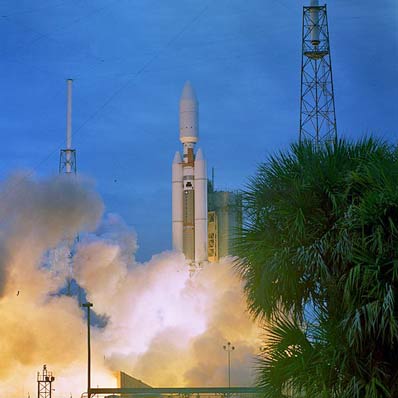
Missile warning satellite launched by Titan 4B rocket
BY JUSTIN RAY
SPACEFLIGHT NOW

Posted: February 15, 2004

The U.S. military's newest orbiting sentry was successfully deployed Saturday, joining a space surveillance system that maintains a constant vigil 22,300 miles above Earth to detect enemy missile launches and nuclear weapon detonations.


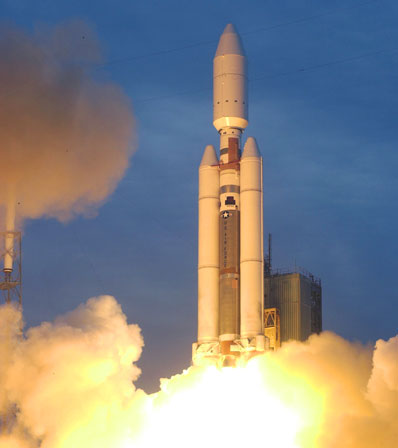
The Titan 4 rocket launches with DSP-22. Photo: Pat Corkery/Lockheed Martin
 
A $396 million Lockheed Martin Titan 4B rocket blasted off at 1:50 p.m. EST (1850 GMT) from Cape Canaveral's Complex 40, ascending into a gloomy gray Florida sky.

Minutes later, the Titan delivered the Boeing Inertial Upper Stage and attached Defense Support Program-22 satellite payload into a preliminary parking orbit around the planet.

Over the next six-and-a-half hours, the $111 million IUS kick motor performed two firings that propelled the $256 million DSP-22 into geostationary orbit. The satellite was safely released from the rocket stage to complete the launch nearly seven hours after it began.

DSP satellites, built by Northrop Grumman, use infrared telescopes to spot the heat from missile and booster plumes against the Earth's background, giving the U.S. and allies early warning of impending attacks. In addition, the craft detect nuclear explosions.

"For 34 years, the Defense Support Program satellites have been the mainstay of this great nation's space-based strategic missile warning and surveillance capability," said Col. Robert "Bo" Reese, deputy system program director for the Air Force's Space Based Infrared Systems. "During the past 13 years, relatively inexpensive computer resources allowed us to expand that DSP mission to tactical missile warning and support commanders deployed worldwide."


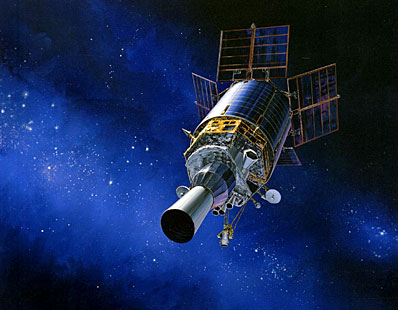
An artist's concept shows a DSP satellite deployed in space. Credit: Northrop Grumman
 
Conceived decades ago in the Cold War, the military says the surveillance system remains vital.

"The threat is still there," said Maj. Francis Doiron, chief of DSP current operations at Air Force Space Command.

"The kinds of threat systems that we are looking at have proliferated. They have been exported elsewhere. They are all over the world. We see nations and other elements that are willing to use them. So we think we still need the capability," Reese added.

The 23rd and last DSP satellite is scheduled for launch next March aboard a Boeing Delta 4-Heavy rocket from the Cape. And as the last DSP craft reach space, a new generation of infrared satellites is being readied to fly.

"As we transition to more capable systems that will succeed DSP, these satellites will remain the backbone for this nation's missile warning needs for the foreseeable future, at least for the next decade," Reese said.

 
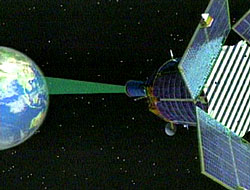
Animation shows the DSP satellite scanning Earth. Photo: Credit: Northrop Grumman
 
"The need to replenish the constellation and provide the cornerstone for this important transition is dependent upon the successful launch and deployment of the two remaining DSP satellites -- DSP-22 and 23."

DSP-22 is affectionately known as Eagle Eye.

"'Eagle Eye' not only conveys the sharp visual acuity of the DSP satellite, but also the nation's infrared 'eye' on the world,'" the Air Force says.

Saturday's mission was the 24th and final IUS launch. Dating back to 1982, IUS motors flew aboard 15 space shuttle missions, eight Titan 4 rockets and a single Titan 34D, launching NASA's Magellan space probe to Venus, Galileo to Jupiter, Ulysses to the sun, the Chandra X-ray Observatory, the original fleet of Tracking and Data Relay Satellites, plus many military spacecraft, including a few classified ones.

One additional IUS, standing by as back up for the DSP-22 mission, remains in storage at Cape Canaveral. The Air Force and Boeing are looking at options to safe the IUS, replace the two solid-fueled stages with inert motors and display it in a museum.

Boeing has about 145 employees working the IUS program -- 80 at the IUS factory in Washington and 65 at Cape Canaveral.

"These employees will be redeployed to other Boeing programs shortly after launch or will support near-term program closeout tasks," said Bill Benshoof, Boeing's IUS program manager.


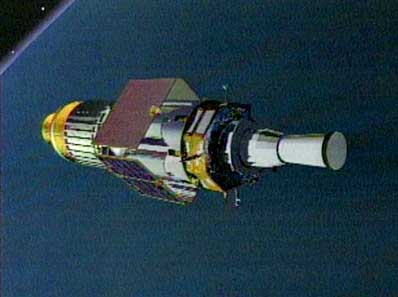
An artist's concept shows the DSP riding atop the IUS booster. Credit: Northrop Grumman
 
Benshoof started working on the IUS program in 1978 as a writer of technical manuals. He ascended the ladder, becoming program manager in 2001.

"There is something about a program where you start at the very beginning and you get to see it all the way. You get to see the products born, built, tested and integration with the boost vehicle and spacecraft, and then you actually get to be part of the ground and site operations. Being with the product from all of the way, beginning to end, is pretty exciting," he said in an interview.

"It's been a fun journey."

For the Titan rocket fleet, this marked the next-to-last Florida launch for the heavy-lift vehicle. The East Coast Titan finale is scheduled for October 1 when a secret satellite cargo will be launched for the U.S. National Reconnaissance Office.

As soon as Saturday's mission was airborne, crews were turning their attention to launch pad refurbishment and modification work to support the next flight, Air Force launch director Lt. Col. Jimmy Comfort said.

Plans call for the rocket to be rolled to the pad in April to begin the launch campaign.


Only one more Titan 4 rocket will launch from Cape Canaveral following Saturday's liftoff carrying the DSP-22 satellite. Photo: Carleton Bailie/Boeing
 
The Titan 4 era ends next February when another NRO payload is launched from Vandenberg Air Force Base in California.

"The Lockheed Martin Titan team is treating these final missions of the Titan 4 like they are first-time launches, not final launches," said G. Thomas Marsh, executive vice president of Lockheed Martin Space Systems. "The pride of our entire team is riding on these missions, because we know how important they are for our nation's security."

Saturday's launch was the 37th flight for Titan 4 since 1989, the 26th to occur from Florida.

Spaceflight Now Plus
Video coverage for subscribers only:
   VIDEO: THE TITAN 4 ROCKET LIFTS OFF WITH DSP-22 QT
   VIDEO: 15-MINUTE CLIP OF COUNTDOWN TO TITAN/IUS SEPARATION QT
   VIDEO: THE DSP SATELLITE UNDERGOES LAUNCH PREPS QT
   VIDEO: DSP-22 MOUNTED ATOP ROCKET AT LAUNCH PAD QT
   VIDEO: ANIMATION OF DSP SATELLITE IN SPACE QT

   VIDEO: TITAN 4 ROCKET BACKS OUT OF SMARF BUILDING QT
   VIDEO: THE ROCKET MAKES ITS WAY TO LAUNCH PAD QT
   SUBSCRIBE NOW

Flight data file
Vehicle: Titan 4B (B-39)
Upper stage: IUS-10
Payload: DSP-22
Launch date: Feb. 14, 2004
Launch window: 1:21 to 5:21 p.m. EST (1821-2221 GMT)
Launch site: Complex 40, Cape Canaveral, Florida
Satellite broadcast: Telstar 6, Transponder 15, C-band

Pre-launch briefing
Launch timeline - Chart with times and descriptions of events to occur during the launch.

Weather forecast - The latest forecast for launch day conditions.

Launch hazard area - A map of the restricted area during liftoff.

DSP satellite - An overview of the Defense Support Program spacecraft being launched.

Titan 4B - Description of rocket being used in this launch.

Titan 4 history - Chart with listing of previous Titan 4 flights.

Titan 4 directory - See our coverage of previous Titan 4 rocket flights.

Soviet Space
For the first time ever available in the West. Rocket & Space Corporation Energia: a complete pictorial history of the Soviet/Russian Space Program from 1946 to the present day all in full color. Available from our store.
 Choose your store:
U.S. - U.K. - E.U. - Worldwide

Viking patch
This embroidered mission patch celebrates NASA's Viking Project which reached the Red Planet in 1976.
 Choose your store:
U.S. - U.K. - E.U. - Worldwide

Apollo 7 DVD
For 11 days the crew of Apollo 7 fought colds while they put the Apollo spacecraft through a workout, establishing confidence in the machine what would lead directly to the bold decision to send Apollo 8 to the moon just 2 months later.
 Choose your store:
U.S. - U.K. - E.U. - Worldwide

Gemini 12
Gemini 12: The NASA Mission Reports covers the voyage of James Lovell and Buzz Aldrin that capped the Gemini program's efforts to prove the technologies and techniques that would be needed for the Apollo Moon landings. Includes CD-ROM.
 Choose your store:
U.S. - U.K. - E.U. - Worldwide

John Glenn Mission Patch

Free shipping to U.S. addresses!

The historic first orbital flight by an American is marked by this commemorative patch for John Glenn and Friendship 7.
 U.S. STORE
 WORLDWIDE STORE

Final Shuttle Mission Patch

Free shipping to U.S. addresses!

The crew emblem for the final space shuttle mission is available in our store. Get this piece of history!
 U.S. STORE
 WORLDWIDE STORE

Celebrate the shuttle program

Free shipping to U.S. addresses!

This special commemorative patch marks the retirement of NASA's Space Shuttle Program. Available in our store!
 U.S. STORE
 WORLDWIDE STORE

Anniversary Shuttle Patch

Free shipping to U.S. addresses!

This embroidered patch commemorates the 30th anniversary of the Space Shuttle Program. The design features the space shuttle Columbia's historic maiden flight of April 12, 1981.
 U.S. STORE
 WORLDWIDE STORE

Mercury anniversary

Free shipping to U.S. addresses!


Celebrate the 50th anniversary of Alan Shephard's historic Mercury mission with this collectors' item, the official commemorative embroidered patch.
 U.S. STORE
 WORLDWIDE STORE

Fallen Heroes Patch Collection
The official patches from Apollo 1, the shuttle Challenger and Columbia crews are available in the store.
 U.S. STORE
 WORLDWIDE STORE

Ferryflight Shuttle Patch

Free shipping to U.S. addresses!

"The Final Mission" - NASA emblem developed for the Shuttle Carrier Aircraft crew and their support teams to deliver the orbiters to their final destinations at museums.
 U.S. STORE
 WORLDWIDE STORE


An insider's view of how Apollo flight controllers operated and just what they faced when events were crucial.
 Choose your store:
U.S.

Apollo 12 tribute DVD set

New! Featuring the jovial crew of Pete Conrad, Dick Gordon and Alan Bean, the Apollo 12 mission was struck by lightning shortly after liftoff but proceeded on the second successful exploration voyage to the lunar surface. This three-disc DVD brings the mission to life with extraordinary detail.
 Choose your store:
U.S. - U.K. - E.U. - Worldwide

Fallen Heroes special patch
This special 12-inch embroidered patch commemorates the U.S. astronauts who made the ultimate sacrifice, honoring the crews of Apollo 1, Challenger and Columbia.
 Choose your store:
U.S. - U.K. - E.U. - Worldwide

Women in Space
Women of Space: Cool Careers on the Final Frontier is for girls, young women, and anyone else interested in learning about exciting careers in space exploration. Includes CD-ROM.
 Choose your store:
U.S. - U.K. - E.U. - Worldwide

Mars rover poster
This new poster features some of the best pictures from NASA's amazing Mars Exploration Rovers Spirit and Opportunity.
 Choose your store:
U.S.

Get e-mail updates
Sign up for our NewsAlert service and have the latest news in astronomy and space e-mailed direct to your desktop (privacy note: your e-mail address will not be used for any other purpose).
Enter your e-mail address:
MISSION STATUS CENTER

INDEX | PLUS | NEWS ARCHIVE | LAUNCH SCHEDULE
ASTRONOMY NOW | STORE

ADVERTISE

© 2012 Spaceflight Now Inc.