Spaceflight Now Home


The Mission


Rocket: Proton M with Breeze M upper stage
Payload: BADR 4
Date: November 8, 2006
Time: 2001 GMT (3:01 p.m. EST)
Site: Baikonur Cosmodrome, Kazakhstan
Satellite feed: Intelsat Americas 6, Transponder 14, C-band, 93° West


Spaceflight Now +


Premium video content for our Spaceflight Now Plus subscribers.

STEREO launch
The twin STEREO space observatories designed to change the way we view the sun launch from Cape Canaveral aboard a Boeing Delta 2 rocket.

 Full Coverage

Exploration update
A progress report on development of the Orion crew exploration spacecraft and the Ares launch vehicle is given during this briefing held October 18 at the Glenn Research Center in Cleveland.

 PLAY

MRO early images
Some of the initial pictures and data from NASA's Mars Reconnaissance Orbiter since the craft entered its mapping orbit around the Red Planet are presented in this news briefing held October 16 from the Jet Propulsion Laboratory.

 PLAY

Become a subscriber
More video


BY JUSTIN RAY

Follow the countdown and launch of the Russian Proton rocket carrying the Arab BADR 4 communications satellite. Reload this page for the very latest on the mission.

0230 GMT (9:30 p.m. EST Wed.)

International Launch Services' first flight since its reorganization to focus exclusively on commercial Russian Proton rocket missions successfully lofted an Arab telecommunications satellite Wednesday. Read our full story.

0014 GMT (7:14 p.m. EST Wed.)

SUCCESS. The BADR 4 telecommunications satellite for ARABSAT has been successfully deployed by the Breeze M upper stage, capping a four-hour flight to geosynchronous transfer orbit.

Check back later tonight for a wrap-up story.

2225 GMT (5:25 p.m. EST)

The upper stage has performed its second and third firings of the BADR 4 launch sequence, ILS has confirmed. The rocket motor is flying with its attached payload in a highly inclined, highly elliptical intermediate orbit. A final engine burn coming up will deliver the spacecraft into geosynchronous transfer orbit.

2022 GMT (3:22 p.m. EST)

T+plus 21 minutes. The Breeze M motor has completed its first burn, ILS says.

The upper stage and BADR 4 are entering a coast period that will last until T+plus 65 minutes when the stage re-ignites for a 31-minute firing. A minute after the burn ends, the Breeze M will jettison its emptied Additional Propellant Tank. The stage then re-starts at T+plus 98 minutes for a three-minute burn. This will result in an intermediate orbit with a low point of 539 miles, high point of 22,239 miles and inclination of 51.5 degrees to the equator.

A final burn lasting nine minutes begins at T+plus 3 hours, 39 minutes to raise the orbit's low point and greatly reduce the orbital inclination.

The BADR 4 spacecraft will be deployed into its targeted geosynchronous transfer orbit with a low point of 1,957 miles, a high point of about 22,237 miles and an inclination of 14.2 degrees. Separation of the satellite from the upper stage to complete the launch is expected at T+plus 4 hours.

We'll update this page as information becomes available later today.

2012 GMT (3:12 p.m. EST)

T+plus 11 minutes, 30 seconds. The Breeze M should be firing now. However, the rocket is out of range from live tracking coverage. So confirmation of this first burn won't be available in real-time.

2011 GMT (3:11 p.m. EST)

T+plus 10 minutes. The third stage engine cutoff has occurred and the spent stage separated as expected. The Breeze M upper stage and attached BADR 4 spacecraft are placed on a suborbital trajectory in preparation for the first of four planned firings by the upper stage to reach geosynchronous transfer orbit over the next four hours.

2010 GMT (3:10 p.m. EST)

T+plus 9 minutes. Nearing third stage burn out and separation.

2007 GMT (3:07 p.m. EST)

T+plus 6 minutes. ILS now confirms that the second stage was jettisoned and the Proton third stage ignited. Also, the payload fairing enclosing the spacecraft atop the rocket separated a little while ago.

2006 GMT (3:06 p.m. EST)

T+plus 5 minutes. Standing by for burnout and separation of the second stage.

2004 GMT (3:04 p.m. EST)

T+plus 3 minutes. Proton is 75 km in altitude as the second stage engines continue to fire.

2003 GMT (3:03 p.m. EST)

T+plus 2 minutes, 15 seconds. The first stage engines have shut down and the spent stage has separated. The four second stage engines have ignited to continue boosting the vehicle to space.

2003 GMT (3:03 p.m. EST)

T+plus 2 minutes. The rocket is passing 40 km in altitude and 50 km downrange from the pad.

2002 GMT (3:02 p.m. EST)

T+plus 60 seconds. The vehicle is now approaching the period of maximum dynamic pressure during its ascent through the atmosphere.

2001 GMT (3:01 p.m. EST)

T+plus 30 seconds. All six liquid-fueled engines on the first stage are firing as the rocket maneuvers to the proper heading for its climb to space.

2001 GMT (3:01 p.m. EST)

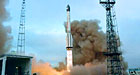
LIFTOFF! Liftoff of the Proton rocket launching the Arab BADR 4 communications spacecraft!

1959 GMT (2:59 p.m. EST)

T-minus 2 minutes. The master computer sequencer is in control. It is mostly clear and cold at Baikonur for this middle-of-the-night liftoff from the central Asian base.

1956 GMT (2:56 p.m. EST)

T-minus 5 minutes. The launch readiness of the Proton core vehicle and Breeze M upper stage is verified over the last minutes in the countdown. The BADR 4 spacecraft is confirmed on internal power and ready for liftoff.

1949 GMT (2:49 p.m. EST)

T-minus 12 minutes. The final countdown is proceeding at Baikonur for today's launch of the Proton rocket. International Launch Services is not reporting any problems.

WEDNESDAY, NOVEMBER 8, 2006

International Launch Services' first flight since its reorganization to focus exclusively on commercial Russian Proton rocket missions is scheduled for liftoff today.

Launch from pad 39 at Baikonur Cosmodrome in Kazakhstan carrying the Arab BADR 4 telecommunications satellite is expected at 2001 GMT (3:01 p.m. EST).

ILS was formed in 1995 as a joint venture between Russian aerospace firms and the U.S. Lockheed Martin to jointly market the Proton and American Atlas families of rockets.

Lockheed Martin sold its part last month, leading to ILS transforming into a new company solely dedicated to selling satellite-launching missions using the Khrunichev-built Proton rocket with Breeze M upper stages. ILS remains headquartered in McLean, Virginia, a suburb of Washington, D.C.

"We want the Proton to be synonymous with solid, reliable, on-time performance," says Frank McKenna, the new ILS president who took over October 11.

ILS is moving toward a business model of flying three-to-five Protons per year and capturing launch contracts that are profitable.

"Striving for market share, and the attendant fierce competition and significant reductions in pricing, has led to losses and financial debt. This is not a sustainable business position in the long run," ILS said in a recent statement.

"The establishment of a stand-alone ILS that is financially restructured without debt, and with a solid backlog of missions, provides the foundation for a great business for commercial Proton."

ILS has conducted 37 Proton launches since its first in 1996.

Today's mission will loft the BADR 4 spacecraft for ARABSAT of Riyadh, Saudi Arabia. It will take four hours for the launch vehicle to propel the satellite into the targeted orbit.

The Proton first stage's six RD-275 engines are ignited at liftoff to push the 20-story rocket away from Earth on two million pounds of thrust. After first stage separation two minutes into flight, four engines aboard the second stage will fire for three-and-a-half minutes before shutting down and jettisoning. The Proton's third stage will then come to life for its four-minute job, during which time the protective payload fairing shielding BADR 4 will be let go after reaching the upper atmosphere.

The Proton booster's three core stages deliver an upper stage and the payload into an initial suborbital trajectory by T+plus 10 minutes. That sets the stage for the Breeze M upper stage to conduct four burns that will methodically propel BADR 4 into the desired orbit for deployment. The stage will first reach a parking orbit 108 miles high by T+plus 15 minutes, before the remaining three steps raise altitude and reduce orbital inclination.

The second firing begins 65 minutes into flight and should last a half-hour in duration. Then the emptied auxiliary fuel tank on rocket motor is jettisoned. The Breeze M immediately re-ignites its main engine for three more minutes of propulsion to reach a highly elliptical intermediate orbit with a low point of 539 miles, high point of 22,239 miles and inclination of 51.5 degrees to the equator.

After coasting through space for about two hours, the upper stage gives a final push lasting nine minutes to inject the payload into a geosynchronous transfer orbit with a low point of 1,957 miles, a high point of about 22,237 miles and an inclination of 14.2 degrees.

Spacecraft separation from the rocket is anticipated just after 0000 GMT (7 p.m. EST).

The satellite's onboard engine system will complete the task of circularizing the orbit to an altitude of 22,300 miles along the equator, and controllers will later guide the craft into an orbital slot at 26 degrees East longitude.

The 7,231-pound satellite is a Eurostar E2000+ model built by Astrium. It carries 32 Ku-band transponders, and has a 15-year design life. Alcatel Alenia Space manufactured the communications payload.

ARABSAT will operate the craft to beam television and Internet broadband services across the Middle East -- from Morocco to the Gulf -- and parts of Europe.

The satellite is the second of the firm's fourth-generation telecommunications satellite. But the first was lost in a Proton/Breeze M failure earlier this year.

Astrium manufactured both craft in this series and has been awarded a contract to replace the one lost February 28.

Today's mission will the third ILS Proton of 2006, with one more expected in December with the Malaysian MEASAT 3 communications satellite.

Copyright 2006 SpaceflightNow.com, all rights reserved.


Current Shuttle Mission Patch
The official embroidered patch for shuttle Atlantis' flight to deliver critical spare equipment to the space station.
 U.S. STORE
 WORLDWIDE STORE

Ares 1-X Patch
The official embroidered patch for the Ares 1-X rocket test flight, is available for purchase.
 U.S. STORE
 WORLDWIDE STORE

Apollo Collage
This beautiful one piece set features the Apollo program emblem surrounded by the individual mission logos.
 U.S. STORE
 WORLDWIDE STORE


Project Orion
The Orion crew exploration vehicle is NASA's first new human spacecraft developed since the space shuttle a quarter-century earlier. The capsule is one of the key elements of returning astronauts to the Moon.
 U.S. STORE


Fallen Heroes Patch Collection
The official patches from Apollo 1, the shuttle Challenger and Columbia crews are available in the store.
 U.S. STORE
 WORLDWIDE STORE

Ares 1-X Patch
The official embroidered patch for the Ares 1-X rocket test flight, is available for purchase.
 U.S. STORE
 WORLDWIDE STORE

Apollo Collage
This beautiful one piece set features the Apollo program emblem surrounded by the individual mission logos.
 U.S. STORE

Expedition 21
The official embroidered patch for the International Space Station Expedition 21 crew is now available from our stores.
 U.S. STORE
 WORLDWIDE STORE

Hubble Patch
The official embroidered patch for mission STS-125, the space shuttle's last planned service call to the Hubble Space Telescope, is available for purchase.
 U.S. STORE
 WORLDWIDE STORE

INDEX | PLUS | NEWS ARCHIVE | LAUNCH SCHEDULE
ASTRONOMY NOW | STORE

ADVERTISE

© 2009 Spaceflight Now Inc.