Spaceflight Now Home


The Mission


Rocket: Proton M with Breeze M upper stage
Payload: AMC 12
Date: Feb. 3, 2005
Time: 0227 GMT (9:27 p.m. EST on Feb. 2)
Site: Baikonur Cosmodrome, Kazakhstan
Satellite feed: AMC 4, Transponder 17, C-band, 101° West


Spaceflight Now +


Premium video content for our Spaceflight Now Plus subscribers.

Proton lofts Amazonas
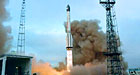
A Russian Proton M rocket launches from Baikonur Cosmodrome carrying the Amazonas communications satellite that will serve the Americas and Europe. (2min 25sec file)
 Play video

Rocket rollout
The fully assembled Proton rocket is rolled to launch pad for its flight to place the Amazonas spacecraft into orbit. (41sec file)
 Play video

Become a subscriber
More video


NewsAlert


Sign up for our NewsAlert service and have the latest news in astronomy and space e-mailed direct to your desktop.

Enter your e-mail address:

Privacy note: your e-mail address will not be used for any other purpose.


BY JUSTIN RAY

Follow the countdown and launch of the Russian Proton rocket carrying the AMC 12 telecommunications satellite. Reload this page for the very latest on the mission.

1221 GMT (7:21 a.m. EST)

SUCCESS. The Breeze M upper stage completed final engine firing and then released the 11,000-pound AMERICOM 12 spacecraft into geosynchronous transfer orbit to conclude the 9-hour ascent today.

The satellite features 72 C-band transponders to relay television programming, data and voice communications and provide high-speed Internet connections. AMC 12's transmission power is focused into beams -- one for North America, one for South America and another to Europe, the Middle East and Africa. The craft's reach extends from the United States to the eastern stretches of the Mediterranean, and from Cape Town, South Africa to Lima, Peru.

Formerly known as WORLDSAT 2, AMC 12 is the first to use Alcatel's Spacebus 4000 model design. It has a 16-year life expectancy.

International Launch Services managed today's Proton mission. The next commercial Proton launch is expected later this spring when the DirecTV 8 broadcasting satellite is carried aloft.

1040 GMT (5:40 a.m. EST)

ILS says the fourth burn by the Breeze M went off as scheduled. The fifth and final firing to boost AMC 12 into the proper orbit is upcoming nearly 9 hours into flight. Deployment of the satellite from the launch vehicle is expected around 1146 GMT (6:46 a.m. EST). We'll post confirmation as soon as it is available.

0644 GMT (1:44 a.m. EST)

The second and third burns of the Breeze M have occurred as planned, ILS says.

0308 GMT (10:08 p.m. EST Wed.)

ILS confirms that the first Breeze M firing has gone well. The rocket is coasting in its parking orbit before the second of five planned engine burns that occur over the next several hours.

0249 GMT (9:49 p.m. EST Wed.)

T+plus 22 minutes. The Breeze M upper stage and AMC 12 are supposed to enter a coast period that will last until T+plus 68 minutes, 22 seconds when the stage re-ignites for a 17-minute firing to reach an intermediate orbit.

A third burn begins at T+plus 3 hours, 29 minutes and lasts for 11 minutes. Following completion of its third burn of the mission, the Breeze M will jettison its emptied Additional Propellant Tank. The stage then restarts at T+plus 3 hours, 42 minutes for a two-minute burn. A final 7 minute burn will occur at T+plus 8 hours, 49 minutes.

The AMC 12 spacecraft will be deployed into a targeted geosynchronous transfer orbit of 22,000 x 4,000 miles at 18.3 degrees. Separation of the satellite from the upper stage to complete the launch is expected at T+plus 9 hours, 19 minutes.

We'll update this page when the next information is released from International Launch Services.

0246 GMT (9:46 p.m. EST Wed.)

T+plus 19 minutes, 25 seconds. Standing by for confirmation that the first Breeze M burn has been accomplished as planned.

0239 GMT (9:39 p.m. EST Wed.)

T+plus 12 minutes. This initial firing by the Breeze M will last about 8 minutes to reach a low-altitude parking orbit around Earth.

0238 GMT (9:38 p.m. EST Wed.)

T+plus 11 minutes, 25 seconds. Based on the planned timeline, the Breeze M upper stage should have ignited for its first firing of the night. But we're still awaiting word from ILS.

0237 GMT (9:37 p.m. EST Wed.)

T+plus 10 minutes. Third stage engine cutoff has occurred and the spent stage separated as expected.

The Breeze M upper stage and attached AMC 12 spacecraft are on a suborbital trajectory in preparation for the first of five planned firings by the upper stage to reach geosynchronous transfer orbit over the next 9 hours.

0234 GMT (9:34 p.m. EST Wed.)

T+plus 7 minutes, 25 seconds. About two minutes remain in the third stage burn.

0233 GMT (9:33 p.m. EST Wed.)

T+plus 6 minutes, 15 seconds. The payload fairing enclosing the AMC 12 spacecraft atop the rocket has separated as the third stage continues to fire.

0233 GMT (9:33 p.m. EST Wed.)

T+plus 6 minutes. The second stage has been jettisoned and the Proton third stage has fired to life.

0232 GMT (9:32 p.m. EST Wed.)

T+plus 5 minutes, 15 seconds. Coming up on burn out and separation of the second stage. Long-range tracking cameras at Baikonur continue to follow the rocket as a bright star in the clear morning sky.

0232 GMT (9:32 p.m. EST Wed.)

T+plus 5 minutes. The vehicle is over 100 km in altitude now.

0231 GMT (9:31 p.m. EST Wed.)

T+plus 4 minutes. The flight continues to go smoothly, mission control reports.

0230 GMT (9:30 p.m. EST Wed.)

T+plus 3 minutes, 25 seconds. Pitch, yaw and roll conditions are stable as the second stage continues to fire.

0230 GMT (9:30 p.m. EST Wed.)

T+plus 3 minutes. The rocket is over 50 km in altitude. Engine chamber pressures on the second stage are reported normal.

0229 GMT (9:29 p.m. EST Wed.)

T+plus 2 minutes, 25 seconds. The first stage engines have shut down and the spent stage has separated. The four second stage engines have ignited to continue boosting the vehicle to space.

0228 GMT (9:28 p.m. EST Wed.)

T+plus 75 seconds. All systems are working performing normally.

0228 GMT (9:28 p.m. EST Wed.)

T+plus 60 seconds. The vehicle is now approaching the period of maximum dynamic pressure during its climb through the atmosphere.

0227 GMT (9:27 p.m. EST Wed.)

T+plus 25 seconds. The Russian rocket is maneuvering to the proper heading for its climb to space. All six liquid-fueled engines on the first stage are firing.

0227 GMT (9:27 p.m. EST Wed.)

LIFTOFF! Liftoff of the commercial Proton rocket carrying the AMERICOM 12 transatlantic communications spacecraft to serve the Americas, Europe and Africa!

0226 GMT (9:26 p.m. EST Wed.)

T-minus 60 seconds. It is almost dawn at the launch site.

0225 GMT (9:25 p.m. EST Wed.)

T-minus 2 minutes. International Launch Services says everything is still "go" for liftoff for an on-time liftoff.

0222 GMT (9:22 p.m. EST Wed.)

T-minus 5 minutes. The launch readiness of the Proton core vehicle, Breeze M upper stage and AMC 12 spacecraft will be verified over the next few minutes in the countdown.

0220 GMT (9:20 p.m. EST Wed.)

T-minus 7 minutes and counting. The Proton rocket weighs about 1.5 million pounds as it sits on the launch pad. The AMC 12 spacecraft accounts for about 11,000 pounds of the weight. The Proton's six first stage engines will be ignited at launch to boost the rocket off the ground.

0218 GMT (9:18 p.m. EST Wed.)

T-minus 9 minutes and counting.

0215 GMT (9:15 p.m. EST Wed.)

T-minus 12 minutes and counting. The weather is within limits for today's Proton launch with clear skies, a temperature of -16 degrees C and winds from the east at 5 gusting to 10 meters per second.

0211 GMT (9:11 p.m. EST Wed.)

T-minus 16 minutes and counting. All systems are "go" for liftoff of the Russian Proton rocket and the AMERICOM 12 communications satellite at 0227 GMT tonight.

WEDNESDAY, FEBRUARY 2, 2005

A communications satellite designed to serve the Americas, Europe and Africa from its intended perch above the Atlantic Ocean will rocket into space tonight atop a Russian Proton booster.

Liftoff of the modernized Proton M booster fitted with a Breeze M upper stage carrying the 11,000-pound AMERICOM 12 craft is scheduled for 0227 GMT (9:27 p.m. EST) tonight from the Baikonur Cosmodrome in Central Asia.

The lower three stages of the Khrunichev-built Proton will fire during the mission's first 10 minutes, placing the Breeze M upper stage and attached AMC 12 satellite on a suborbital trajectory.

The initial firing of the Breeze M is needed to achieve a temporary parking orbit around Earth at an altitude of 107 miles, inclined 51.5 degrees.

Four additional burns by the upper stage will follow in a pre-scripted sequence to reach geosynchronous transfer orbit for release of the satellite at T+plus 9 hours and 19 minutes.

The targeted spacecraft separation orbit has an apogee of 22,200 miles, perigee of 4,000 miles and inclination of 18.3 degrees.

AMC 12 will rely upon its onboard engine to reach a circular geostationary orbit 22,300 miles above the planet where it can match Earth's rotation and appear fixed along the equator at 37.5 degrees West longitude.

Built in Europe by Alcatel Space for New Jersey-based satellite operator SES AMERICOM, the spacecraft's uses range from television broadcasting to high-speed Internet connections.

The satellite features 72 C-band transponders to relay a host of communications services across its coverage zone. The transmission power is focused into beams -- one for North America, one for South America and another to Europe, the Middle East and Africa. The craft's reach extends from the United States to the eastern stretches of the Mediterranean, and from Cape Town, South Africa to Lima, Peru.

Formerly known as WORLDSAT 2, AMC 12 is the first to use Alcatel's Spacebus 4000 model design. It has a 16-year life expectancy.

"I compliment the Alcatel Space team for delivering a very sophisticated spacecraft and for their flexibility as we optimized the satellite's design to reflect the changing dynamics of a very challenging international marketplace," said Andreas Georghiou, senior vice president of business operations, SES AMERICOM. "The reach and power of this satellite complements the services strategy that was invigorated by our recent acquisition of the teleports and infrastructure of Verestar."

International Launch Services, the joint venture formed in 1995 to market American Atlas and Russian Proton rockets, is managing tonight's mission. This will be the 32nd Proton flight for ILS and the first of at least five in 2005.

ILS plans to launch an Atlas 3B rocket a few hours after the AMC 12 mission. You can follow that launch here.

STS-115 patch
The official crew patch for the STS-115 mission of space shuttle Atlantis to resume orbital construction of the International Space Station.
 Choose your store:
U.S. - U.K. - E.U. - Worldwide

Apollo patches
The Apollo Patch Collection: Includes all 12 Apollo mission patches plus the Apollo Program Patch. Save over 20% off the Individual price.
 Choose your store:
U.S. - U.K. - E.U. - Worldwide

Mars Rover mission patch
A mission patch featuring NASA's Mars Exploration Rover is available from our online.
 Choose your store:
U.S. - U.K. - E.U. - Worldwide

The ultimate Apollo 11 DVD
This exceptional chronicle of the historic Apollo 11 lunar landing mission features new digital transfers of film and television coverage unmatched by any other.
 Choose your store:
U.S. - U.K. - E.U. - Worldwide

INDEX | PLUS | NEWS ARCHIVE | LAUNCH SCHEDULE
ASTRONOMY NOW | STORE

ADVERTISE

© 2008 Pole Star Publications Ltd