Galaxy Evolution Explorer ready for launch
BY JUSTIN RAY
SPACEFLIGHT NOW

Posted: April 24, 2003

An observatory that will survey 10 billion years of the Universe's history like never before will be hurled into space Monday aboard an air-launched Pegasus XL rocket.

 
The Pegasus rocket will be launched at 39,000 feet over the Atlantic. Photo: NASA
 
Dropped from the belly of the Stargazer carrier jet off the east coast of Florida at 8:00 a.m. EDT (1200 GMT), the 51,000-pound, three-stage Orbital Sciences launcher will deliver NASA's Galaxy Evolution Explorer into a 430-mile circular orbit inclined 29 degrees to the equator.

Fitted with a 19.7-inch telescope with near- and far-ultraviolet detectors, the 609-pound satellite is expected to begin scientific work by the end of May.

"This is going to be the first ultraviolet survey mission of the Universe," said James Fanson, the GALEX project manager from NASA's Jet Propulsion Laboratory. "Ultraviolet is really the last portion of the electromagnetic spectrum where we don't have a survey of the Universe. So it fills in that last gap."

"The Galaxy Evolution Explorer is crucial to understanding how galaxies, the basic structures of our universe, form and function," added Dr. Anne Kinney, director of astronomy and physics in the Office of Space Science at NASA Headquarters.

GALEX is expected to make observations for 28 months, although officials say funding is the only "life-limiting" constraint on the mission.


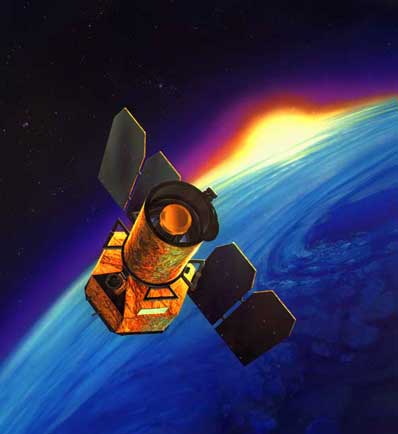
An artist's concept of GALEX deployed in orbit. Credit: NASA
 
"Being a survey mission, we are going to collect an enormous volume of data that will constitute a huge legacy for the entire scientific community. But from that data our scientists will be studying, specifically, evolution of galaxies over 80 percent of the age of the Universe," Fanson said in an interview.

"(GALEX) is designed specifically to measure the distances and star formation rate in a million galaxies. It is going to help us put together a picture of the Universe we see today -- how stars formed in galaxies, how galaxies evolved through time, what caused star formation and led to the development of heavy elements of the periodic table.

"There is evidence from surveys that have been done from the ground that star formation peaked at a particular point in history. But the data is not very precise, it is suggestive. This mission is designed to make a definitive measurement of what the star formation history has been in the evolution of galaxies."

The launch of GALEX was delayed last month after workers found a connector on the satellite wasn't attached, prompting a thorough inspection of connectors throughout the craft.

"In the course of performing some of our functional tests and final thermal blanket closeout, we discovered there was a connector on the spacecraft bus that pulled loose and had never been flight-mated," Fanson explained.


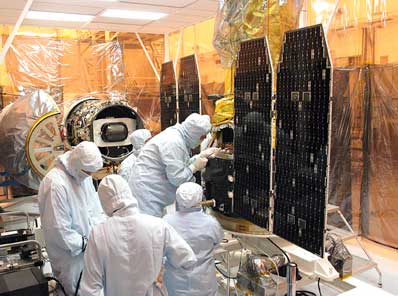
Workers install debris shields inside the GALEX spacecraft in the Kennedy Space Center clean room. Photo: NASA
 
"Each electrical connector has two screws. On the connector was still attached one screw but on the other side of the connector there was no screw. So it appeared as though the connector had never been flight-mated.

"It was supposed to have been mated some time ago. So our conclusion was that this missing fastener was probably never on the connector. But it was quite a surprise to discover that loose connector. So to be 100 percent certain that every other connector was properly mated, we did a 100 percent visual inspection both inside and outside the spacecraft."

The precautionary check revealed all of the other connectors were properly mated.

"We also took some additional time to put a thermal blanket over a portion of the instrument," Fanson said of the launch postponement. "There is an optics wheel in the instrument that is rotated by a mechanism. Just in the unlikely possibility that this missing fastener is still floating around somewhere inside, we wanted to make sure it could not float into the mechanism in any way."

So how the the loose connector escape earlier detection in pre-flight activities?

"Apparently, it was out of sight and didn't get caught in inspections. But that is the reason we do tests and people checking other people's work. What is also unusual is that apparently this connector was in a non-flight mated condition through the entire environmental tests...None of these environments were enough to pull it loose. It came lose when they were actually working on the blanket."

Flight data file
Vehicle: Pegasus XL
Payload: GALEX
Launch date: April 28, 2003
Launch window: 7:50-9:50 a.m. EDT (1150-1350 GMT)
Mission staging site: Cape Canaveral, Florida
Satellite broadcast: AMC 2, Transponder 9, C-band

Pre-launch briefing

Mission preview - Our story providing an overview of this launch.

Launch timeline - Chart with times and descriptions of events to occur during the launch.

GALEX spacecraft - A technical look at the Galaxy Evolution Explorer.

Telescope - Description of the telescope at the heart of GALEX.

Science goals - A look at the GALEX mission objectives.

Galaxies - Article on why study how galaxies form.

Pegasus XL rocket - Overview of this air-launched rocket.

Pegasus directory - See our coverage of previous Pegasus rocket flights.

Soviet Space
For the first time ever available in the West. Rocket & Space Corporation Energia: a complete pictorial history of the Soviet/Russian Space Program from 1946 to the present day all in full color. Available from our store.
 Choose your store:
U.S. - U.K. - E.U. - Worldwide

Viking patch
This embroidered mission patch celebrates NASA's Viking Project which reached the Red Planet in 1976.
 Choose your store:
U.S. - U.K. - E.U. - Worldwide

Apollo 7 DVD
For 11 days the crew of Apollo 7 fought colds while they put the Apollo spacecraft through a workout, establishing confidence in the machine what would lead directly to the bold decision to send Apollo 8 to the moon just 2 months later.
 Choose your store:
U.S. - U.K. - E.U. - Worldwide

Gemini 12
Gemini 12: The NASA Mission Reports covers the voyage of James Lovell and Buzz Aldrin that capped the Gemini program's efforts to prove the technologies and techniques that would be needed for the Apollo Moon landings. Includes CD-ROM.
 Choose your store:
U.S. - U.K. - E.U. - Worldwide

Get e-mail updates
Sign up for our NewsAlert service and have the latest news in astronomy and space e-mailed direct to your desktop (privacy note: your e-mail address will not be used for any other purpose).
Enter your e-mail address:

Mission Report
Space Shuttle Flights 1-5: The NASA Mission Reports covers the shuttle through its test flight stage and on to the first operational flight. Includes CD-ROM.
 U.S. STORE
 WORLDWIDE STORE

Apollo patches
The Apollo Patch Collection: Includes all 12 Apollo mission patches plus the Apollo Program Patch. Save over 20% off the Individual price.
 Choose your store:
U.S. - U.K. - E.U. - Worldwide

Apollo 11 special patch
Special collectors' patch marking the 35th anniversary of the historic Apollo 11 moon landing is now available.
 Choose your store:
U.S. - U.K. - E.U. - Worldwide

Inside Apollo mission control
An insider's view of how Apollo flight controllers operated and just what they faced when events were crucial.
 Choose your store:
U.S.

The ultimate Apollo 11 DVD
This exceptional chronicle of the historic Apollo 11 lunar landing mission features new digital transfers of film and television coverage unmatched by any other.
 Choose your store:
U.S. - U.K. - E.U. - Worldwide

Next ISS crew
Own a little piece of history with this official patch for the International Space Station's Expedition 11 crew. We'll ship yours today!
 Choose your store:
U.S.
MISSION STATUS CENTER

INDEX | PLUS | NEWS ARCHIVE | LAUNCH SCHEDULE
ASTRONOMY NOW | STORE

ADVERTISE

© 2008 Pole Star Publications Ltd