|
|
|
|
BY JUSTIN RAY Follow the countdown and launch of the Orbital Sciences Pegasus rocket with NASA's Demonstration of Autonomous Rendezvous Technology spacecraft. Reload this page for the very latest on the mission.

SATURDAY, APRIL 16, 2005
1829 GMT (2:29 p.m. EDT) DART was designed to perform two series of maneuvers around the target satellite, plus featured a 30 percent fuel margin, Jim Snoddy said. But the satellite safed itself at a distance of 92 meters from the MUBLCOM satellite instead of closing within five meters and later performing the flyaround demonstrations. Sensing it didn't have enough fuel to continue with the mission, DART backed away and began its "retirement" procedures. The craft is supposed to fire engines and deplete its hydrazine fuel in the next half-hour or so, thereby moving into a disposal orbit and formally concluding the $110 million flight. Check back later for a complete report.
1446 GMT (10:46 a.m. EDT) The mission was supposed to last nearly 24 hours before expending battery life and onboard fuel supplies. "After a successful rendezvous, acquisition of the target spacecraft, and approach to within approximately 300 feet, DART placed itself in the retirement phase before completing all planned proximity operations, ending the mission prematurely," NASA announced a short time ago. "NASA is convening a mishap investigation board to determine the reason for the DART spacecraft anomaly," the statement said. The space agency plans a news conference later today.
FRIDAY, APRIL 15, 2005 The spacecraft is on course to rendezvous with the MUBLCOM target satellite later tonight. The entire mission of DART lasts just one-day and finishes with the craft completing a "retirement" engine firing to reach a disposal orbit where it will circle Earth for the next decade or two before re-entering the atmosphere and burning up.
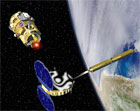
1810 GMT (2:10 p.m. EDT) The satellite is controlling itself with absolutely no human touch. The revolutionary autopilot technologies will either make or break the mission. "It'll be an interesting mission where you'll really have no control of your mission once you let go of it, but that's what the technology's all about," said Jim Snoddy, DART project manager from NASA's Marshall Space Flight Center. NASA expects to release a couple of status updates during the DART rendezvous tests over the next 24 hours. Watch this page for the latest. Below is a preview of the mission: DART's sophisticated systems will locate the U.S. military's retired MUBLCOM communications satellite and rendezvous with the five-year old craft to demonstrate autopilot concepts. Over a one-day period, DART is programmed to perform a series of maneuvers around the target before concluding the $115 million mission. The mission timeline called for a checkout of onboard systems starting about 30 minutes after launch. The craft then begins trek to reach its target, which will take about 7 hours or so. The science phase of the DART project to navigate in and around MUBLCOM begins about 8 hours after launch and continues through tomorrow. "About 21 hours into the mission, God willing, we complete everything," Snoddy said. If successful, DART will mark the first autonomous rendezvous conducted without any human involvement in U.S. space program history. "DART is totally autonomous. There is no ability for human intervention," Snoddy said. "Of course systems of the future will want human intervention but DART was not designed to do that just to show that we could put all of these events together is a 24-hour timeline." The 800-pound, 6-foot DART spacecraft uses its futuristic "brain" and "eye" to smartly chase down the target satellite and maneuver within feet of the object. "DART has the ability to fire lasers, calculate precise distances down to millimeters to bring two objects together in space. Currently we don't have the technology to do that with a high degree of autonomy and accuracy, and six degrees of freedom so that we can know the X, Y and Z coordinates and be able to have vehicles with pitch, yaw and roll and bring those together with precise accuracy in space." NASA developed the DART mission to test autopilot capabilities for the now-cancelled Orbital Space Plane project. But the technology is considered valuable for future human spacecraft, cargo-carrying resupply ships and satellite servicing concepts. "DART is unique relative to the president's vision of going back to the moon and to Mars. We are going to have to put things together in space whether they be for cargo or crews," Snoddy said. "It is kind of like in the airline industry. You have a pilot but you always want an autopilot. I think of DART kind of like an autopilot. You have the ability to have all of these things automated, so if you have an astronaut and want the autopilot to take over that is fine. But if you have cargo or things like that, you don't have (an astronaut) so you need this autopilot to also be there."
1756 GMT (1:56 p.m. EDT)
1752 GMT (1:52 p.m. EDT)
1741 GMT (1:41 p.m. EDT)
1739 GMT (1:39 p.m. EDT)
1738 GMT (1:38 p.m. EDT)
1737 GMT (1:37 p.m. EDT)
1736 GMT (1:36 p.m. EDT)
1735 GMT (1:35 p.m. EDT)
1734 GMT (1:34 p.m. EDT)
1733 GMT (1:33 p.m. EDT)
1732 GMT (1:32 p.m. EDT)
1731 GMT (1:31 p.m. EDT)
1730 GMT (1:30 p.m. EDT)
1729 GMT (1:29 p.m. EDT)
1728 GMT (1:28 p.m. EDT)
1727 GMT (1:27 p.m. EDT)
1726:57 GMT (1:26:57 p.m. EDT)
1726:52 GMT (1:26:52 p.m. EDT)
1726 GMT (1:26 p.m. EDT) With the batteries activated there is just 90 seconds to launch today or else an abort will be called. That is due to the limited life of the batteries. In the final moments prior to release of Pegasus, the L-1011 carrier aircraft crew will oversee the last seconds of the countdown and flip the switch that will drop the vehicle, with the DART spacecraft aboard, from the belly of the jet.
1724 GMT (1:24 p.m. EDT)
1723 GMT (1:23 p.m. EDT)
1722 GMT (1:22 p.m. EDT)
1721 GMT (1:21 p.m. EDT)
1720 GMT (1:20 p.m. EDT)
1718 GMT (1:18 p.m. EDT)
1716 GMT (1:16 p.m. EDT)
1715 GMT (1:15 p.m. EDT)
1714 GMT (1:14 p.m. EDT)
1713 GMT (1:13 p.m. EDT)
1710 GMT (1:10 p.m. EDT)
1705 GMT (1:05 p.m. EDT)
1700 GMT (1:00 p.m. EDT)
1657 GMT (12:57 p.m. EDT)
1655 GMT (12:55 p.m. EDT)
1645 GMT (12:45 p.m. EDT)
1635 GMT (12:35 p.m. EDT) The air-launched rocket will be released from the L-1011 jet over the Pacific Ocean west of California's central coast. Weather permitting, the rocket's exhaust trail should be visible to residents throughout central southern California as the Pegasus streaks southward on the trek to space.
1634 GMT (12:34 p.m. EDT)
1627 GMT (12:27 p.m. EDT)
1626 GMT (12:26 p.m. EDT)
1624 GMT (12:24 p.m. EDT)
1622 GMT (12:22 p.m. EDT)
1615 GMT (12:15 p.m. EDT)
1603 GMT (12:03 p.m. EDT)
1530 GMT (11:30 a.m. EDT)
1455 GMT (10:55 a.m. EDT)
THURSDAY, APRIL 14, 2005 NASA's Demonstration of Autonomous Rendezvous Technology craft, called DART for short, will be blasted into space by the air-launched Pegasus XL rocket made by Orbital Sciences. A modified L-1011 carrier aircraft ferries the Pegasus off the California coast from Vandenberg Air Force Base where the winged rocket will drop around 1725 GMT (10:25 a.m. local time; 1:25 p.m. EDT) about 62 nautical miles west of Pebble Beach. It will take about 12 minutes to reach the intended orbit. "We're recently glad to be back here and hopefully put this thing into space tomorrow morning," launch manager Omar Baez told reporters Thursday. "We finished our Launch Readiness Review this morning and we're really looking forward to launch tomorrow." The mission has been delayed numerous times by a variety of technical concerns. It was supposed to fly last fall, but NASA grounded the launch to double-check the G-force loads the satellite would experience at ignition of the Pegasus second stage. "This has been a long time in coming. People have been working on this project, developing technologies probably for 10 years now," said Jim Snoddy, DART project manager from NASA's Marshall Space Flight Center. "So I think the excitement is back up to the fevered pitch for one-day before launch." "The rocket is in excellent condition, the L-1011 is ready to support and we're looking forward to a very uneventful launch," added Bryan Baldwin, Pegasus program director at Orbital Sciences. DART's sophisticated systems will locate the U.S. military's retired MUBLCOM communications satellite and rendezvous with the five-year old craft to demonstrate autopilot technologies. Over a one-day period, DART is expected to perform a series of maneuvers around the target before concluding the $115 million mission. "About 21 hours into the mission, God willing, we complete everything," Snoddy said. If successful, DART will mark the first autonomous rendezvous conducted without any human involvement in U.S. space program history. "DART is totally autonomous. There is no ability for human intervention," Snoddy said. "Of course systems of the future will want human intervention but DART was not designed to do that just to show that we could put all of these events together is a 24-hour timeline." The 800-pound, 6-foot DART spacecraft uses its futuristic "brain" and "eye" to smartly chase down the target satellite and maneuver within feet of the object. "DART has the ability to fire lasers, calculate precise distances down to millimeters to bring two objects together in space. Currently we don't have the technology to do that with a high degree of autonomy and accuracy, and six degrees of freedom so that we can know the X, Y and Z coordinates and be able to have vehicles with pitch, yaw and roll and bring those together with precise accuracy in space." NASA developed the DART mission to test autopilot capabilities for the now-cancelled Orbital Space Plane project. But the technology is considered valuable for future human spacecraft, cargo-carrying resupply ships and satellite servicing concepts. "DART is unique relative to the president's vision of going back to the moon and to Mars. We are going to have to put things together in space whether they be for cargo or crews," Snoddy said. "It is kind of like in the airline industry. You have a pilot but you always want an autopilot. I think of DART kind of like an autopilot. You have the ability to have all of these things automated, so if you have an astronaut and want the autopilot to take over that is fine. But if you have cargo or things like that, you don't have (an astronaut) so you need this autopilot to also be there." Watch this page for live updates during the countdown and launch.
![]() |
|
|
|
Ares 1-X Patch The official embroidered patch for the Ares 1-X rocket test flight, is available for purchase.Apollo Collage This beautiful one piece set features the Apollo program emblem surrounded by the individual mission logos.Expedition 21 The official embroidered patch for the International Space Station Expedition 21 crew is now available from our stores.Hubble Patch The official embroidered patch for mission STS-125, the space shuttle's last planned service call to the Hubble Space Telescope, is available for purchase. |
||||||||||||||||||||||||||||||||||||||||||||||||||||||||||||
|
INDEX | PLUS | NEWS ARCHIVE | LAUNCH SCHEDULE ASTRONOMY NOW | STORE ADVERTISE © 2012 Spaceflight Now Inc. |
||||||||||||||||||||||||||||||||||||||||||||||||||||||||||||||||||