Premium video content for our Spaceflight Now Plus subscribers. Joining tank and SRBs The space shuttle Discovery is hoisted high into the Vehicle Assembly Building and mated with its external fuel tank and solid rocket boosters. Hoisted | Attached Discovery moves to VAB Space shuttle Discovery makes an evening move October 31 from its processing hangar to the Vehicle Assembly Building for mating with an external fuel tank and twin solid rocket boosters in preparation for the STS-116 mission. Play Final Hubble servicing The objectives of the just-approved final Hubble Space Telescope servicing mission are detailed and the anticipated science from the new instruments to be installed are detailed in this briefing from Goddard Space Flight Center. Full Coverage Meet Hubble astronauts The crew for the final Hubble Space Telescope servicing mission will be led by Scott Altman, with pilot Greg C. Johnson, robot arm operator Megan McArthur and spacewalkers Andrew Feustel, Mike Good, John Grunsfeld and Mike Massimino. The astronauts meet the press in this news briefing from Johnson Space Center. Full Coverage STEREO launch The twin STEREO space observatories designed to change the way we view the sun launch from Cape Canaveral aboard a Boeing Delta 2 rocket. Full Coverage STS-48: Atmosphere research satellite With launch of the Upper Atmosphere Research Satellite from space shuttle Discovery in September 1991, a new era in studying Earth's environment from space began. The crew of STS-48 describes the mission in this post-flight film, which includes an beautiful nighttime flyover of the United States. Small | Large STS-40: Medical lab Astronauts, rodents and jellyfish were the subjects during extensive medical tests performed aboard the first Spacelab Life Sciences mission launched in June 1991 aboard shuttle Columbia. A space laboratory module riding in the payload bay housed the experiment facilities. The crew of STS-40 explain the mission in this post-flight film. Small | Large Exploration update A progress report on development of the Orion crew exploration spacecraft and the Ares launch vehicle is given during this briefing held October 18 at the Glenn Research Center in Cleveland. PLAY MRO early images Some of the initial pictures and data from NASA's Mars Reconnaissance Orbiter since the craft entered its mapping orbit around the Red Planet are presented in this news briefing held October 16 from the Jet Propulsion Laboratory. PLAY Become a subscriber More video
Twin star explosions fascinate astronomers PENNSYLVANIA STATE UNIVERSITY NEWS RELEASE Posted: November 21, 2006
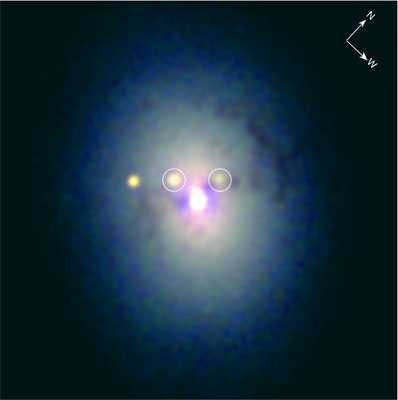
Credit: NASA/Swift/Stefan Immler
Scientists using NASA's Swift satellite stumbled upon a rare sight: two supernovas side by side in one galaxy. Large galaxies typically play host to three supernovas per century. Galaxy NGC 1316 has had two supernovas in less than five months, and a total of four supernova in 26 years, as far back as the records go. This makes NGC 1316 the most prodigious known producer of supernovas.
The
first supernova, still visible on the "right" in the image, was
detected on June 19, 2006, and was named SN 2006dd. The second
supernova, on the immediate "left" in the image, was detected on
November 5 and has been named SN 2006mr. (Other objects in the image
include a central bright spot, whic is the galaxy core, and a bright
object to the far left, like an earring, which is a foreground star.)
NGC 1316, a massive elliptical galaxy about 80 million light years
way, has recently merged with a spiral galaxy. Mergers do indeed
spawn supernovas by forcing the creation of new, massive stars, which
quickly die and explode. Yet all four supernovas in NGC 1316 appear
to be Type Ia, a variety previously not associated with galaxy
mergers and massive star formation.
Scientists are intrigued and are
investigating whether the high supernova rate is a coincidence or a
result of the merger. Swift was launched on this date, November 20,
in 2004.
Swift was launched in November 2004 and was fully operational by
January 2005. Swift carries three main instruments: the Burst Alert
Telescope, the X-ray Telescope, and the Ultraviolet/Optical
Telescope. Swift's gamma-ray detector, the Burst Alert Telescope,
provides the rapid initial location and was built primarily by the
NASA Goddard Space Flight Center in Greenbelt and Los Alamos National
Laboratory and constructed at GSFC.
Swift's X-Ray Telescope and
UV/Optical Telescope were developed and built by international teams
led by Penn State and drew heavily on each institution's experience
with previous space missions. The X-ray Telescope resulted from Penn
State's collaboration with the University of Leicester in England and
the Brera Astronomical Observatory in Italy.
The Ultraviolet/Optical
Telescope resulted from Penn State's collaboration with the Mullard
Space Science Laboratory of the University College-London.
These
three telescopes give Swift the ability to do almost immediate
follow-up observations of most gamma-ray bursts because Swift can
rotate so quickly to point toward the source of the gamma-ray signal.
The spacecraft was built by General Dynamics.




 The space shuttle Discovery is hoisted high into the Vehicle Assembly Building and mated with its external fuel tank and solid rocket boosters.
 Space shuttle Discovery makes an evening move October 31 from its processing hangar to the Vehicle Assembly Building for mating with an external fuel tank and twin solid rocket boosters in preparation for the STS-116 mission.
 The objectives of the just-approved final Hubble Space Telescope servicing mission are detailed and the anticipated science from the new instruments to be installed are detailed in this briefing from Goddard Space Flight Center.
 The crew for the final Hubble Space Telescope servicing mission will be led by Scott Altman, with pilot Greg C. Johnson, robot arm operator Megan McArthur and spacewalkers Andrew Feustel, Mike Good, John Grunsfeld and Mike Massimino. The astronauts meet the press in this news briefing from Johnson Space Center.
 The twin STEREO space observatories designed to change the way we view the sun launch from Cape Canaveral aboard a Boeing Delta 2 rocket.
 With launch of the Upper Atmosphere Research Satellite from space shuttle Discovery in September 1991, a new era in studying Earth's environment from space began. The crew of STS-48 describes the mission in this post-flight film, which includes an beautiful nighttime flyover of the United States.
 Astronauts, rodents and jellyfish were the subjects during extensive medical tests performed aboard the first Spacelab Life Sciences mission launched in June 1991 aboard shuttle Columbia. A space laboratory module riding in the payload bay housed the experiment facilities. The crew of STS-40 explain the mission in this post-flight film.
 A progress report on development of the Orion crew exploration spacecraft and the Ares launch vehicle is given during this briefing held October 18 at the Glenn Research Center in Cleveland.
 Some of the initial pictures and data from NASA's Mars Reconnaissance Orbiter since the craft entered its mapping orbit around the Red Planet are presented in this news briefing held October 16 from the Jet Propulsion Laboratory.