|
|
|

|
|
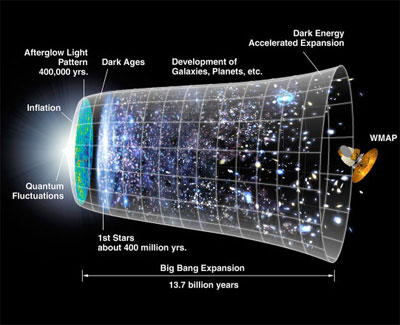
Satellite reveals universe's first trillionth second JOHNS HOPKINS UNIVERSITY NEWS RELEASE Posted: March 16, 2006 Scientists peering back to the oldest light in the universe have new evidence for what happened within its first trillionth of a second, when the universe suddenly grew from submicroscopic to astronomical size in far less than a wink of the eye.
In 2003, NASA announced that the WMAP satellite had produced a detailed picture of the infant universe by measuring fluctuations in temperature of the afterglow -- answering many longstanding questions about the universe's age, composition and development. The WMAP team has built upon those results with a new measurement of the faint glare from the afterglow to obtain clues about the universe's first moments, when the seeds were sown for the formation of the first stars 400 million years later. "It amazes me that we can say anything about what transpired within the first trillionth of a second of the universe, but we can," said Charles L. Bennett, WMAP principal investigator and a professor in the Henry A. Rowland Department of Physics and Astronomy at The Johns Hopkins University. "We have never before been able to understand the infant universe with such precision. It appears that the infant universe had the kind of growth spurt that would alarm any mom or dad." The newly detected pattern, or polarization signal, in the glare of the afterglow is the weakest cosmological signal ever detected -- less than a hundredth of the strength of the temperature signal reported three years ago. "This is brand new territory," said Princeton University physicist Lyman Page, a WMAP team member. "We are quantifying the cosmos in a different way to open up a new window for understanding the universe in its earliest times." Comparing the brightness of broad features to compact features in the afterglow light (like comparing the heights of short-distance ripples versus long-distance waves on a lake) helps tell the story of the infant universe. One long-held prediction was that the brightness would be the same for features of all sizes. In contrast, the simplest versions of inflation predict that the relative brightness decreases as the features get smaller. WMAP data are new evidence for the inflation prediction. The new WMAP data, combined with other cosmology data, also support established theories on what has happened to matter and energy over the past 13.7 billion years since its inflation, according to the WMAP researchers. The result is a tightly constrained and consistent picture of how our universe grew from microscopic quantum fluctuations to enable the formation of stars, planets and life. According to this picture, researchers say, only 4 percent of the universe is ordinary familiar atoms; another 22 percent is an as-yet unidentified dark matter, and 74 percent is a mysterious dark energy. That dark energy is now causing another growth spurt for the universe, fortunately, they say, more gentle than the one 13.7 billion years ago. WMAP was launched on June 30, 2001, and is now a million miles from Earth in the direction opposite the sun. It is able to track temperature fluctuations at levels finer than a millionth of a degree. The WMAP team includes researchers at the Goddard Space Flight Center in Greenbelt, Md.; The Johns Hopkins University; Princeton University; the Canadian Institute of Theoretical Astrophysics in Toronto; the University of Texas at Austin; Cornell University; the University of Chicago; Brown University; the University of British Columbia; the University of Pennsylvania; and the University of California, Los Angeles. |
|
|
|
 |
|||||||||||||||||||||

 During the final seconds prior to the planned launch of the Space Technology 5 mission on March 15, a retention pin that holds the starboard-side fin aerosurface on the Pegasus rocket first stage did not retract. That forced the launch team to call an abort. This movie shows the scrub as it happened.
 Space Shuttle Program Manager Wayne Hale announces his decision to replace suspect fuel-level sensors inside the liquid hydrogen portion of Discovery's external tank. The three-week job means Discovery will miss its May launch window, delaying the second post-Columbia test flight to the next daylight period opening July 1. Hale made the announcement during a news conference from Johnson Space Center on March 14.
 NASA's Stardust spacecraft returned to Earth in January with the first samples ever retrieved from a comet. This briefing with mission scientists held March 13 from the Johnson Space Center offers an update on the initial research into the comet bits.
 The Cassini spacecraft orbiting the planet Saturn has found evidence indicating pockets of liquid water may exist near the surface on the icy moon Enceladus, raising the question of whether the small world could support life. This movie includes stunning images of Enceladus taken by Cassini and animation of geysers seen erupting from the moon.
 The make-or-break engine firing by the Mars Reconnaissance Orbiter to enter orbit around Mars and the subsequent aerobraking to reach the low-altitude perch for science observations are explained by project manager Jim Graf in this narrated animation package.
 Fuk Li, Mars program manager at JPL, Jim Graf, MRO project manager, Rich Zurek, MRO project scientist, and Dan McCleese, the principal investigator for the Mars Climate Sounder instrument, provide an overview on the Mars Reconnaissance Orbiter on March 8, about 48 hours before arrival at Mars.
 Spacelab was an orbiting laboratory tucked in the payload bay of the space shuttle for scientists to conduct a range of experiments. The joint European/NASA program flew multiple times aboard shuttle missions starting with STS-9 in November 1983. In this post-flight film presentation, the astronauts from that Columbia mission narrate the highlights from Spacelab-1.