Spaceflight Now +
|
|
|
|
|

Premium video content for our Spaceflight Now Plus subscribers.
Discovery in the VAB
 Shuttle Discovery enters into the Vehicle Assembly Building after a 10-hour journey from launch pad 39B. (4min 29sec file) Shuttle Discovery enters into the Vehicle Assembly Building after a 10-hour journey from launch pad 39B. (4min 29sec file)
 Play video Play video
Memorial Day message
 The International Space Station's Expedition 11 crew pays tribute to our fallen heroes for Memorial Day. (1min 00sec QuickTime file) The International Space Station's Expedition 11 crew pays tribute to our fallen heroes for Memorial Day. (1min 00sec QuickTime file)
Play video
Apollo-era transporter
 In the predawn hours, the Apollo-era crawler-transporter is driven beneath shuttle Discovery's mobile launch platform at pad 39B in preparation for the rollback to the Vehicle Assembly Building. (2min 37sec QuickTime file) In the predawn hours, the Apollo-era crawler-transporter is driven beneath shuttle Discovery's mobile launch platform at pad 39B in preparation for the rollback to the Vehicle Assembly Building. (2min 37sec QuickTime file)
Play video
Unplugging the shuttle
 Workers disconnect a vast number of umbilicals running between launch pad 39B and Discovery's mobile launch platform for the rollback. The cabling route electrical power, data and communications to the shuttle. (2min 32sec file) Workers disconnect a vast number of umbilicals running between launch pad 39B and Discovery's mobile launch platform for the rollback. The cabling route electrical power, data and communications to the shuttle. (2min 32sec file)
Play video
Shuttle rollback
 The crawler-transporter begins rolling space shuttle Discovery off launch pad 39B at 6:44 a.m. EDT May 26 for the 4.2-mile trip back to the Vehicle Assembly Building. (7min 28sec file) The crawler-transporter begins rolling space shuttle Discovery off launch pad 39B at 6:44 a.m. EDT May 26 for the 4.2-mile trip back to the Vehicle Assembly Building. (7min 28sec file)
Play video
Voyager adventures
 This animation shows the Voyager spacecraft heading into the solar system's final frontier and the edge of interstellar space. (1min 24sec file) This animation shows the Voyager spacecraft heading into the solar system's final frontier and the edge of interstellar space. (1min 24sec file)
Play video
Mike Griffin at KSC
 NASA Administrator Mike Griffin and Kennedy Space Center Director Jim Kennedy chat with reporters at the Cape on a wide range of topics. The press event was held during Griffin's tour of the spaceport. (27min 48sec file) NASA Administrator Mike Griffin and Kennedy Space Center Director Jim Kennedy chat with reporters at the Cape on a wide range of topics. The press event was held during Griffin's tour of the spaceport. (27min 48sec file)
Play video
Delta rocket blasts off
 The NOAA-N weather satellite is launched aboard a Boeing Delta 2 rocket from Vandenberg Air Force Base, California. The NOAA-N weather satellite is launched aboard a Boeing Delta 2 rocket from Vandenberg Air Force Base, California.
Play video:
Liftoff | Extended clip
Umbilicals | IR tracker
Countdown culmination
 Watch shuttle Discovery's countdown dress rehearsal that ends with a simulated main engine shutdown and post-abort safing practice. (13min 19sec file) Watch shuttle Discovery's countdown dress rehearsal that ends with a simulated main engine shutdown and post-abort safing practice. (13min 19sec file)
Play video
Become a subscriber
More video
|
|
|
|
|
|
Jupiter moon throws curve ball at formation theories
NASA/JPL NEWS RELEASE
Posted: May 31, 2005
Scientists studying data from NASA's Galileo spacecraft have found that Jupiter's moon Amalthea is a pile of icy rubble less dense than water. Scientists expected moons closer to the planet to be rocky and not icy. The finding shakes up long-held theories of how moons form around giant planets.
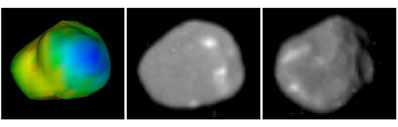
LEFT: Image shows the escape velocities color-coded on a shape model of Amalthea with the same viewpoint as the Voyager spacecraft image in the middle panel. Blue represents the lowest escape velocity, barely 1 meter per second (about 3 feet) near the anti-Jupiter end, while red (barely visible) shows the region of much higher escape velocity, nearly 90 meters per second (295 feet). MIDDLE: This image is a composite from both Galileo and Voyager spacecraft and shows Amalthea from the anti-Jupiter side. RIGHT: A Galileo image of Amalthea. Credit: NASA/JPL/Cornell University
Download larger image version here
|
"I was expecting a body made up mostly of rock. An icy component in a body orbiting so close to Jupiter was a surprise," said Dr. John D. Anderson, an astronomer at NASAšs Jet Propulsion Laboratory, Pasadena, Calif. Anderson is lead author of a paper on the findings that appears in the current issue of the journal Science.
"This gives us important information on how Jupiter formed, and by implication, how the solar system formed," Anderson said.
Current models imply that temperatures were high at Amalthea's current position when Jupiteršs moons formed, but this is inconsistent with Amalthea being icy. The findings suggest that Amalthea formed in a colder environment. One possibility is that it formed later than the major moons. Another is that the moon formed farther from Jupiter, either beyond the orbit of Jupiter's moon Europa or in the solar nebula at or beyond Jupiter's position. It would have then been transported or captured in its current orbit around Jupiter. Either of these explanations challenges models of moon formation around giant planets.
"Amalthea is throwing us a curve ball," said Dr. Torrence Johnson, co-author and project scientist for the Galileo mission at JPL. "Its density is well below that of water ice, and even with substantial porosity, Amalthea probably contains a lot of water ice, as well as rock." Analysis of density, volume, shape and internal gravitational stresses lead the scientists to conclude that Amalthea is not only porous with internal empty spaces but also contains substantial water ice.
One model for the formation of Jupiter's moons suggests that moons closer to the planet would be made of denser material than those farther out. That is based on a theory that early Jupiter, like a weaker version of the early Sun, would have emitted enough heat to prevent volatile, low-density material from condensing and being incorporated into the closer moons. Jupiter's four largest moons fit this model, with the innermost of them, Io, also the densest, made mainly of rock and iron.
Amalthea is a small red-tinted moon that measures about 168 miles in length and half that in width. It orbits about 181,000 kilometers (112,468 miles) from Jupiter, considerably closer than the Moon orbits Earth. Galileo passed within about 99 miles of Amalthea on Nov. 5, 2002. Galileo's flyby of Amalthea brought the spacecraft closer to Jupiter than at any other time since it began orbiting the giant planet on Dec. 7, 1995. After more than 30 close encounters with Jupiter's four largest moons, the Amalthea flyby was the last moon flyby for Galileo.
The Galileo spacecraft's 14-year odyssey came to an end on Sept. 21, 2003. JPL, a division of the California Institute of Technology in Pasadena, managed the Galileo mission for NASA.
|
|
|
|

|