|
|
|

|
|
Spitzer telescope reveals what Edwin Hubble missed HARVARD-SMITHSONIAN CENTER FOR ASTROPHYSICS RELEASE Posted: June 14, 2004 For centuries, biologists and paleontologists have classified animal species based solely on their appearance and anatomical differences. Astronomers do the same thing when they look at photographs and classify galaxies into the elliptical, lenticular, spiral, and irregular classes.
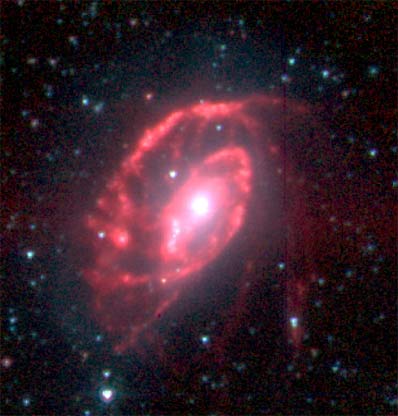
Modern biological research has undergone a revolution by going beyond appearances to classify species based on their DNA similarities. Modern astronomy appears poised for a similar revolution. At the 204th meeting of the American Astronomical Society in Denver, Colorado, astronomer Michael Pahre (Harvard-Smithsonian Center for Astrophysics) and colleagues presented new ideas for classifying galaxies based on infrared observations by NASA's Spitzer Space Telescope. "By looking at galaxies in infrared light, Spitzer can see structures hidden by dust-which is like looking up at the Milky Way at night and seeing straight through those dark bands," said Dr. Pahre, the lead researcher in the study. The fundamental differences among galaxies may not be only their appearances but also their compositions: What fraction of a galaxy is stars versus what fraction is clouds of gas and dust that float between the stars? That dust and gas, called the interstellar medium (ISM), is the material out of which new stars are born. That difference in galaxy composition leads to differing outward appearances. Elliptical and lenticular galaxies have lots of stars, but little dust or gas, and hence no current star formation activity. Spiral galaxies, on the other hand, have both stars and interstellar gas and dust, and they are continuously forming stars. The starlight in the images released appears blue, while the interstellar dust emission appears red. The unique capabilities of Spitzer's Infrared Array Camera (IRAC) "provide a direct way of separating the stars from the warm dust, thereby dissecting a galaxy into its individual components and revealing its true nature, like a frog in a biology lab" said Giovanni Fazio, a co-author on the study. The new infrared Spitzer pictures show two things. One, Spitzer can use infrared light to peer through the dust that obscures the galaxy, thereby revealing the entire galaxy. And two, the warm dust itself emits so strongly that it can be used as a direct tracer of the ISM. "When you look at blue light photographs and infrared pictures side-by-side, there is little question that it is easier to classify a galaxy in the infrared," said Dr. Pahre. "The warm dust emission provides higher contrast for the spiral arms, for example, than does blue starlight."
The infrared pictures also revealed another big surprise: some of the galaxies previously classified to be in the elliptical/lenticular class were found to have warm dust faintly emitting from spiral arms. It's akin to analyzing DNA to find out that two seemingly unrelated species are actually close cousins. "Seeing spiral arms in lenticular galaxies was totally unexpected. It could represent a missing link between lenticulars and spirals that gives us insight into both their past and current star formation history," said Dr. Pahre. Pahre and collaborators also went a step beyond the infrared classification scheme to propose three quantitative methods, based on the infrared pictures, which are alternate ways to classify the galaxies. The most fundamental of these three is the ratio of the light emitted by a galaxy in starlight versus that emitted via warm dust. All the suggested methods correlate well with Hubble's optical classification scheme. With additional observations, astronomers will test the new methods to determine which provide the best accuracy and insight into galactic structure and evolution. "Our ultimate goal is to replace the Hubble classification method with a new Spitzer classification method. These data put us well on our way toward realizing that ambitious goal," said Pahre. This research will be published in a special issue of The Astrophysical Journal Supplement in a paper co-authored by Michael Pahre, Matthew Ashby, Giovanni Fazio and Steven Willner (Harvard-Smithsonian Center for Astrophysics). The NASA Jet Propulsion Laboratory (JPL) manages the Spitzer Space Telescope mission for NASA's Office of Space Science, Washington. Science operations are conducted at the Spitzer Science Center at the California Institute of Technology in Pasadena. JPL is a division of Caltech. Headquartered in Cambridge, Mass., the Harvard-Smithsonian Center for Astrophysics (CfA) is a joint collaboration between the Smithsonian Astrophysical Observatory and the Harvard College Observatory. CfA scientists, organized into six research divisions, study the origin, evolution and ultimate fate of the universe. |
|
|
|
 |
||||||||||||||||||||||||||||||||||||||||||
 Space shuttle Columbia lands at 8:39 a.m. local time June 14, 1991 on Runway 22 at Edwards Air Force Base, California, capping a successful 9-day medical research flight featuring the Spacelab Life Sciences laboratory module on mission STS-40. (3min 28sec file)
 The two-man crew living aboard the International Space Station pays tribute to President Ronald Reagan. (2min 20sec file)
 Ride along with Oppportunity as the rover drives into and back out of Endurance Crater on June 8.
 Plans to drive the Mars rover Opportunity into Endurance Crater and new results from Spirit's search for past water at Gusev Crater are announced at this briefing from June 8. (38min 18sec file)
 Opportunity's path into Endurance Crater and plans for the drive are explained by mission manager Jim Erickson. (1min 28sec file)
 The rover lead scientist, Steve Squyres, explains what Opportunity will study inside Endurance Crater and what the results would say about Mars. (3min 09sec file)
 Steve Squyres, rover principal investigator, narrates a new panorama from Spirit showing the Columbia Hills. (2min 01sec file)