Satellite solves 30-year gamma-ray mystery
EUROPEAN SPACE AGENCY NEWS RELEASE
Posted: March 17, 2004

ESA's Integral gamma-ray observatory has resolved the diffuse glow of gamma rays in the centre of our Galaxy and has shown that most of it is produced by a hundred individual sources. Integral's high sensitivity and pointing precision have allowed it to detect these celestial objects where all other telescopes, for more than thirty years, had seen nothing but a mysterious, blurry fog of gamma rays ...


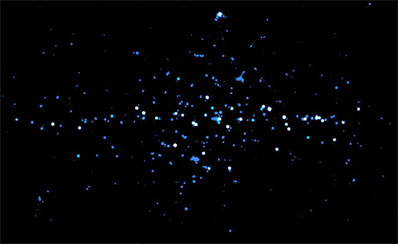
The central regions of the Mikly Way as seen by Integral in gamma rays. The brightest 91 objects seen in this image were classified by Integral as individual sources, while the others appear too faint to be properly characterised at this stage. Credit: ESA, F. Lebrun (CEA-Saclay)
 
During the spring and autumn of 2003, Integral observed the central regions of our Galaxy, collecting some of the perpetual glow of diffuse low-energy gamma rays that bathe the entire Galaxy.

These gamma rays were first discovered in the mid-1970s by high-flying balloon-borne experiments. Astronomers refer to them as the 'soft' Galactic gamma-ray background, with energies similar to those used in medical X-ray equipment.

Initially, astronomers believed that the glow was caused by interactions involving the atoms of the gas that pervades the Galaxy. Whilst this theory could explain the diffuse nature of the emission, since the gas is ubiquitous, it failed to match the observed power of the gamma rays. The gamma rays produced by the proposed mechanisms would be much weaker than those observed. The mystery has remained unanswered for decades.

Now Integral's superb gamma-ray telescope IBIS, built for ESA by an international consortium led by Principal Investigator Pietro Ubertini (IAS/CNR, Rome, Italy), has seen clearly that, instead of a fog produced by the interstellar medium, most of the gamma-rays are coming from individual celestial objects. In the view of previous, less sensitive instruments, these objects appeared to merge together.

In a paper published today in "Nature", Francois Lebrun (CEA Saclay, Gif sur Yvette, France) and his collaborators report the discovery of 91 gamma-ray sources towards the direction of the Galactic centre. Lebrun's team includes Ubertini and seventeen other European scientists with long-standing experience in high-energy astrophysics. Much to the team's surprise, almost half of these sources do not fall in any class of known gamma-ray objects. They probably represent a new population of gamma-ray emitters.

The first clues about a new class of gamma-ray objects came last October, when Integral discovered an intriguing gamma-ray source, known as IGRJ16318-4848. The data from Integral and ESA's other high-energy observatory XMM-Newton suggested that this object is a binary system, probably including a black hole or neutron star, embedded in a thick cocoon of cold gas and dust. When gas from the companion star is accelerated and swallowed by the black hole, energy is released at all wavelengths, mostly in the gamma rays.

However, Lebrun is cautious to draw premature conclusions about the sources detected in the Galactic centre. Other interpretations are also possible that do not involve black holes. For instance, these objects could be the remains of exploded stars that are being energised by rapidly rotating celestial 'powerhouses', known as pulsars.

Observations with another Integral instrument (SPI, the Spectrometer on Integral) could provide Lebrun and his team with more information on the nature of these sources. SPI measures the energy of incoming gamma rays with extraordinary accuracy and allows scientist to gain a better understanding of the physical mechanisms that generate them.

However, regardless of the precise nature of these gamma-ray sources, Integral's observations have convincingly shown that the energy output from these new objects accounts for almost ninety percent of the soft gamma-ray background coming from the centre of the Galaxy. This result raises the tantalising possibility that objects of this type hide everywhere in the Galaxy, not just in its centre.

Again, Lebrun is cautious, saying, "It is tempting to think that we can simply extrapolate our results to the entire Galaxy. However, we have only looked towards its centre and that is a peculiar place compared to the rest."

Next on Integral's list of things to do is to extend this work to the rest of the Galaxy. Christoph Winkler, ESA's Integral Project Scientist, says, "We now have to work on the whole disc region of the Galaxy. This will be a tough and long job for Integral. But at the end, the reward will be an exhaustive inventory of the most energetic celestial objects in the Galaxy."

The paper explaining these results will appear on the 18 March 2004 issue of "Nature". The author list includes F. Lebrun, R. Terrier, A. Bazzano, G. Belanger, A. Bird, L. Bouchet, A. Dean, M. Del Santo, A. Goldwurm, N. Lund, H. Morand, A. Parmar, J. Paul, J.-P. Roques, V. Schoenfelder, A. Strong, P. Ubertini, R. Walter and C. Winkler.

Integral
The International Gamma Ray Astrophysics Laboratory (Integral) is the first space observatory that can simultaneously observe celestial objects in gamma rays, X-rays and visible light. Integral was launched on a Russian Proton rocket on 17 October 2002 into a highly elliptical orbit around Earth. Its principal targets include regions of the galaxy where chemical elements are being produced and compact objects, such as black holes.

IBIS, Imager on Board the Integral Satellite - IBIS provides sharper gamma-ray images than any previous gamma-ray instrument. It can locate sources to a precision of 30 arcseconds, the equivalent of measuring the height of a person standing in a crowd, 1.3 kilometres away. The Principal Investigators that built the instrument are P. Ubertini (IAS/CNR, Rome, Italy), F. Lebrun (CEA Saclay, Gif sur Yvette, France), G. Di Cocco (ITESRE, Bologna, Italy). IBIS is equipped with the first un-cooled semiconductor gamma-ray camera, called ISGRI, which is responsible for its outstanding sensitivity. ISGRI was developed and built for ESA by CEA Saclay, France.

SPI, Spectrometer on Integral - SPI measures the energy of incoming gamma rays with extraordinary accuracy. It is more sensitive to faint radiation than any previous gamma ray instrument and allows the precise nature of gamma ray sources to be determined. The Principal Investigators that developed SPI are J.-P. Roques, (CESR, Toulouse, France) and V. Schoenfelder (MPE, Garching, Germany).

XMM-Newton
XMM-Newton can detect more X-ray sources than any previous observatory and is helping to solve many cosmic mysteries of the violent Universe, from black holes to the formation of galaxies. It was launched on 10 December 1999, using an Ariane-5 rocket from French Guiana. Its orbit takes it almost a third of the way to the Moon, so that astronomers can enjoy long, uninterrupted views of celestial objects.

Apollo 12 tribute DVD set

New! Featuring the jovial crew of Pete Conrad, Dick Gordon and Alan Bean, the Apollo 12 mission was struck by lightning shortly after liftoff but proceeded on the second successful exploration voyage to the lunar surface. This three-disc DVD brings the mission to life with extraordinary detail.
 Choose your store:
U.S. - U.K. - E.U. - Worldwide

Fallen Heroes special patch
This special 12-inch embroidered patch commemorates the U.S. astronauts who made the ultimate sacrifice, honoring the crews of Apollo 1, Challenger and Columbia.
 Choose your store:
U.S. - U.K. - E.U. - Worldwide

Women in Space
Women of Space: Cool Careers on the Final Frontier is for girls, young women, and anyone else interested in learning about exciting careers in space exploration. Includes CD-ROM.
 Choose your store:
U.S. - U.K. - E.U. - Worldwide

Mars rover poster
This new poster features some of the best pictures from NASA's amazing Mars Exploration Rovers Spirit and Opportunity.
 Choose your store:
U.S.

Expedition 20
The official embroidered patch for the International Space Station Expedition 20 crew is now available from our stores.
 U.S. STORE
 WORLDWIDE STORE

Current Shuttle Mission Patch
The official embroidered patch for shuttle Atlantis' flight to deliver critical spare equipment to the space station.
 U.S. STORE
 WORLDWIDE STORE


Ares Patch
The Ares Project will develop two new rockets to launch astronauts back to the Moon under NASA's Vision for Exploration. The Ares 1 will employ a single space shuttle solid rocket booster to loft the Orion crew capsule. The gigantic Ares 5 will haul the equipment and cargo needed for such lunar voyages. This is the Ares emblem.
 U.S. STORE


One Giant Leap
Hosted by Corbin Bernsen, this award winning documentary marks the 50th anniversary of the U.S. space agency and features exclusive interviews with veteran astronauts.
 U.S. STORE
 WORLDWIDE STORE

Expedition 21
The official embroidered patch for the International Space Station Expedition 21 crew is now available from our stores.
 U.S. STORE
 WORLDWIDE STORE

Soviet Space
For the first time ever available in the West. Rocket & Space Corporation Energia: a complete pictorial history of the Soviet/Russian Space Program from 1946 to the present day all in full color. Available from our store.
 Choose your store:
U.S. - U.K. - E.U. - Worldwide

Viking patch
This embroidered mission patch celebrates NASA's Viking Project which reached the Red Planet in 1976.
 Choose your store:
U.S. - U.K. - E.U. - Worldwide

Apollo 7 DVD
For 11 days the crew of Apollo 7 fought colds while they put the Apollo spacecraft through a workout, establishing confidence in the machine what would lead directly to the bold decision to send Apollo 8 to the moon just 2 months later.
 Choose your store:
U.S. - U.K. - E.U. - Worldwide

Gemini 12
Gemini 12: The NASA Mission Reports covers the voyage of James Lovell and Buzz Aldrin that capped the Gemini program's efforts to prove the technologies and techniques that would be needed for the Apollo Moon landings. Includes CD-ROM.
 Choose your store:
U.S. - U.K. - E.U. - Worldwide

Soviet Space
For the first time ever available in the West. Rocket & Space Corporation Energia: a complete pictorial history of the Soviet/Russian Space Program from 1946 to the present day all in full color. Available from our store.
 Choose your store:
U.S. - U.K. - E.U. - Worldwide

Viking patch
This embroidered mission patch celebrates NASA's Viking Project which reached the Red Planet in 1976.
 Choose your store:
U.S. - U.K. - E.U. - Worldwide

Apollo 7 DVD
For 11 days the crew of Apollo 7 fought colds while they put the Apollo spacecraft through a workout, establishing confidence in the machine what would lead directly to the bold decision to send Apollo 8 to the moon just 2 months later.
 Choose your store:
U.S. - U.K. - E.U. - Worldwide

Gemini 12
Gemini 12: The NASA Mission Reports covers the voyage of James Lovell and Buzz Aldrin that capped the Gemini program's efforts to prove the technologies and techniques that would be needed for the Apollo Moon landings. Includes CD-ROM.
 Choose your store:
U.S. - U.K. - E.U. - Worldwide

Apollo patches
The Apollo Patch Collection: Includes all 12 Apollo mission patches plus the Apollo Program Patch. Save over 20% off the Individual price.
 Choose your store:
U.S. - U.K. - E.U. - Worldwide

Get e-mail updates
Sign up for our NewsAlert service and have the latest news in astronomy and space e-mailed direct to your desktop (privacy note: your e-mail address will not be used for any other purpose).
Enter your e-mail address:

INDEX | PLUS | NEWS ARCHIVE | LAUNCH SCHEDULE
ASTRONOMY NOW | STORE

ADVERTISE

© 2009 Spaceflight Now Inc.