|
 |

|
||||
|
|
||||
|
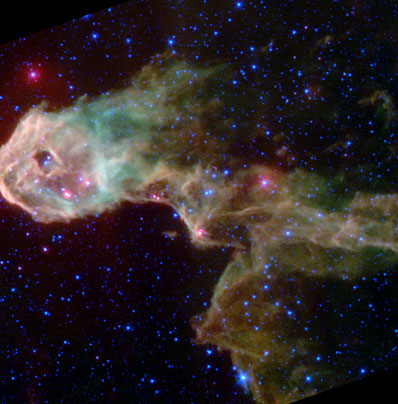
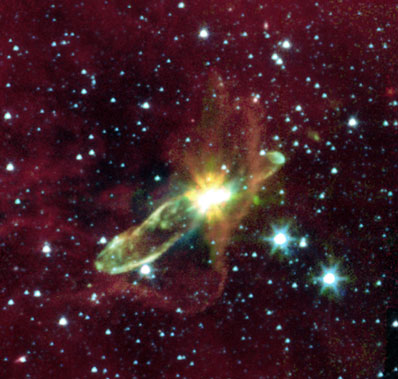
First images from Spitzer Space Telescope unveiled BY WILLIAM HARWOOD STORY WRITTEN FOR CBS NEWS "SPACE PLACE" & USED WITH PERMISSION Posted: December 18, 2003 NASA unveiled the first images from the $670 million Spitzer Space Telescope today, spectacular infrared glimpses of the optically-hidden heart of a distant galaxy, the dusty cradle of an infant solar system and a peek at heretofore unseen stars lurking inside a vast cloud of gas and dust.
"Those are the building blocks that go into assembling larger and larger organic molecules, the process that eventually [can] lead to life," said James Houck, a principal investigator from Cornell University. "That's a tremendous result." Especially since it took the new telescope just 14 minutes to collect the data. "What are we going to be able to accomplish in five years?" Houck asked. "We're going to be able to see things that make this look like ho hum. It's the enormous sensitivity of the Spitzer Space Telescope, and its wide wavelength coverage, that are the features that are going to make it a killer mission. We can expect a flood of discovery over the next five years. A flood." John Bahcall of the Institute for Advanced Study chaired a panel in 1991 that concluded a large infrared telescope was the top priority for astronomy in the decade of the 90s. At a news conference today, he said the first images from the newly named Spitzer Space Telescope represented the dawn of yet another astronomical revolution. "Today we open our eyes for the first time on a new universe," he said. "With the help of the Spitzer Space Telescope, we can see things that human beings couldn't see before. We can watch stars being born, we can see planets form, we can observe galaxies shrouded in dust, we can look to the edge of the visible universe."
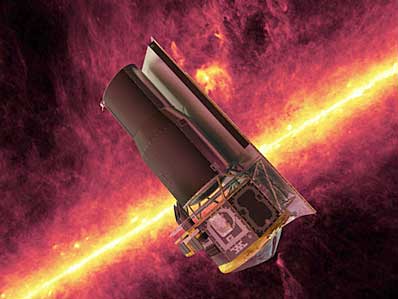
"Many secrets are hidden in the infrared. But ... observations with the Spitzer Telescope can unveil a beautiful spiral galaxy and show where the mass and the stars are concentrated. Beginning today, it will no longer be possible to characterize a system by its optical light. ... In order to understand how things operate in the heavens, we will need all of the colors and the Lyman Spitzer Space Telescope, along with other telescopes, will make that possible." NASA's fourth and final "great observatory," originally known as the Space Infrared Telescope Facility and renamed today in honor of astronomer Lyman Spitzer, was launched Aug. 25. To achieve the ultra-low operating temperatures required to detect faint infrared radiation from deep space objects, the telescope was boosted into an orbit around the sun that's slightly larger than Earth's. Equipped with a solar panel that doubles as a huge sunshade, the telescope's digital cameras are chilled to a few degrees above absolute zero. The observatory is so well shaded and insulated, only about an ounce of liquid helium coolant per month is required to maintain the desired operating temperature. If all goes well, engineers say, the helium should last for nearly six years.
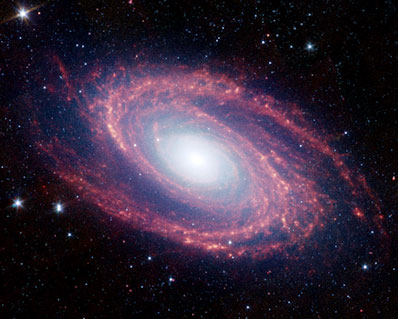
It took two months for the telescope to cool down to operational temperatures and for scientists to check out and calibrate the instruments. Only then did they begin taking the pictures that were unveiled today at a news conference at NASA headquarters in Washington. "For me and, I think, all astronomers, today seems very much like a dream come true," Bahcall said. "It's clear that the telescope is performing beyond our expectations, we are getting more science than expected for fewer public dollars." The new observatory is expected to beam back 8 gigabytes of data per day - the equivalent of 20,000 observations per year - over the life of the program. It is 100 to 1,000 times more sensitive than any previous infrared space telescope. The images released today were intended to demonstrate the telescope's health and capabilities as well provide new insights into a variety of cosmic processes. The most spectacular image, to this writer at least, was a shot of galaxy M-81, a spiral starswarm 12 million light years from Earth.
"For the first time, the Spitzer Space Telescope allows us to dissect a galaxy into its component parts just like a kid in a biology lab is dissecting a frog," said Giovanni Fazio, a principal investigator at the Harvard-Smithsonian Center for Astrophysics. "This is something we've never been able to do before and it will change the way we classify galaxies." As for mapping the distribution of organic molecules in distant galaxies, Houck said it's too soon to say what the presence of such material might mean for the evolution of life elsewhere. "The implications for life are totally uncertain," he said. "What we see is a bunch of building blocks, a bunch of bolts, some screws, maybe a horn button. That doesn't mean a car is going to appear soon, it just means there are a lot of pieces that are characteristic of the pieces that must have gone into building a car. So predicting life on the basis of the evidence we have now, I think, is going very far out on a limb. But we're ahead of the game. We've fond the molecules are present." Bahcall agreed. "All of us are interested in the origin of life," he said. "All of us are interested in how the universe that we inhabit got to be the way it is. To be honest, we don't have all the answers now. But with the advent of the Spitzer Space Telescope, we are a lot closer than we have ever been before. I am thrilled, thrilled to hear about the discovery of organic molecules in a distant galaxy at a time when the Earth was in its infancy."
|
|
|
|

|
||||