Extensive destruction powers solar explosions
NASA NEWS RELEASE
Posted: December 9, 2003

Large-scale destruction of magnetic fields in the sun's atmosphere likely powers enormous solar explosions, according to a new observation from NASA's Ramaty High Energy Solar Spectroscopic Imager (RHESSI) spacecraft.

The explosions, called solar flares, are capable of releasing as much energy as a billion one-megaton nuclear bombs. The destruction of magnetic fields, called magnetic reconnection, was a leading theory to explain how solar flares could suddenly release so much energy, but there were other possibilities as well. The new picture from RHESSI confirms large-scale magnetic reconnection as the most likely scenario.


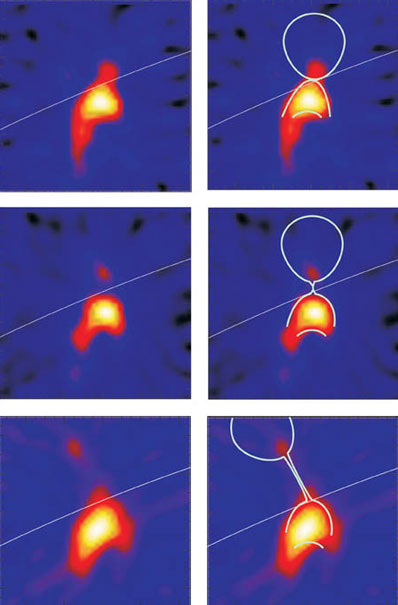
These are false-color images of solar X-rays detected by RHESSI. White represents the brightest areas, and blue the dimmest. For each row, the RHESSI image is shown on the left and the same image is shown on the right with an inference of the magnetic geometry. RHESSI first observed an X-ray arch with a hot blob at its top (top row, left image). The blob may have been associated with a magnetic X-point, where oppositely directed magnetic fields come into contact and very slow reconnection can occur (top row, right). The blob separated from the arch when the most energetic X-rays from the flare rapidly brightened (middle row, left). This separation was probably associated with the collapse of the magnetic X-point to a thin region of rapid magnetic reconnection (middle row, right). Two minutes later, the X-ray blob sped away from the Sun (bottom row, left). This was associated with the ejection of the upper magnetic structure from the Sun and the upward elongation of the reconnection layer (bottom row, right). Credit: NASA
 
"Many observations gave hints that magnetic reconnection over large areas was responsible for solar flares, but the new pictures from RHESSI are the first that are really convincing," said Linhui Sui of the Catholic University of America, Washington. "The hunt for the energy source of flares has been like a story where villagers suspect a dragon is on the loose because something roars overhead in the middle of the night, but only something resembling the tail of a dragon is ever seen. With RHESSI, we've now seen both ends of the dragon." Linhui is lead author of a paper on this research published October 20 in Astrophysical Journal Letters.

Magnetic reconnection can happen in the solar atmosphere because it is hot enough to separate electrons from atoms, producing a gas of electrically charged particles called plasma. Because plasma is electrically charged, magnetic fields and plasma tend to flow together. When magnetic fields and plasma are ejected from the sun, the ends of the magnetic fields remain attached to the surface. As a result, the magnetic fields are stretched and forced together until they break under the stress, like a rubber band pulled too far, and then reconnect -- snap -- to a new shape with less energy.

The thin region where they reconnect is called the reconnection layer, and it is where oppositely directed magnetic fields come close enough to merge. Magnetic reconnection could power a solar flare by heating the sun's atmosphere to tens of millions of degrees, and accelerating electrically charged particles that comprise the plasma (electrons and ions) to almost the speed of light.

At such high temperatures, solar plasma will shine in X-rays, and RHESSI observed high-energy X-rays, emitted by plasma, heated to tens of millions of degrees in a flare on April 15, 2002. The hot, X-ray emitting plasma initially appeared in the RHESSI images as a blob atop an arch of relatively cooler plasma protruding from the sun's surface. The blob-and-arch structure is consistent with reconnection, because the X-ray blob could be heated by reconnection, and the part of the magnetic field that breaks and snaps back to the solar surface will assume an arch shape.

These structures have been seen before and hinted at reconnection, but the observations were not conclusive. However, as RHESSI made images of the 20-minute long flare, over the course of about four minutes during the most intense part of the flare, the X-ray emitting blob exhibited two characteristics consistent with large-scale magnetic reconnection.

First, the blob split in two, with the top part ultimately rising away from the solar surface at a speed of about 700,000 miles per hour, or around 1.1 million km/hr. This is expected if extensive reconnection is occurring, because as the magnetic fields stretch, the reconnection layer also stretches, like taffy being pulled. Plasma heated by reconnection squirts out of the top and bottom of the reconnection layer, forming the two X-ray blobs in the RHESSI pictures, when the top and bottom are sufficiently far apart to be resolved as distinct areas.

Second, in both blobs, the area closest to the apparent reconnection layer was hottest, and the area farthest away was coolest, according to temperature measurements by RHESSI. This is also expected if reconnection is occurring, because, as the magnetic fields break and reconnect, other magnetic fields nearby move in to the reconnection region and reconnect as well, since the overall, large-scale field continues to stretch. Thus, plasma is continuously heated and blasted out from the reconnection layer. The plasma closest to the reconnection area is the most recently expelled and therefore the hottest. Plasma farther away was ejected earlier and had time to cool.

"This temperature gradient in the hot plasma was the clincher for me," said Dr. Gordon Holman, a Co-Investigator on RHESSI and co-author of the paper, at NASA's Goddard Space Flight Center, Greenbelt, Md. "If some other process was powering the flare, the hot plasma would not appear like this."

Gemini 7
Gemini 7: The NASA Mission Reports covers this 14-day mission by Borman and Lovell as they demonstrated some of the more essential facts of space flight. Includes CD-ROM.
 Choose your store:
U.S. - U.K. - E.U. - Worldwide

Apollo patches
The Apollo Patch Collection: Includes all 12 Apollo mission patches plus the Apollo Program Patch. Save over 20% off the Individual price.
 Choose your store:
U.S. - U.K. - E.U. - Worldwide

Mars Rover mission patch
A mission patch featuring NASA's Mars Exploration Rover is available from our online.
 Choose your store:
U.S. - U.K. - E.U. - Worldwide

Apollo 9 DVD
On the road to the moon, the mission of Apollo 9 stands as an important gateway in experience and procedures. This 2-DVD collection presents the crucial mission on the voyage to the moon.
 Choose your store:
U.S. - U.K. - E.U. - Worldwide

Gemini 7
Gemini 7: The NASA Mission Reports covers this 14-day mission by Borman and Lovell as they demonstrated some of the more essential facts of space flight. Includes CD-ROM.
 Choose your store:
U.S. - U.K. - E.U. - Worldwide

Apollo patches
The Apollo Patch Collection: Includes all 12 Apollo mission patches plus the Apollo Program Patch. Save over 20% off the Individual price.
 Choose your store:
U.S. - U.K. - E.U. - Worldwide

Mars Rover mission patch
A mission patch featuring NASA's Mars Exploration Rover is available from our online.
 Choose your store:
U.S. - U.K. - E.U. - Worldwide

Apollo 9 DVD
On the road to the moon, the mission of Apollo 9 stands as an important gateway in experience and procedures. This 2-DVD collection presents the crucial mission on the voyage to the moon.
 Choose your store:
U.S. - U.K. - E.U. - Worldwide

Mars Rover mission patch
A mission patch featuring NASA's Mars Exploration Rover is now available from the Astronomy Now Store.
 Choose your store:
U.S. - U.K. - E.U. - Worldwide

Exploring Mars
Astronomy Now is pleased to announce the publication of Exploring Mars. The very best images of Mars taken by orbiting spacecraft and NASA's Spirit and Opportunity rovers fill up the 98 glossy pages of this special edition!
 Choose your store:
U.S. - U.K. - E.U. - Worldwide

Soviet Space
For the first time ever available in the West. Rocket & Space Corporation Energia: a complete pictorial history of the Soviet/Russian Space Program from 1946 to the present day all in full color. Available from our store.
 Choose your store:
U.S. - U.K. - E.U. - Worldwide

Viking patch
This embroidered mission patch celebrates NASA's Viking Project which reached the Red Planet in 1976.
 Choose your store:
U.S. - U.K. - E.U. - Worldwide

Apollo 7 DVD
For 11 days the crew of Apollo 7 fought colds while they put the Apollo spacecraft through a workout, establishing confidence in the machine what would lead directly to the bold decision to send Apollo 8 to the moon just 2 months later.
 Choose your store:
U.S. - U.K. - E.U. - Worldwide

Gemini 12
Gemini 12: The NASA Mission Reports covers the voyage of James Lovell and Buzz Aldrin that capped the Gemini program's efforts to prove the technologies and techniques that would be needed for the Apollo Moon landings. Includes CD-ROM.
 Choose your store:
U.S. - U.K. - E.U. - Worldwide

Current Shuttle Mission Patch
The official embroidered patch for shuttle Endeavour's flight to finish building Japanese section of the space station.
 U.S. STORE
 WORLDWIDE STORE

Hubble Patch
The official embroidered patch for mission STS-125, the space shuttle's last planned service call to the Hubble Space Telescope, is available for purchase.
 U.S. STORE
 WORLDWIDE STORE

Ares Patch
The Ares Project will develop two new rockets to launch astronauts back to the Moon under NASA's Vision for Exploration. The Ares 1 will employ a single space shuttle solid rocket booster to loft the Orion crew capsule. The gigantic Ares 5 will haul the equipment and cargo needed for such lunar voyages. This is the Ares emblem.
 U.S. STORE


Project Orion
The Orion crew exploration vehicle is NASA's first new human spacecraft developed since the space shuttle a quarter-century earlier. The capsule is one of the key elements of returning astronauts to the Moon.
 U.S. STORE


Fallen Heroes Patch Collection
The official patches from Apollo 1, the shuttle Challenger and Columbia crews are available in the store.
 U.S. STORE
 WORLDWIDE STORE

Get e-mail updates
Sign up for our NewsAlert service and have the latest news in astronomy and space e-mailed direct to your desktop (privacy note: your e-mail address will not be used for any other purpose).
Enter your e-mail address:

INDEX | PLUS | NEWS ARCHIVE | LAUNCH SCHEDULE
ASTRONOMY NOW | STORE

ADVERTISE

© 2009 Spaceflight Now Inc.