|
 |

|
||||
|
|
||||
|
Details of Saturn become visible to Cassini spacecraft CICLOPS NEWS RELEASE Posted: December 7, 2003
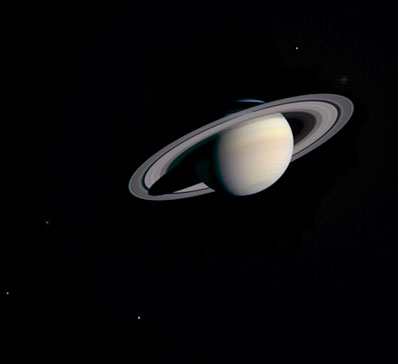
The planet was 111 million kilometers (69 million miles) from the spacecraft when the images were taken, about the equivalent of three-fourths of the distance between Earth and the Sun. The image shows details in the rings and atmosphere not seen a year ago, as well as five of Saturn's icy moons. "After more than a decade of preparation and waiting for arrival, it is satisfying to see the Saturnian moons in this approach picture," said Dr. Gerhard Neukum, an imaging team member and a professor at Free University in Berlin, Germany. "Soon we will be in orbit around Saturn to investigate these worlds in detail and to decipher their geologic history from close-up images - an exciting prospect." Dr. Anthony DelGenio, imaging team member from NASA Goddard Institute for Space Studies in New York City and a specialist in atmospheric studies, said, "We can only see the general banded structure of Saturn from this distance, but we know that as we get closer those bands will break up before our eyes into smaller features - spots, storms, wave patterns that we'll be able to see in 10 times more detail than any previous observation of Saturn. "I can't wait to dive in as we see it all unfold over the next few months. For all of us who have worked for more than a decade preparing for this mission, seeing Saturn grow larger and larger in the eyes of the Cassini cameras is a bit like the feelings children have as they come downstairs on Christmas morning to see what gifts are waiting for them under the tree," DelGenio said. "But this Christmas will last for four years." Dr. Carolyn Porco, a planetary ring specialist and leader of the Imaging Science team, said, "For someone who was involved in the Voyager exploration of Saturn twenty-three years ago, this is turning out to be a very sentimental journey. I'm reminded of what it felt like to see Saturn's rings for the first time with Voyager, and how rich and surprising they were. The spokes in the B ring, the twisted F ring and its shepherding moons, the sheer number and diversity of ring features.... we'll be on the lookout for all these things and more over the next few months". Dr. Wesley Huntress, former Cassini Study Scientist in the mid-1980s, Director of NASA's Solar System Exploration Division in 1990 at the inception of the Cassini mission, and presently the Director of Carnegie Institution of Washington's Geophysical Laboratory, said of the latest image, "Wow! So far away, so long to travel, so much effort to make it happen, and so worth it". A cold, dusky Saturn looms in the distance in the striking, natural color view of the ringed planet and five of its icy satellites. This image was composed of exposures taken by Cassini's narrow angle camera on November 9, 2003 at 08:54 UTC (spacecraft event time) from a distance of 111.4 million km (69.2 million mi) -- about three-fourths the distance of the Earth from the Sun -- and 235 days from insertion into Saturn orbit. The smallest features visible here are about 668 km (415 mi) across, which is a marked improvement over the last Cassini Saturn image released on November 1, 2002. New features such as intricate cloud patterns and small moons near the rings should become visible over the next several months as the spacecraft speeds toward its destination. Some details within Saturn's massive ring system are already visible. Structure is evident in the B ring, the middle and brightest of Saturn's three main rings. The 4800 km (2980 mi)-wide Cassini Division is the distinctive dark, central band that separates the outermost A ring from the brighter B ring. Interestingly, the outer edge of the B ring is maintained by a strong gravitational resonance with the moon Mimas, also visible in this image (see below). The 325 km (200 mi)-wide Encke gap in the A ring, near the outer edge of the ring system, is also visible, as is the fainter C ring, interior to the B ring. With a thickness of only a few tens of meters or less, the main rings span 274,000 km (171,000 mi) from one end to the otherŠ about three-quarters of the distance between the Earth and the Moon. Saturn's multi-banded, multi-hued atmosphere is also apparent at this distance. In this composite made of images taken through broadband blue, green, and red spectral filters, the color is very close to what the human eye would see. The different hues of yellow, brown and red seen in the illuminated southern hemisphere are more delicate and subtle than the colors on Jupiter. Coloration on both Jupiter and Saturn is caused by small colored particles mixed with the white ammonia clouds. The ammonia clouds on Saturn are deeper and thicker than those on Jupiter because ammonia gas condenses at a deeper level in Saturn's colder atmosphere. The composition of the colored particles is not known but is thought to include sulfur and nitrogen as key constituents at middle and low latitudes. In the southern polar region, a dusky haze is visible, more gray than the light-brown at middle latitudes. This polar haze may be produced by energetic electrons and protons in the aurorae which destroy methane gas, leading to the formation of a haze of complex hydrocarbons. Most of Saturn's northern hemisphere is in shadow of the rings, with the exception of a small sliver visible on the limb. (Light passing through the Cassini Division illuminates the higher altitudes in the atmosphere.) This sliver appears bluer than the visible southern hemisphere, probably due to molecular scattering by hydrogen at these altitudes above the haze and clouds. As the Cassini tour unfolds over the next five years and beyond, we will have an opportunity to see how the colors change with time, whether due to changing seasonal heating or to some other mechanism. Five Saturnian satellites can also be seen in this image. The brightnesses of these bodies have been increased three- to ten-fold to enhance visibility. The satellites are, on the left, from brightest to faintest, Rhea (1530 km, 951 mi across), Dione (1120 km, 696 mi), and Enceladus (520 km, 323 mi); and on the right, from brightest to faintest, Tethys (1060 km, 659 mi) and Mimas (392 km, 244 mi). From the Voyager encounters in 1980 and 1981, we know that each of Saturn's icy moons possesses intriguing features. Enceladus is the most reflective body in the solar system; both Mimas and Tethys exhibit large craters on their surfaces; Dione and Rhea have curious streaks of bright, wispy material. Cassini will make very close approaches to Rhea, Dione and Enceladus, returning images in which features as small as 50 meters or less will be detectable. Images with details finer than those seen by Voyager (~ 2 km, 1.3 mi) will be returned from all five moons. Fourteen camera-team scientists from the United States and Europe will use the two cameras on Cassini to investigate many features of Saturn, its moons and its rings. Cassini will begin a four-year prime mission in orbit around Saturn when it arrives on July 1, 2004. It will release its piggybacked Huygens probe about six months later for descent through the thick atmosphere of the moon Titan. The probe could impact in what may be a liquid methane ocean. The Cassini-Huygens mission is a cooperative mission of NASA, the European Space Agency and the Italian Space Agency. JPL, a division of the California Institute of Technology in Pasadena, manages the mission for NASA's Office of Space Science, Washington, D.C. The Space Science Institute, home to the Cassini Imaging Central
Laboratory for Operations, is a non-profit organization of
scientists and educators engaged in research in the areas of
astrophysics, planetary science and the earth sciences, and in
integrating research with education and public outreach.
|
|
|
|

|
|