NASA cites progress in earthquake research
NASA NEWS RELEASE
Posted: December 4, 2003

Nearly 10 years after Los Angeles was shaken by the devastating, magnitude 6.7 Northridge earthquake, scientists at NASA and other institutions say maturing space-based technologies, new ground-based techniques and more complex computer models are rapidly advancing our understanding of earthquakes and earthquake processes.


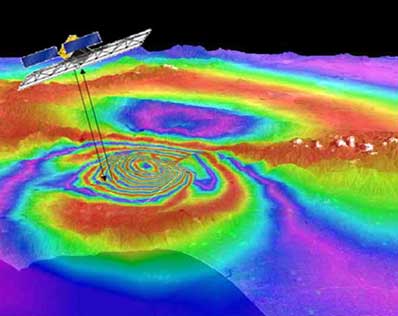
Interferometric synthetic aperture radar (InSAR) uses a satellite's radar picture of the Earth's surface. Credit: NASA/JPL
 
Dr. Andrea Donnellan, a geophysicist at NASA's Jet Propulsion Laboratory, Pasadena, Calif., says the past decade has seen substantial progress in space-based earthquake research. "We've confirmed through space observation the Earth's surface is constantly moving, periodically resulting in earthquakes, and we can measure both the seismically quiet motions before and after earthquakes, as well as the earthquakes themselves," she explains. "These technologies are allowing us to pursue lines of data and research we didn't know existed only a few years ago."

Two months before the Northridge earthquake, Donnellan and university colleagues published a paper in the journal Nature on ground deformation north of Los Angeles' San Fernando Valley. Six years of Global Positioning System (GPS) data showed the area's faults were active and building up strain, and indicated the size and style of a potential earthquake there. Following the earthquake, the data made it possible to rapidly determine where the fault ruptured and to measure how the earthquake had deformed the Earth's surface.

Space-based instruments can image Earth movements to within fractions of an inch, measuring the slow buildup of deformation along faults, and mapping ground deformation after an earthquake. Two primary tools are the space-based GPS navigation system and Interferometric Synthetic Aperture Radar (InSAR). The latter compares satellite radar images of Earth taken at different times to detect ground movement.

InSAR complements surface measurements because it lets us look at whole regions in a spatial context. An InSAR mission is also a key component of EarthScope, a jointly led initiative by the National Science Foundation (NSF), NASA and the U.S. Geological Survey (USGS).

EarthScope studies the North American continent's structure and evolution, and the physical processes that control earthquakes and volcanic eruptions, according to Dr. James Whitcomb, section head for Special Projects, Earth Sciences Division, National Science Foundation, Arlington, Va.

Precise Earth surface-movement data measure strain, and provide a first approximation of where earthquakes are likely to occur, notes Dr. Brad Hager, a Massachusetts Institute of Technology (MIT) professor and co-author of the 1993 Nature paper. "In California, patterns of ground deformation are complicated by the complex interactions between fault systems," he says. "Interpreting this data requires computer models that can estimate how much deformation has accumulated and identify regions where strain should be released, but hasn't been."


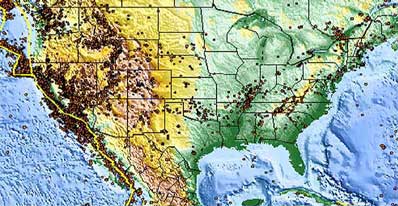
Recent earthquakes in the continental United States. Credit: NASA/JPL
 
University of California, Davis, researcher Dr. John Rundle says the complexity of earthquakes requires we study them as part of the full Earth system. "Most natural events result from interrelated Earth processes over various lengths and times," he adds. "These processes have variables that can't be readily observed, so understanding them requires computers."

NASA's QuakeSim project is developing a similar forecasting methodology. Its tools simulate earthquake processes, and manage and model the increasing quantities of data available. "We're focusing on observing and understanding earthquakes in space and time, and developing methods that use patterns of small earthquakes to forecast larger ones," Rundle explains. "New simulations of earthquakes on California's active faults are providing considerable insight, showing earthquakes tend to "cluster" in space and time due to their interactions: that is, an earthquake on one fault section can turn on or off earthquake activity on nearby fault sections, depending on the relative orientation of the faults. Simulations have led researchers to conclude that fault system geometry determines earthquake activity patterns."

A NASA/Department of Energy-funded research team reports promising results from an experiment to forecast earthquakes in southern/central California from 2000 to 2010. It uses mathematical methods to forecast likely locations of earthquakes above magnitude 5 by processing data on earthquakes of about magnitude 3 from the past decade. The high-risk regions identified in the forecast are refined from those already identified by the government as susceptible to large earthquakes. Five earthquakes greater than magnitude 5 have occurred since the research was completed, all in those high-risk regions.

Dr. Wayne Thatcher, a senior research geophysicist at the USGS, Menlo Park, Calif., says as these technologies are validated they will be transferred to end users. "Such data and models improve understanding of earthquake and volcanic processes, substantially refining seismic hazard maps and resulting in more appropriate, earthquake-resistant construction codes and more targeted retrofitting strategies," he says.

Spaceflight Now Plus
Video coverage for subscribers only:
   VIDEO: WATCH NEWS CONFERENCE ON EARTHQUAKE RESEARCH QT
   MORE VIDEO AVAILABLE!
   SUBSCRIBE NOW

Soviet Space
For the first time ever available in the West. Rocket & Space Corporation Energia: a complete pictorial history of the Soviet/Russian Space Program from 1946 to the present day all in full color. Available from our store.
 Choose your store:
U.S. - U.K. - E.U. - Worldwide

Viking patch
This embroidered mission patch celebrates NASA's Viking Project which reached the Red Planet in 1976.
 Choose your store:
U.S. - U.K. - E.U. - Worldwide

Apollo 7 DVD
For 11 days the crew of Apollo 7 fought colds while they put the Apollo spacecraft through a workout, establishing confidence in the machine what would lead directly to the bold decision to send Apollo 8 to the moon just 2 months later.
 Choose your store:
U.S. - U.K. - E.U. - Worldwide

Gemini 12
Gemini 12: The NASA Mission Reports covers the voyage of James Lovell and Buzz Aldrin that capped the Gemini program's efforts to prove the technologies and techniques that would be needed for the Apollo Moon landings. Includes CD-ROM.
 Choose your store:
U.S. - U.K. - E.U. - Worldwide

Columbia Report
A reproduction of the official accident investigation report into the loss of the space shuttle Columbia and its crew of seven.
 Choose your store:
U.S. - U.K. - E.U. - Worldwide

Mars Panorama

DISCOUNTED! This 360 degree image was taken by the Mars Pathfinder, which landed on the Red Planet in July 1997. The Sojourner Rover is visible in the image.
 Choose your store:
U.S.

Apollo 11 Mission Report
Apollo 11 - The NASA Mission Reports Vol. 3 is the first comprehensive study of man's first mission to another world is revealed in all of its startling complexity. Includes DVD!
 Choose your store:
U.S. - U.K. - E.U. - Worldwide

Rocket DVD
If you've ever watched a launch from Kennedy Space Center, Cape Canaveral, Vandenberg Air Force Base or even Kodiak Island Alaska, there's no better way to describe what you witnessed than with this DVD.
 Choose your store:
U.S. - U.K. - E.U. - Worldwide

Exploring Mars
Astronomy Now is pleased to announce the publication of Exploring Mars. The very best images of Mars taken by orbiting spacecraft and NASA's Spirit and Opportunity rovers fill up the 98 glossy pages of this special edition!
 Choose your store:
U.S. - U.K. - E.U. - Worldwide

Mars Rover mission patch
A mission patch featuring NASA's Mars Exploration Rover is now available from the Astronomy Now Store.
 Choose your store:
U.S. - U.K. - E.U. - Worldwide

Gemini 7
Gemini 7: The NASA Mission Reports covers this 14-day mission by Borman and Lovell as they demonstrated some of the more essential facts of space flight. Includes CD-ROM.
 Choose your store:
U.S. - U.K. - E.U. - Worldwide

Apollo patches
The Apollo Patch Collection: Includes all 12 Apollo mission patches plus the Apollo Program Patch. Save over 20% off the Individual price.
 Choose your store:
U.S. - U.K. - E.U. - Worldwide

Mars Rover mission patch
A mission patch featuring NASA's Mars Exploration Rover is available from our online.
 Choose your store:
U.S. - U.K. - E.U. - Worldwide

Apollo 9 DVD
On the road to the moon, the mission of Apollo 9 stands as an important gateway in experience and procedures. This 2-DVD collection presents the crucial mission on the voyage to the moon.
 Choose your store:
U.S. - U.K. - E.U. - Worldwide

Apollo Collage
This beautiful one piece set features the Apollo program emblem surrounded by the individual mission logos.
 U.S. STORE

STS-127 Patch
The official embroidered patch for shuttle Endeavour's flight to finish building Japanese section of the space station.
 U.S. STORE
 WORLDWIDE STORE


Hubble Patch
The official embroidered patch for mission STS-125, the space shuttle's last planned service call to the Hubble Space Telescope, is available for purchase.
 U.S. STORE
 WORLDWIDE STORE

Project Orion
The Orion crew exploration vehicle is NASA's first new human spacecraft developed since the space shuttle a quarter-century earlier. The capsule is one of the key elements of returning astronauts to the Moon.
 U.S. STORE


Fallen Heroes Patch Collection
The official patches from Apollo 1, the shuttle Challenger and Columbia crews are available in the store.
 U.S. STORE
 WORLDWIDE STORE

Get e-mail updates
Sign up for our NewsAlert service and have the latest news in astronomy and space e-mailed direct to your desktop (privacy note: your e-mail address will not be used for any other purpose).
Enter your e-mail address:

INDEX | PLUS | NEWS ARCHIVE | LAUNCH SCHEDULE
ASTRONOMY NOW | STORE

ADVERTISE

© 2009 Spaceflight Now Inc.