|
 |

|
||||
|
|
||||
|
Space sailing test could launch within months BY STEPHEN CLARK SPACEFLIGHT NOW Posted: July 6, 2003
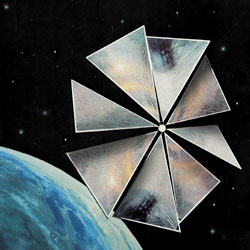
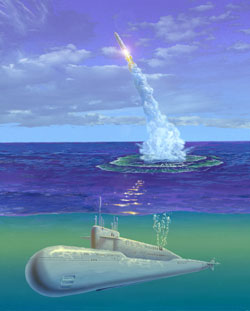
Despite a pair of failures of the solar sail's submarine-launched Volna launch vehicle in 2001 and 2002, project officials are progressing in their preparations of both the Cosmos 1 solar sail vehicle and the Volna rocket. A mock-up of the solar sail spacecraft was flown on a suborbital trajectory two years ago this month. The test flight ended in failure for reasons that have not been precisely identified, but the focus was narrowed to the payload separation system. A similar failure occurred last July in a test of an inflatable re-entry vehicle. The Cosmos 1 engineering model was shipped a few months ago to a vacuum chamber to test modifications to the Volna's payload separation mechanism, although Planetary Society Executive Director Louis Friedman reported that those have not yet been completed. Cosmos 1 is likely the next flight of the Volna rocket. Because it is going in a circular orbit some 800 kilometers high, the spacecraft requires an orbital injection engine to go from the suborbital trajectory the Volna leaves it in and into orbit. A test firing of the liquid-fueled engine was successful late last year. Final assembly of the flight vehicle is also underway at the NPO Lavochkin facility near Moscow. Engineers are awaiting the delivery of a few components that had to undergo changes after testing, Friedman said. Various other types of critical testing have been completed in the past few months, Friedman told Spaceflight Now. The vibration and dynamics tests were successfully carried out. Also, checkout of the solar array power production system occurred in early April and uncovered a leakage problem with the electrical current that required a fix. Overall, officials are pleased with the progress of the assembly and testing campaign. "Things (are) progressing well," Friedman said. "Not every test is successful, but we have had no major setback and are proceeding forward. Minor problems occur and have to be corrected."
"We launch when ready, and we are making progress," he said. "If all goes perfectly we will launch in September or October, but all may not go perfectly." "Lots of things have to come together." Friedman explained in a status report posted on the Planetary Society web site in May that there are three variables in building a spacecraft -- time, performance, and money. "We do not want to sacrifice performance; we have no extra money. Time is therefore our only variable. We will launch when ready." The Planetary Society believes they still have as good of a shot as anyone else at launching and flying the world's first solar sail mission. Solar sails rely on light pressure from the Sun for gradual acceleration. Officials will be able to keep track of Cosmos 1's orbital parameters for an increase in size, which would signal a successful demonstration of the solar sail technology.
|
|
|
|
Mars DVD Explore the Red Planet from the comfort of your home with this interactive DVD. Includes 3D glasses for viewing three-dimensional images of Mars. Explore the Red Planet from the comfort of your home with this interactive DVD. Includes 3D glasses for viewing three-dimensional images of Mars. U.S. STOREU.K. & WORLDWIDE STORE U.S. STOREU.K. & WORLDWIDE STORE
|
||||