|
 |

|
||||
|
|
||||
|
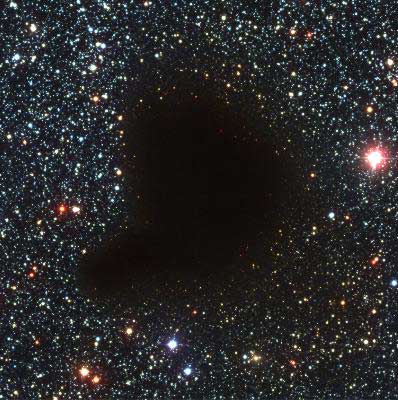
Molecular cloud 300 light-years away has a heartbeat HARVARD-SMITHSONIAN CENTER FOR ASTROPHYSICS NEWS RELEASE Posted: March 1, 2003 February is a month known for its holiday celebrating matters of the heart. Therefore, it is fitting that this month would see the announcement of an appropriately themed astronomical discovery - a celestial object that beats like a heart. Astronomer Charles Lada of the Harvard-Smithsonian Center for Astrophysics (CfA) and colleagues have discovered that the dark molecular cloud known as Barnard 68 seems to pulsate like a heavenly tribute to Saint Valentine.
Barnard 68 is the only molecular cloud known to pulsate in this manner. The dark heart of Barnard 68 Molecular clouds are stellar nurseries. Young stars form from collapsing molecular clouds. Barnard 68, however, is a stable cloud containing no newborn stars. Barnard 68 holds as much material as one and a half Suns, chilled to a temperature of only 10 degrees above absolute zero (-440 degrees F). It is one of the coldest objects in the Universe. Appropriately for such a frigid temperature, it pulsates very slowly, considerably more slowly than the heart of an earthbound lizard on a cold fall morning. Barnard 68 spans about 12,000 times the average distance between the Earth and the Sun, or about one trillion miles. If our Sun were placed at the center of Barnard 68, the cloud would extend out to 300 times the orbit of Pluto. Our solar system would be a lonely place, because the cloud's thick dust would obscure light from the surrounding stars and galaxies that fill the cosmos. Our night sky would be as black as coal, showing only the occasional pinpoint of light from the other nearby planets. Whacked by a supernova What force could have struck Barnard 68 to make it ring like a bell? Lada speculates that the shockwave from an exploding star may have smacked into the molecular cloud in the relatively recent past. The blast from a supernova easily could provide the impulse that started these pulsations. This theory is supported by other observations showing that Barnard 68 is located inside a hot "bubble" within the interstellar medium - a rarefied zone cleared out by a supernova. The supernova shockwave may even have been powerful enough to rip off the outer layers of Barnard 68, leaving behind the ringing core of a once-massive cloud. A molecular cloud that behaves like a star "Stars are known to pulsate, but clouds are not known to pulsate," Lada confirms. In this respect, Barnard 68 behaves like a star. It shows clear differences from the Sun, but also surprising similarities given the very different environments involved. Pulsations are described by "modes." Each pulsation mode is essentially a sound wave with a characteristic amplitude and timescale. The Sun shows thousands of pulsation modes, while Barnard 68 seems to have only a few. Also, the Sun pulsates on a short timescale of minutes, while Barnard 68 pulsates on a much longer timescale of about 250,000 years. "Still, it's remarkable that the same equations which describe stellar structure and pulsations also apply to Barnard 68, even though they're very different systems with different physics involved," says Lada. Lada now plans to examine the handful of other molecular clouds that are close enough for high-resolution observations in order to see if any others show signs of pulsation. The research on Barnard 68 will be published in the March 20, 2003, issue of The Astrophysical Journal in a paper co-authored by Lada, Edwin Bergin (CfA), Joao Alves (European Southern Observatory) and Tracy Huard (CfA). Headquartered in Cambridge, Massachusetts, the Harvard-Smithsonian
Center for Astrophysics (CfA) is a joint collaboration between the
Smithsonian Astrophysical Observatory and the Harvard College
Observatory. CfA scientists organized into six research divisions
study the origin, evolution, and ultimate fate of the universe.
|
|
|
|
 Hubble Calendar  NEW! This remarkable calendar features stunning images of planets, stars, gaseous nebulae, and galaxies captured by NASA's orbiting Hubble Space Telescope.
 U.S. STOREU.K. & WORLDWIDE STORE U.S. STOREU.K. & WORLDWIDE STOREHubble Posters  Stunning posters featuring images from the Hubble Space Telescope and world-renowned astrophotographer David Malin are now available from the Astronomy Now Store.U.S. STOREU.K. & WORLDWIDE STORE Stunning posters featuring images from the Hubble Space Telescope and world-renowned astrophotographer David Malin are now available from the Astronomy Now Store.U.S. STOREU.K. & WORLDWIDE STORE
|
|