|
 |

|
||||
|
|
||||
|
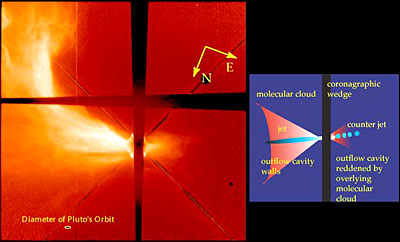
Young star blasts its way out of stellar nursery NASA-GSFC NEWS RELEASE Posted: January 13, 2002 A young star is apparently blasting high-speed gas jets from its poles, carving a void through the dense molecular cloud that was its birthplace, according to an international team of astronomers. The observation indicates that the jets are more common and last longer than supposed.
"If these features are indeed gas jets from SU Aurigae, then they are more common around intermediate-mass stars than previously believed," said Dr. Carol Grady, an astronomer with Eureka Scientific and the National Optical Astronomy Observatory who is stationed at NASA's Goddard Space Flight Center, Greenbelt, Md. "We only have 11 coronagraphic images of stars like SU Aurigae, and it's already the second one we've seen with features that look like gas jets. Unless we are incredibly lucky, gas jets are likely a relatively common feature of young stars, regardless of their mass," said Grady. "Also, the jets were once thought to last for only the first 100,000 years or so of a star's lifetime, but SU Aurigae is about four million years old, so we are learning that jets can persist for a lot longer than we thought." Grady is presenting a poster about this research today at the American Astronomical Society meeting in Washington, D.C. The team observed features resembling a jet of gas extending about 110 billion miles in front of SU Aurigae, and a fainter jet about 100 billion miles long behind the star, directed into a vast, dark molecular cloud that provided the matter for the star's formation. Additionally, the team saw a 170 billion-mile wide void in the molecular cloud around SU Aurigae. The void is filled with thin gas that reflects light from the star, making it visible in the STIS coronagraphic image. According to the team, the void could have been carved by the gas jets and radiation pressure from the star. Astronomers believe gas jets are emitted by stars which are still forming that also have strong magnetic fields. The star's gravity pulls gas from its parent cloud, while the star's magnetic field, which is twisted into rope-like structures at the poles due to the star's rotation, expels some of the infalling gas as high-speed polar jets. Gas jets are commonly observed around young stars with the mass of the Sun or less, but SU Aurigae has nearly twice the Sun's mass. The common presence of jets around intermediate-mass stars like SU Aurigae is a surprise because such stars typically do not have a strong, global magnetic field required to direct some of the infalling gas into a jet. This is because their internal structure is different from lower-mass stars; they lack a turbulent layer near their surface that generates a strong, global magnetic field. "It may be that a young, intermediate-mass star has a similar structure to a solar-mass star, which allows it to generate a strong magnetic field. However, when the intermediate-mass star matures and starts shining by hydrogen fusion in its core, its structure changes and the powerful magnetic field of its youth gradually fades," said Grady. Astronomers were unsure how long infalling matter persists to feed the jets; this observation indicates that, in some cases, the jets survive for millions of years. "Some astronomers want well-defined stages for starbirth, but reality, as usual, is more messy," said Grady. "We are finding that the timing of stellar birth phases depends a lot on the star's environment. If a star has nearby companion stars, or if it starts forming planets in its disk, these objects can clear away gas that feeds the jets, terminating them more quickly than an isolated star without planets." SU Aurigae's lifetime is estimated to be less than a billion years, making its current age equivalent to about three and a half months of a 70-year human lifespan. Support for this research was provided by NASA through a grant from the Space Telescope Science Institute, which is operated by the AURA Inc., under NASA contract NAS 5-26555.
|
|
|
|

|
|