|
 |

|
||||
|
|
||||
|
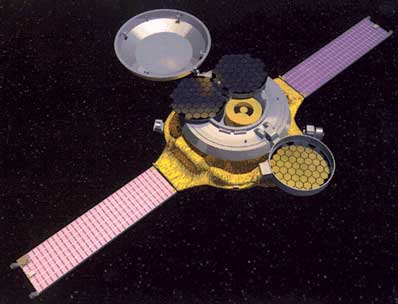
Genesis begins mission to collect samples of the Sun NASA NEWS RELEASE Posted: December 4, 2001 NASA's Genesis mission officially opened for business Monday, as it extends its special collector arrays to catch atoms from the solar wind. The atoms it collects, believed to have been part of the solar nebula "cloud" from which our solar system developed, will help scientists gain a better understanding of the conditions in the distant past before the Earth and other planets formed.
Genesis orbits a point in space, about one million miles from Earth in the direction of the Sun, where the gravities of Earth and the Sun balance. The spacecraft first opened its outer shell, then last Friday opened its inner science canister to reveal collector arrays. Monday, these arrays fanned out like petals to catch heavier atoms of the solar wind. "We expect to start getting particle hits right away," said Dr. Donald Burnett, Genesis principal investigator, of the California Institute of Technology (Caltech), Pasadena. "Now we've gotten to the real focus of the mission: the start of science, leading to the return in 2004 and the analysis phase of the mission." This treasured smidgen of the Sun will be preserved in a special laboratory at NASA's Johnson Space Center, Houston, for study by scientists over the next century. It will help them answer fundamental questions about the exact composition of our star and the birth of our solar system. Sample collection will conclude in April 2004, when the spacecraft begins its return to Earth. In September of that year, the samples will arrive on Earth in a dramatic helicopter capture. As the sample-return capsule parachutes toward the ground at the Utah Testing and Training Range of the U.S. Air Force, specially trained helicopter pilots will catch the capsule in mid-air to prevent the delicate samples from being disturbed by the impact of a landing. Scientists say that the surface of the Sun, from which the solar wind originates, has preserved the composition of the era when the solar system formed. Study of Genesis' samples will yield the average composition of the solar system to greater accuracy. It will also give clues about the process that led to the incredible diversity of environments in today's solar system. Genesis carries four instruments: bicycle-tire-sized solar- wind collector arrays, made of materials such as diamond, gold, silicon and sapphire designed to entrap solar wind particles; an ion monitor, to record the speed, density, temperature and approximate composition of the solar wind ions; an electron monitor, to make similar measurements of electrons in the solar wind; and an ion concentrator, to separate and focus elements like oxygen and nitrogen in the solar wind into a special collector tile. The ion and electron monitors were turned on several months ago in preparation for their role during solar wind collection. The monitors communicate with Earth frequently and will give a periodic solar-wind weather report. "It has been exciting watching the space weather so far," said Dr. Roger Wiens of Los Alamos National Laboratory, N.M., head of the team that operates the instruments. "We've had a rather stormy autumn in space, which has been great for checking out our instruments." JPL, a division of Caltech, manages the mission for NASA's
Office of Space Science, Washington. Lockheed Martin
Astronautics, Denver, designed and built the spacecraft and
will operate it jointly with JPL. Major portions of the
payload design and fabrication were carried out at the Los
Alamos National Laboratory and at Johnson Space Center.
|
|
|
|

|
|