|
 |

|
||||
|
|
||||
|
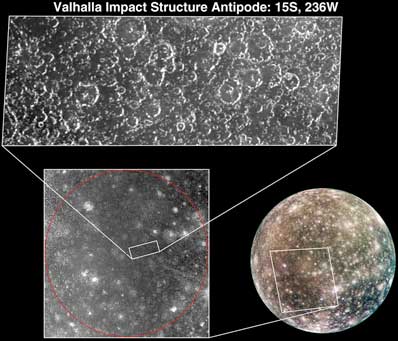
Ocean inside Jupiter moon may have cushioned impact NASA NEWS RELEASE Posted: November 29, 2001 A recent image from NASA's Galileo spacecraft adds evidence to a theory that Callisto, the outermost of Jupiter's four large moons, may hold an underground ocean. The image shows a part of Callisto's surface directly opposite from the Valhalla basin where Callisto was punched by a major collision. The opposition point shows no effect from the impact. Points opposite major impact features on some similar-size worlds, such as Mercury and Earth's Moon, show lumpy terrain attributed to seismic shocks from the distant impacts.
"Although there is a lot of uncertainty in the computer modeling of Callisto, it's good that this image supports the hypothesis presented a decade ago. But it's not a smoking gun, and a lot more evidence needs to be uncovered before we will know for sure whether Callisto has a subsurface ocean," Williams said. "Galileo has given us indications, primarily from magnetometer data, of the possibility that Europa, Ganymede and Callisto -- three of Jupiter's four large moons -- have liquid-water layers," said Dr. Torrence Johnson, project scientist for Galileo at NASA's Jet Propulsion Laboratory, Pasadena, Calif. "Liquid water is of interest not only for what it may tell us about the evolution of these bodies, but also for biological implications," Johnson said. Life relies on liquid water, but an ocean on Callisto would not draw as much interest in a search for life as one on Europa. An ocean on Callisto would be much farther below the surface than Europa's ocean. It would also be trapped between two layers of ice rather than sitting on top of a warm rocky layer, as models suggest for Europa. Images taken of Valhalla's opposite point, or antipode, during a May 25, 2001, flyby of Callisto by Galileo, show the same type of cratered surface seen all over Callisto. In contrast, regions opposite large impact basins on the Moon and Mercury have grooved and hilly features known as "antipodal terrains" and attributed to shocks from the impacts. "The Valhalla antipodal region on Callisto is cratered, but definitely not grooved and hilly," Williams said. He is processing and analyzing the Galileo Callisto imagery with James E. Klemaszewski and Dr. Ronald Greeley, also of Arizona State University. Williams presented a preliminary analysis today at the annual meeting of the American Astronomical Society's Division for Planetary Sciences, being held in New Orleans. Earlier computer modeling of Callisto by Greeley and his student Allison Watts suggested that if Callisto had a liquid water layer in its interior, this layer would have dispersed the seismic shock waves from the ancient Valhalla impact. These shock waves might otherwise have produced grooved and hilly terrain at the antipode. Callisto is about the same size as Mercury. Its surface of ice and rock is the most heavily cratered of any moon in the solar system, signifying that it is geologically "dead." There is no clear evidence that Callisto has experienced the volcanic activity or tectonic shifting that have erased some or all of the impact craters on Jupiter's other three large moons. So, if the Valhalla impact billions of years ago had reshaped the landscape on the opposite side of Callisto, those effects would likely still be detectable. NASA's Jet Propulsion Laboratory, a division of the
California Institute of Technology in Pasadena, manages
Galileo for NASA's Office of Space Science, Washington, D.C.
|
|
|
|

|
|