|
 |

|
||||
|
|
||||
|
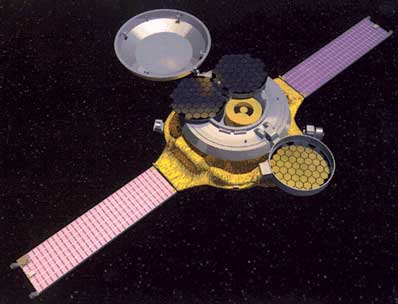
Genesis spacecraft performs crucial maneuver BY JUSTIN RAY SPACEFLIGHT NOW Posted: November 15, 2001 Updated: November 16, 2001 The NASA probe in search of our origins fired its thrusters Friday to settle into orbit a million miles away where it can collect bits of the solar wind for return to Earth.
"This is a crucial maneuver for Genesis, since it sets up the five-loop halo orbit around L1 in which we gather the solar wind samples," explained project manager Chester Sasaki of NASA's Jet Propulsion Laboratory, Pasadena, Calif., which manages the mission. "We're thrilled with how well Genesis has performed during its flight in space, and now that it is in orbit, we are looking forward to the incredible science that the spacecraft will begin to obtain in a few days and throughout its two-year science phase of the mission," said G. Thomas Marsh, president and general manager of Lockheed Martin Space Systems, which built Genesis. "Based on the telemetry data we have received, the spacecraft is in good health, the science canister is functioning well, and we are very pleased to have another important mission underway with NASA and the Jet Propulsion Laboratory," Marsh said. Mission controllers will now prepare the spacecraft for its main objective of capturing pieces from the solar wind, the stream of charged particles flowing from the Sun. The collection should begin in December. Scientists are anxious to study the solar wind samples because they will help determine what was in the cloud of gas and dust from which the solar system formed 4.5 billion years ago. "Genesis will return a small but precious amount of data crucial to our knowledge of the Sun and the formation of our solar system," said Donald Burnett, principal investigator of Genesis. "Data from Genesis will provide critical pieces for theories about the birth of the Sun and planets." The L1 location, a common place for stationing spacecraft that study the Sun, is also free of the Earth's magnetic field, allowing Genesis to study the solar wind without interference. Mission planners have built-in maneuvers to maintain the spacecraft in its orbit around the Lagrange point. If Genesis' injection into orbit goes as planned, the next maneuvers will be very small. On November 30, the sample return capsule will be opened, and a few days later Genesis will open its inner canister, extend its collector arrays and begin collecting concentrated ions. Genesis will spend 29 months at L1, completing five orbits before beginning a round-about trek back home. The spacecraft will perform a distant flyby of the Earth and then circle the Earth-Sun L2 point, behind the Earth, to set up for a daytime reentry over the western U.S. in September 2004. While the rest of the spacecraft burns up over the eastern Pacific Ocean, a small return canister will survive the reentry and descend to Earth by parachute over a military training range near Salt Lake City, Utah. Before landing, though, the capsule will be captured in midair by helicopter so that the impact of landing does not damage the solar wind samples.
|
|
|
|
Video Vault Genesis movie clips available to our Spaceflight Now+Plus service (subscribers only):  The launch of the Genesis spacecraft atop a Boeing Delta 2 as seen live on NASA Television.
QuickTime or RealVideo  A video camera mounted to the Delta 2 rocket shows dramatic views of the first stage engines shutting down, stage jettison and ignition of the second stage.
QuickTime or RealVideo  The onboard camera shows the two halves of the Delta's nose falling away after finishing its job protecting Genesis during launch through the atmosphere.
QuickTime or RealVideo  Spaceflight Now captured this video of the Delta 2 rocket lifting off with Genesis from Jetty Park located just south of pad 17A.
QuickTime or RealVideo  Engineering video cameras at launch pad 17A provide a close-up view of ignition and liftoff of the Boeing Delta 2 rocket.
QuickTime or RealVideo  Animation shows NASA's Genesis spacecraft as it is launched, flying through space and its return to Earth with solar wind samples.
QuickTime or RealVideo See our full listing of video clips. 
|
|