|
 |

|
||||
|
|
||||
|
Astronomers discover extrasolar planet 'cousins' BY JEFF FOUST SPACEFLIGHT NOW Posted: October 16, 2001 Astronomers announced Monday that they have discovered eight more extrasolar planets, including three that scientists called "cousins" of planets in our own solar system.
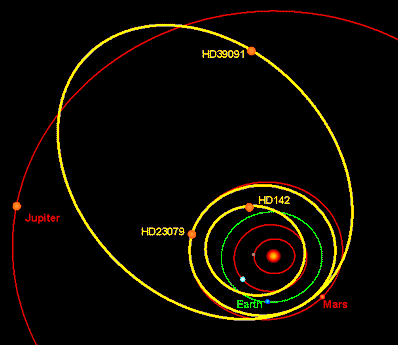
Three of the eight new planets were of particular interest. Each of three had characteristics -- mass, orbital distance, and orbital eccentricity -- that are more closely similar to planets in our own solar system than of most of the other exoplanets discovered to date. One, orbiting the star HD114783, has a minimum mass the same as Jupiter, orbiting its parent star at an average distance of 1.2 astronomical units (180 million kilometers) with an eccentricity of 0.10, or close to circular. A second, orbiting HD23079, has a minimum mass 2.75 times that of Jupiter and orbits its star at an average distance of 1.48 AU (222 million km) with an even lower eccentricity, 0.03. The third planet orbits HD4208 at an average distance of 1.69 AU (253 million km) with an eccentricity of 0.04, and has a minimum mass just 81% that of Jupiter. These three planets are a far cry from most of the other exoplanets discovered to date. Those planets have had some combination of very large masses, very eccentric orbits, and/or orbits very close to their parent stars. None of those extrasolar planetary systems even faintly resembled our own solar system, leading some to wonder if our system is the exception rather than the rule. Other astronomers argued that a type of observational bias was taking place, based on the radial velocity technique that has been used to discover most exoplanets. That technique indirectly measures the presence of planets by looking for Doppler shifts in key spectral lines in the light of the parent star as the gravity of the orbiting planet causes the star to wobble. Very massive planets, and planets orbiting close to stars, would exert the biggest forces on the star, making them easier to detect than smaller, more distant worlds. "Most of the planetary systems we've found have looked like very distant relatives of the solar system -- no family likeness at all," said Steve Vogt, a University of California Santa Cruz astronomer. "Now we're starting to see something like second cousins." Hugh Jones, an astronomer with Liverpool John Moores University, made a similar familial comparison. "These discoveries strengthen the statistics we are accumulating for such planets and we are now starting to see, if not twins, then second cousins," he said.
These new planets, combined with the nearly 70 other exoplanets found to date, are helping astronomers get a handle on planetary formation. "To understand the formation and evolution of planets and planetary systems we need a large sample of planets to study," said Anne Kinney, an astronomer who heads NASA's Astronomy and Physics Division. "This result, added to others in the recent past, marks the beginning of an avalanche of data which will help to provide the answers." Those involved with the discoveries are confident that they will soon be able to find planets virtually identical to the largest planets in our solar system. "In a few years' time," said Vogt, "we could be finding brothers and sisters."
|
|
|
|

|
||