|
 |

|
||||
|
|
||||
|
Scientists find largest flood channels in the solar system UNIVERSITY OF ARIZONA NEWS RELEASE Posted: August 3, 2001
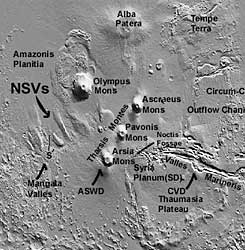
A system of gigantic ancient valleys -- some as much as 200 kilometers wide -- lies partly buried under a veneer of volcanic lava flows, ash fall and wind-blown dust in Mars' western hemisphere. New observations made with the Mars Orbiter Laser Altimeter on the Mars Global Surveyor spacecraft reveal northwestern slope valleys (NSVs) northwest of the huge martian volcano, Arsia Mons, and south of Amazonis Planitia, site of a postulated ocean. The northwestern slope valley system is ten times larger than Kasei Valles, the largest previously known outflow channel system on Mars, said James M. Dohm of the University of Arizona. The best explanation is that they were formed by catastrophic floods that at their peak potentially discharged as much as 50,000 times the flow of the Amazon River, Earth's largest river, Dohm said. Smaller outflows flooded the valleys later in Martian history. Dohm and others from the University of Arizona Department of Hydrology and Water Resources, UA Lunar and Planetary Laboratory, NASA Jet Propulsion Laboratory, U.S. Geological Survey-Flagstaff and Smithsonian Institution reported the discovery in the June 2001 issue of the Journal of Geophysical Research. "The implications of uncovering such a significant flood record of the ancient martian past is of great significance in that such activity supports northern ocean (s) and (or) large paleolakes in the northern plains," the researchers wrote. At sustained peak discharge rates, floods through the valleys would have filled a large ocean (96 million cubic kilometers) hypothesized for northern Mars in about 8 weeks, and a smaller ocean (14 million cubic kilometers) in the same region in about 8 days, according to the scientists' calculations. The large ocean is equivalent to about a third the volume of the Indian Ocean, or more than three times the volume of the Mediterranean Sea, Caribbean Sea, South China Sea and Arctic Ocean combined. The smaller ocean is equal in volume to the Arctic Ocean. "The Tharsis region has had pulses of major magmatic activity that triggered catastrophic floods that sculpted the surface, ponded, perhaps forming oceans and lakes that in turn perturbed the climate," Dohm said. "After picking the complex geologic picture apart like a jigsaw puzzle, we think there must have been several episodes of magmatic heating creating catastrophic floods. Dave Scott and others have documented that there was not just one flooding episode at Kasei Valles, but several." Dohm, the late David Scott of the U.S. Geological Survey at Flagstaff, and other collaborators have been mapping Mars' terrain as shown by Viking data for more than 10 years. They mapped basins that appear to be dried lake beds, outflow channels and other water-related features, and determined the relative ages of the features. They determined that almost 25 percent of the martian valleys represent relatively recent hydrologic activity, including flooding events. (Until future sample return missions give geologists absolute dates for surfaces on Mars, they can determine only relative ages for geological features.) New Mars Global Surveyor results are consistent with the idea that Mars is an episodically wetter, warmer planet. "To me, the NSVs document magmatic-driven, catastrophic floods of enormous magnitude that mark a previously unrecognized northwest watershed," Dohm said. "It has taken years of work to piece this story together. Individual pieces of evidence by themselves represent a weak argument, but collectively they give greater creedence to a working hypothesis. I am excited because the results of our work collectively fit a consistent and coherent picture. "When the Mars Global Surveyor data started coming in, from a mapper's point of view, I could understand why there seemed to be anomalies. Part of the story appears to be the result of a highly productive aquifer in the Tharsis region, and the northwestern slope valleys may be a feature of that." The northwestern slope valleys coincide in time with the early development of outflow channels that flooded Chryse Planitia, plains in the northeastern part of the Tharsis region. The channels formed before hot magma formed the northeast-trending chain of gigantic shield volcanoes, Tharsis Montes, that later severed the two watersheds, the researchers said. If Chryse flooding occurred simultaneously with Amazonis flooding, the postulated large and smaller oceans would have filled very quickly, they added. At sustained peak discharge rates, floods from the northwestern slope valleys and Chryse outflow channels would have filled the larger ocean in under 8 days and the smaller ocean in under 6 days. Dohm, who joined the UA in July 1999, collaborates with UA Regents' Professor Victor R. Baker on planetary- and terrestrial-related research. From 1987-98, Dohm was with the U.S. Geological Survey in Flagstaff, where he was assistant coordinator of NASA-funded Mars and Venus mapping programs, now known as the Planetary Mapping Program. Baker, head of the Department of Hydrology and Water Resources, and Lunar and Planetary Laboratory Professor Robert G. Strom are among the authors of the JGR article. They and other UA scientists proposed in 1991 that an "Oceanus Borealis" repeatedly formed over the northern plains of Mars. Baker and colleagues have further developed the theory, naming it the "MEGAOUTFLO" model. Basically, the hypothesis states that over the long term, water and volatiles remain frozen as ground ice in the subsurface because Mars is so extremely cold, due to its distance from the sun and atmospheric conditions. The perennially frozen permafrost acts like a cap on a soda bottle. Just as gas and water in a capped soda bottle explode when heated, sporadic bursts of internal planetary heat likewise trigger the dramatic release of gas and water locked under the permafrost. They theorize that so much water is released in such episodes that a temporary ocean forms repeatedly over the northern hemisphere. Massive martian volcanism near the Thasis Bulge has - and may again - trigger a northern plains ocean or lake, they said. Carbon dioxide released to the atmosphere promotes the warming greenhouse effect so that liquid water is stable near the martian surface. If Mars lacks Earth-like bio-rich soils, water from precipitation, outburst flooding, or both may filter underground more rapidly than it does on Earth. Local valleys and other observed martian features form when
near-surface water springs from below. But when it snows or rains,
water removes carbon dioxide from the atmosphere, so that Mars
chills to the point that permafrost reforms, plunging the planet
into another dry, frigid long-lasting epoch.
|
|
|
|

|
||