|
 |

|
||||
|
|
||||
|
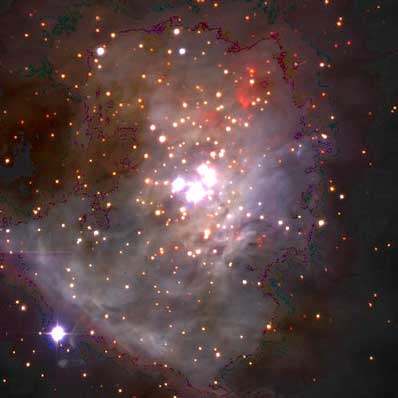
New evidence offered for planets without parent stars BY JEFF FOUST SPACEFLIGHT NOW Posted: April 4, 2001 A pair of British astronomers revealed new evidence Tuesday to support their controversial discovery of a group of "free-floating" planets in a distant nebula that do not orbit any star. Philip Lucas of the University of Hertfordshire and Patrick Roche of Oxford University said Tuesday that new studies of the Orion Nebula had confirmed the existence of a number of bodies too small to be stars. The results were released in Cambridge, England at the annual National Astronomy Meeting.
These findings were treated rather skeptically by astronomers, some of whom argued that the planets could be more distant stars that are not part of the nebula, but are aligned with it as viewed from the Earth. To test this possibility, Lucas and Roche took infrared spectra of the putative planets to measure their temperatures, from which they could derive their masses. Twenty of the objects that they studied had the characteristic absorption spectrum of water vapor, key evidence that the objects are too cool to be more distant stars. Using theoretical work on the atmospheres of giant bodies performed by scientists in France and the US they calculated that the planets have masses 5 to 13 times that of Jupiter. "It's exciting to find these planet-sized objects floating around in space," said Lucas. "Our new results provide the first steps in the exploration of their physical properties." The two astronomers acknowledge that the term "planet" may be inappropriate for these objects, even those they have masses similar to extrasolar planets recently discovered orbiting other stars. Roche noted in an interview last year, when the discovery was first announced, that these objects likely developed independently, rather than form around a star like an ordinary planet and later escape through gravitational interactions. Keeping this in mind this distinction, Lucas and Roche suggested Tuesday that a new designation be given to these objects: "planetars", playing on existing names for two other types of stars, pulsars and magnetars. A committee of the International Astronomical Union recently suggested an alternative term, "sub-brown dwarfs." Regardless of their name, these small objects -- runts of the litter of stellar formation -- may help astronomers better understand how stars are created. "The identification and study of these objects is extremely interesting in itself," said Roche, "but it can also aid our understanding of the star formation process, which is one of the major mysteries in astronomy."
|
|
|
|

|
|