|
|
||
|
|
|
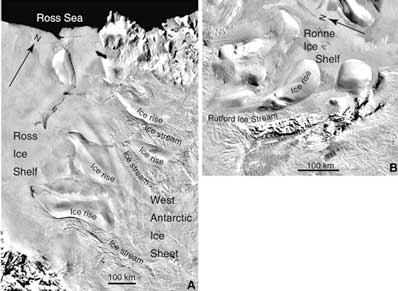
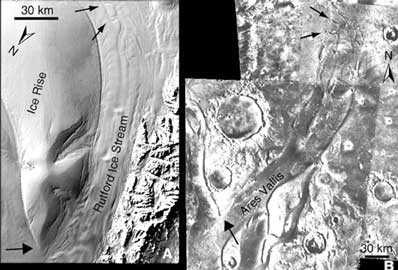
Ice may have formed Martian channels BY JEFF FOUST SPACEFLIGHT NOW Posted: January 18, 2001 Some channels on the surface of Mars believed to have been formed by running water may have instead been carved by streams of ice, one scientist concluded this week. Channels in one region of Mars share a number of key characteristics with those created by ice streams that flow beneath Antarctica's surface and empty into the surrounding oceans, according to work by Baerbel K. Lucchitta of the U.S. Geological Survey and published in the February 1 issue of the journal Geophysical Research Letters.
Lucchitta noticed that the Martian channels, hundreds of kilometers long and tens of kilometers wide, were structurally similar to the Antarctic channels, especially how both formed streamlined features as they moved around rock or ice obstructions in their path. The Martian channels are also below the hypothesized sea level of an ancient Martian ocean, and in some places show signs of uphill flow: impossible with flowing water but possible with more rigid ice streams. Combined, Lucchitta believes that the channels were created by moving ice as it flowed into an ocean, itself possibly covered by ice, that may have once sprawled over much of the northern regions of the planet. "The observations strongly support the notion that an ocean once existed in the northern plains of Mars," she noted. While her research focused on channels in Kasei Vallis and neighboring Ares Vallis, Lucchitta believes that many other channels on the planet may have similar origins. "There are features that look like they may have been formed by ice in all of the big outflow channels," she said. "The size of the streamlined forms in most channels is like that of features carved by ice." While such features could also be created by liquid water, they would require catastrophic floods, "10,000 times the size of the Mississippi," she said. Some of that ice may still exist on Mars today, she said, either in dust-covered deposits in Ares Vallis or beneath the smooth plains of the northern portions of the planet that may have been an ocean floor. Instruments like a ground-penetrating radar that will be flown on the European Space Agency's Mars Express mission in 2003 may be able to detect that ice.
Hoffman, while noting the quality of Lucchitta's work, is not swayed by its conclusions. "It's part of the general recognition that water on Mars is very difficult to achieve and that more frigid models are better," he said, "but it does not do a good job of explaining the flow features in Ares Vallis or any other valley on Mars." Lucchitta, though, believes that ice, or ice mixed with liquid water, is a better way to explain the channels than carbon dioxide. "To make dry ice work one would have to do a lot of special pleading," she said.
|
|
|
|

|
||