|
|
||
|
|
|
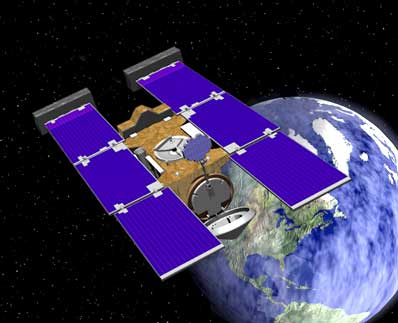
Stardust sling-shots past Earth on course to comet BY STEPHEN CLARK SPACEFLIGHT NOW Posted: January 16, 2001 Officials at the Jet Propulsion Laboratory in California say that Stardust is now on course to Comet Wild 2, where it will collect dust samples for return to Earth. That word comes after a close encounter with Earth early Monday, marking the completion of the craft's first solar orbit since its launch in 1999. The probe's closest approach to its home planet came at 1113 GMT (6:13 a.m. EST), as the spacecraft passed 3,721 miles (6,012 kilometers) above a point off the southern tip of Africa, and while travelling at around 22,400 miles per hour.
Some observers from places such as Australia, Hawaii, and California conducted successful observations of Stardust as it approached, then receded from the planet. Later on Monday, Stardust's recently repaired navigation camera was scheduled to be tested by taking twenty-five images of the Moon as the cometary voyager passed around 61,000 miles (98,000 kilometers) from it. The spacecraft was set for its closest approach to the Moon around 15 hours after passing by Earth. Apparently, the camera was contaminated when certain spacecraft systems began to out-gas shortly after launch aboard a Delta 2 rocket in February 1999. The navigation camera was only fixed last week, after a long-distance repair job that engineers devised from Earth. Engineers decided to try to heat up the camera using a variety of planned -- and unplanned -- methods. The fix chosen "boiled away" the contamination, clearing the camera's image. Preparations for Monday's high-speed fly-by began back on November 28, when the probe conducted the first of three maneuvers to tweak the trajectory of Stardust as it approached Earth. A minute attitude correction burn was executed on December 5, 2000, to ensure that the probe was properly pointed, which is essential for proper communications and solar array pointing. On January 5, the second of the trio of thruster firings to fine-tune the craft's flight path was successfully carried out. Immediately after the fly-by of Earth, the ground controllers commanded the spacecraft's communications system to switch from using the medium-gain antenna to using the backward-looking medium gain antennas. Still remaining in the Earth Gravity Assist phase of Stardust operations is another attitude correction maneuver and another trajectory correction firing of on-board thrusters, as well as the switching of communications back to the medium-gain antenna. The so-called EGA phase of the mission comes to an end on February 14.
|
|
|
|
Video vault The video camera mounted to a Boeing Delta 2 rocket launching Stardust shows the ground-lit solid rocket boosters being jettisoned with Cape Canaveral as backdrop.
PLAY (250k, 26sec QuickTime file)  The spent first stage is jettisoned and the second stage engine ignites aboard the Delta 2 rocket. The payload fairing is also seen falling back to Earth.
PLAY (518k, 57sec QuickTime file) 
|
|