|
|
||
|
|
|
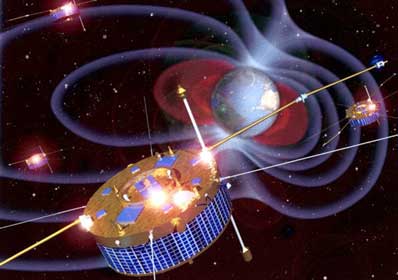
A shocking time for Cluster 2 EUROPEAN SPACE AGENCY SCIENCE RELEASE Posted: January 16, 2000 Studies of near-Earth space will never be the same again. For the first time in the history of space exploration, identical instruments on four spacecraft have begun to return simultaneous measurements of a region of space known as the bow shock.
Most people will have seen the white, foaming bow wave created as a large ship ploughs through the ocean. Less familiar is the bow shock in space that is created as the sea of plasma (electrically charged particles) from the Sun sweeps past spaceship Earth. The Earth's bow shock marks the place where electrons and protons in this solar wind first encounter the magnetic bubble that surrounds our planet - the magnetosphere. Travelling at speeds of more than 1 million km/h, these particles are suddenly slowed to subsonic speeds as they slam into the Earth's magnetic shield. The general features and location of this region have been determined by various spacecraft over the years. For example, scientists are well aware that the position of the bow shock fluctuates considerably as changes in the pressure of the solar wind cause the magnetic bubble to balloon in and out. What Cluster provides is the first opportunity to study the bow shock simultaneously from four different spacecraft. Since the mid-December 2000, the quartet have been flying in tetrahedral formation through the invisible boundary, travelling from the outer magnetosphere (the magnetosheath) into the solar wind and back again. Four data plots obtained on December 22 by the WHISPER instrument on each spacecraft display the dramatic changes that occurred during one of Cluster's first crossings of the bow shock.
At about 08.25 GMT (09.25 CET), WHISPER detected strong wave emissions (red/black area) when each spacecraft crossed the bow shock. However, the exact time of crossing varied over a period of a few minutes for each satellite. This was followed by a data "plateau", characterised by lower frequency emissions in the less dense plasma of the solar wind. Approximately 10 minutes later, at 08.35 GMT (09.35 CET), the quartet headed back across the bow shock (second red/black area) and returned into the magnetosheath. "The interesting thing is that the four spacecraft don't cross the bow shock at the same time," said WHISPER Principal Investigator Pierrette Décréau. "This will give us important information about the shape of the bow shock and allow us to study in detail what is happening there by looking upstream (toward the Sun) and downstream (toward Earth) at the same time." The early morning events of December 22 were repeated later on the same day as the Cluster quartet once more penetrated the bow shock and entered the Sun's domain. On this occasion, when they were almost 125,000 km from Earth, their spell of bathing in the solar wind lasted for 11 hours. "The first bow shock crossing in the morning seems to have taken place when the magnetosphere was compressed by the solar wind," explained Cluster project scientist Philippe Escoubet. "Fairly rapid shifts in the position of the bow shock allowed the spacecraft to re-enter the magnetosphere and then go back into the solar wind later that day." "Since then, there has been a series of bow shock crossings during each orbit, so we are continuing to gather a great deal of exciting new data on this region where the solar wind meets the magnetosphere," he added.
|
|
|
|

|
||