|
|
||
|
|
|
Cassini resumes Jupiter observations in time for flyby SPACEFLIGHT NOW Posted: December 29, 2000
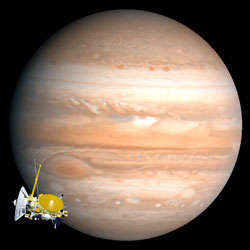
Cassini was forced to halt its observations of Jupiter last week because of troubles with one of three primary reaction wheels inside the satellite used for orientation. Wheel No. 2 experienced abnormal friction and needed more force than expected to turn. The problem caused Cassini to rely upon hydrazine-fueled thrusters to point itself during the ongoing observations of Jupiter. NASA officials, however, decided against using the limited supply of hydrazine for the Jupiter studies in favor of saving the propellant for Cassini's ultimate destination: Saturn. The space agency said Thursday that the spacecraft had been operating trouble-free since its reaction-wheel system was reactivated late last week following troubleshooting. "Everything has been working smoothly, so we're planning to send up commands (Thursday) to resume all scientific observations," said Bob Mitchell, Cassini program manager at NASA's Jet Propulsion Laboratory. Experiments that did not require Cassini to be accurately pointed, such as magnetic-field measurements, have continued. Cassini was put back on the reaction-wheel system for controlling its orientation on December 21, after testing indicated that the above-normal friction had ended. But the spacecraft has been kept in an attitude with its main antenna pointed to Earth, and observations that require pointing of scientific instruments have remained on hold while reaction-wheel operation is monitored. Processing and analysis has continued on thousands of images and measurements taken by Cassini between early October and mid-December. Cassini's first color movie clip of Jupiter was released this week. Cassini has three reaction wheels mounted mutually perpendicular to each other and a fourth as a spare. The reaction wheels control the direction Cassini is facing, but not the direction of its trajectory through space. When a motor accelerates a wheel, the spacecraft rotates slowly in the opposite direction. Moving the three wheels in various combinations can point the spacecraft in any desired direction. A probable cause of the friction that temporarily increased the amount of force needed to turn reaction wheel number two is prolonged operation at relatively low speeds, which may have reduced lubrication in the bearings, mission engineers say. Running the wheel at higher speeds in tests later may have restored the distribution of the lubricant. "That's our leading theory, but we may never know for sure," Mitchell said. As a precaution, Cassini's flight team plans to develop operational procedures for the reaction wheels that will avoid low-speed operations for any significant amount of time, he said. Cassini will pass Jupiter at a distance of 9.7 million kilometers (6 million miles) on Saturday, gaining a boost from its gravity that will allow the spacecraft to reach Saturn in July 2004.
|
|
|
|

|
||