
Jupiter's moon Io covered with volcanoes galore
NASA/JPL NEWS RELEASE
Posted: June 1, 2000
| |

An active volcanic eruption on Io seen February 22. Tvashtar Catena, a chain of giant volcanic calderas, was the location of an energetic eruption caught in action in November. A dark, "L" shaped lava flow to the left of center marks the location of the November eruption. White and orange areas on the left side of the picture show newly erupted hot lava, seen in this false color image because of infrared emission. The two small bright spots are sites where molten rock is exposed to the surface at the toes of lava flows. The larger orange and yellow ribbon is a cooling lava flow that is more than 37 miles long. Dark, diffuse deposits surrounding the active lava flows were not there during the November flyby. Photo: NASA/JPL
|
Abundant volcanoes, including some that turn on and off, and puzzling surface textures are some of the new findings from NASA's Galileo spacecraft during the closest flyby ever of Jupiter's moon Io.
Images and other data gathered by Galileo during a flyby of Io on February 22 were released Wednesday at the American Geophysical Union's spring meeting in Washington, D.C.
The high-resolution observations made by one of the instruments on Galileo, the near-infrared mapping spectrometer, revealed 14 volcanoes in a region that was previously known to have only four. The region covers about five percent of Io's surface and is about three times larger than Texas. Before the flybys, Io was known to have only about 81 active volcanoes.
"Since the distribution of active volcanoes on Io appears to be uniform, we can expect Io to have some 300 active volcanoes, most of which have not been discovered," said Dr. Rosaly Lopes-Gautier, research scientist at NASA's Jet Propulsion Laboratory, Pasadena, Calif.
Scientists have detected changes in the months between the three different flybys in October 1999, November 1999 and February 2000. Some of the smaller, fainter volcanoes appear to turn on and off, changing from hot and glowing to cool and dim within a few weeks. The larger or brighter volcanoes tend to remain active for years or even decades, based on previous observations by Galileo and the Voyager spacecraft that flew through the Jovian system in 1979.
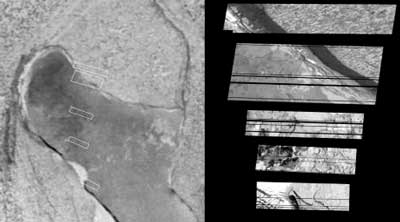
Detail of one of the calderas, or collapsed volcanic craters, on Io, is seen in these images acquired on February 22. The five partial images on the right comprise all of the data that could be returned from an eight-image mosaic. These are the highest resolution images of lava flows ever obtained from Io. The boxes in the image to the left are approximate locations of the five partial images. They are shown superimposed on a lower resolution image of the entire Chaac caldera.
The high-resolution snapshots highlight areas from both the southern and northern rims as well as areas on the floor of the caldera. They reveal fascinating similarities and differences between calderas on Io and Earth. Photo: NASA/JPL
|
Loki, the most powerful volcano in the solar system, was scanned by Galileo's photopolarimeter/radiometer during the October 1999 flyby and again this past February. These two close-up views showed Loki near the beginning and end of one of its periodic major eruptions.
"Most of the surface of its caldera, a region of more than 10,000 square kilometers (about 4,000 square miles) or half the size of Massachusetts, seems to have been covered by hot lava in the intervening four and a half months," said Dr. John Spencer of Lowell Observatory, Flagstaff, Ariz., a co-investigator for the radiometer instrument.

This mosaic shows three mountains and two lava-filled depressions in the Shamshu region of Io. The dark oval feature on the left side is a depression that has been resurfaced by lava flows. The rough terrain northeast of the depression is Shamshu Mons. A 6-mile wide canyon oriented in northeast to southwest direction cuts this mountain. The northwestern edge of the mountain has been scalloped by erosion, and it appears that the material has flowed along the canyon floor. Portions of two more mountains can be seen on the right. The depression between these mountains is Shamshu Patera, a volcanic hotspot. The dark patches within it are recent and active lava flows. The northernmost edge of Shamshu Patera appears to be cutting into the mountain to its northeast. Photo: NASA/JPL
| |
New images show that Chaac Patera has a caldera wall that is about 2.8 kilometers (1.7 miles) high with a 70-degree slope -- about twice as high and steep as the typical slopes of the Grand Canyon.
"The wall rocks must be very strong to support this topography," said Dr. Alfred S. McEwen of the University of Arizona, Tucson, a member of the Galileo imaging team. "Each volcanic center on Io is proving to have unique characteristics."
Observations also show a smaller caldera filled with bright white deposits containing sulfur dioxide that is purer than at any other place observed on Io. Scientists believe it may be a frozen layer of sulfur dioxide ice.
One of the most spectacular volcanic eruptions observed by Galileo was from Tvashtar Catena in November 1999. The February images show that the eruption seen in November has waned, but there is a new eruption with extremely hot lava nearby.
The February Io flyby has yielded more images with higher resolution than previous flybys. They show unprecedented views of small surface areas that give new clues about the volcanic terrain but also reveal landforms that are perplexing to geologists. There are views of one surface area that appears eroded, showing thin, alternating bright and dark layers. Scientists don't yet understand how the layers formed and were eroded or how other plains textures on Io have formed.
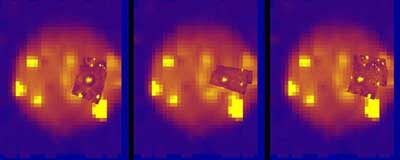
Changes in the volcanoes on Io can be seen in these three views from flybys in October 1999, November 1999 and February 2000. All the images show the active volcanoes as bright yellow, corresponding to hot lava flows that appear glowing in infrared wavelengths. The Prometheus volcano is seen near the middle of all three images. Before the recent flybys, only Prometheus and three other volcanoes were known to be active in this region. After these and other high-resolution observations, scientists were able to detect 14 volcanoes in the same area. The fainter volcanoes (hot spots) show some significant changes over intervals of 1 to 3 months. Photo: NASA/JPL
|
"There are processes on Io for which we have no terrestrial experience," said McEwen. "Strange new observations like these will provide fodder to current and future scientists for understanding the processes that have shaped this fascinating world."
Galileo has been studying Jupiter and its moons for four and a half years. It completed a two-year primary mission in December 1997 and a two-year extended mission in December 1999. Galileo is continuing its studies under yet another extension, the Galileo Millennium Mission.. JPL, a division of the California Institute of Technology in Pasadena, manages the Galileo mission for NASA's Office of Space Science, Washington, D.C.
|
|
|
|

|
