|
 |

|
||||
|
|
||||
|
Giant airbags will give rovers' landings a bounce BY WILLIAM HARWOOD SPACEFLIGHT NOW Posted: December 31, 2003 If all goes well, MER-A will slam into the atmosphere of Mars on Saturday night, at an angle of 11.5 degrees, an altitude of about 128 kilometers (80 miles) and a velocity of 5.4 kilometers per second (12,000 mph). Over the next four minutes, the spacecraft will slow to a velocity of about 430 meters per second (960 mph) and descend to an altitude of just 8.5 kilometers (5.3 miles) above Gusev Crater.
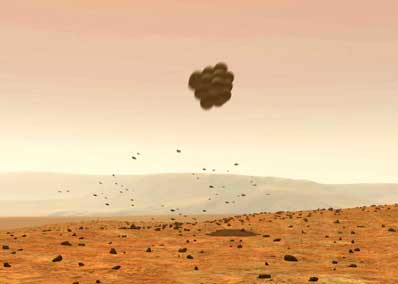
Eight seconds before touchdown, based on data from a radar altimeter, giant airbags will suddenly inflate, encapsulating the spacecraft in a protective cocoon. Two seconds after that, braking rockets will fire to briefly kill the craft's downward velocity and correct for crosswinds. The support bridle then will be cut and the lander will free fall the final 15 meters (50 feet) to the surface. Rebounding like some alien beach ball, the spacecraft will bounce as high as 20 meters (66 feet) on its first bounce, taking several minutes to come to rest somewhere in a landing "footprint" measuring 110 kilometers by 15 kilometers (68 miles by nine miles). The airbags then will deflate, the lander will right itself and protective panels will unfold like the petals of a flower.
Depending on the orientation of the lander immediately after touchdown, and whether or not one of two antennas can "see" Earth, "we may or may not get a signal after we've come to a roll stop." In that case, he said, anxious engineers will have to wait for the first over flight of the Mars Odyssey two hours after landing. "Clearly the one thing you worry about is the actual terrain you hit when we land. Because that's the one thing we can't control," Theisinger said. "If you look at the big Pathfinder panorama, there are places in that photograph where if Pathfinder had landed there, they die. So there are places where we're going where if we land on that rock or that hill or whatever, we're dead."
"The science mission really can't start until that event happens," Theisinger said. "And that's the one thing we haven't done before. We have practiced it. ... But that's what you worry about." MER-B "Opportunity" will reach Mars on Jan. 25 and follow a virtually identical descent to Meridiani Planum. Both rovers are expected to remain operational for at least 90 days and to crawl up to a kilometer or so when all is said and done. A high-resolution panoramic camera mounted atop each rover will be capable of taking pictures three times sharper than those from the Mars Pathfinder. An associated infrared camera will be used to identify minerals near the rover that may have been formed by interactions with water. Pictures from both cameras will be used to identify targets worthy of up-close investigation.
Sophisticated computer equipment will enable the rovers to autonomously move from point A to point B without intervention from ground controllers. They will steer around rocks or other obstacles standing more than 25 centimeters (10 inches) high and simply drive over smaller obstructions. "Mars can always surprise you," Hubbard said. "The landing system has been designed to be tolerant of a whole lot of problems, so I think they've done everything they can to get to the surface of Mars safely. After that, it will depend on whether Mars has some surprises no one has accounted for."
|
|
|
|

|
||||
|
MISSION STATUS CENTER |
||||||||