|
 |

|
||||
|
|
||||
|
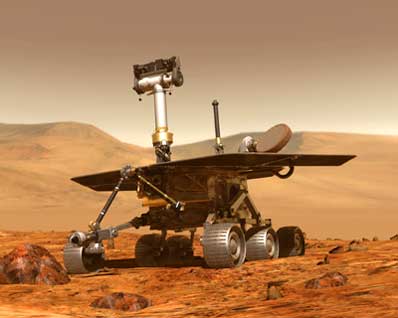
Rover wheels to dig holes for Martian soil study CORNELL UNIVERSITY NEWS RELEASE Posted: December 19, 2003 After the twin Mars Exploration Rovers bounce onto the red planet and begin touring the Martian terrain in January, onboard spectrometers and cameras will gather data and images --- and the rovers' wheels will dig holes.
The researchers perfected a digging method to lock all but one of a rover's wheels on the Martian surface. The remaining wheel will spin, digging the surface soil down about 5 inches, creating a crater-shaped hole that will enable the remote study of the soil's stratigraphy and an analysis of whether water once existed. For controllers at JPL, the process will involve complicated maneuvers -- a "rover ballet," according to Sullivan -- before and after each hole is dug to coordinate and optimize science investigations of each hole and its tailings pile. JPL, a division of the California Institute of Technology, manages the Mars Exploration Rover project for NASA's Office of Space Science, Washington, D.C. Cornell, in Ithaca, N.Y., is managing the science suite of instruments carried by the two rovers. Each rover has a set of six wheels carved from aluminum blocks, and inside each wheel hub is a motor. To spin a wheel independently, JPL operators will simply switch off the other five wheel motors. Sullivan, Stewart and Cornell undergraduates Lindsey Brock and Craig Weinstein used Cornell's Takeo Mogami Geotechnical Laboratory to examine various soil strengths and characteristics. They also used Cornell's George Winter Civil Infrastructure Laboratory to test the interaction of a rover wheel with the soil. Each rover wheel has spokes arranged in a spiral pattern, with strong foam rubber between the spokes; these features will help the rover wheels function as shock absorbers while rolling over rough terrain on Mars. In November, Sullivan used JPL's Martian terrain proving ground to collect data on how a rover wheel interacts with different soil types and loose sand. He used yellow, pink and green sand -- dyed with food coloring and baked by Brock. Sullivan used a stack of large picture frames to layer the different colored sands to observe how a wheel churned out sloping tailings piles and where the yellow, pink and green sand finally landed. "Locations where the deepest colors were concentrated on the surface suggest where analysis might be concentrated when the maneuver is repeated for real on Mars," he says. Stewart notes similarities between these tests and those for the lunar-landing missions in the late-1960s, when engineers needed to know the physical characteristics of the moon's surface. Back then, geologists relied on visual observations from scouting missions to determine if the lunar lander would sink or kick up dust, or whether the lunar surface was dense or powdery. "Like the early lunar missions, we'll be doing the same thing, only
this time examining the characteristics of the Martian soil," Stewart
says. "We'll be exposing fresh material to learn the mineralogy and
composition."
|
|
|
|

|
|