Mars Express a success, but no one hears Beagle's bark
BY STEPHEN CLARK
SPACEFLIGHT NOW

Posted: December 25, 2003

In what was obviously a bittersweet Christmas Day for planetary scientists around the world, a tiny lander disappeared without a trace while its counterpart successfully glided into orbit around the Red Planet, becoming the first European spacecraft to take up residence at another world.

Beagle
The Mars Express orbiter has successfully arrived at the planet. But fate of the Beagle 2 lander is still unknown. Credit: Astrium
 
As the British-led Beagle 2 lander was presumably touching down and rolling to a bouncy stop at 0254 GMT Christmas morning (9:54 p.m. EST Dec. 24), the Mars Express spacecraft was in the early stages of a half-hour firing by its main engine to be captured into orbit by the planet's gravity field.

The $350 million duo were launched June 2 from Kazakhstan aboard a Russian-provided Soyuz booster. Together they journeyed 400 million kilometers before the bolts and umbilicals were cut December 19 leaving each to their own fate.

After landing in the Isidis Planitia basin near the Martian equator, Beagle was supposed to deflate its cushioning airbags and unfold its clamshell-like covering to expose its innards, which included the scientific instruments and other essential pieces of hardware responsible for power, control, and communications.

The first opportunity to hear from the barrel-sized landing craft was via NASA's Mars Odyssey probe orbiting high overhead at about 0530 GMT (12:30 a.m. EST). That chance came and went with no signal being received.

Another communications window late on Thursday also turned up no sign of the highly-ambitious lander, this time using the 76-meter Jodrell Bank radio observatory in England on a UHF frequency.

Beagle
An artist's impression of Beagle 2 moments after landing on Isidis Planitia. Credit: ESA/Medialab
 
Managers in charge of the Beagle team say there are a number of other avenues to take, including continued attempts to contact the spacecraft using both Earth-based radio telescopes in England and the United States, as well as the U.S. Mars Odyssey orbiter through at least the end of the year. Mars Express itself will be able to make attempts to contact Beagle starting in early January.

Flight director Mike McKay said Thursday morning there was no doubt that Beagle 2 entered the Martian atmosphere. "The Beagle 2 certainly has landed. It was targeted with great accuracy last Friday by the Mars Express spacecraft that put it on a very, very precise course into the upper atmosphere...the Beagle 2 certainly has gone into the atmosphere."

Officials want to stay optimistic in spite of the curves that have been thrown their way over the past 24 hours. They say there is still a chance the lander could be intact and alive following its plummet to the Martian surface.

Beagle was planned to use a small robot arm that contained a suite of gadgets that includes a camera, rock grinder, a microscope, a wind sensor and a pair of spectrometers.

The primary goal for the minuscule probe was to have been a colossal one -- to search for evidence of life on the Red Planet. Plans had called for the science payload to look for organic elements and compounds throughout its 180-day mission. Learn more about the $40 million mission here.


An illustration of the Mars Express mission -- the orbiter and Beagle 2 lander. Credit: Astrium
 
Meanwhile, Mars Express successfully conducted its Mars Orbit Insertion engine firing at about 0300 GMT (10:00 p.m. EST) to slip into orbit around the planet.

Controllers at the European Space Operations Center in Darmstadt, Germany, first received preliminary data from Mars Express a little over an hour after the burn ended through the craft's S-band communications system.

Engineers were able to confirm the probe's health a few hours later when contact was made using the craft's X-band antenna system. Officials say Mars Express entered its predicted highly elliptical polar orbit that stretches as far as about 180,000 kilometers from the planet, Mars Express project manager Rudi Schmidt said.

On December 30, another burn of the Mars Express main engine will place the satellite in a less-elongated orbit about 10,000 kilometers by 300 kilometers with an inclination of around 86 degrees.

This egg-shaped polar orbit puts the orbiter in prime position to conduct its experiments using its widely-varied suite of instruments, which are geared toward studies focusing on the presence of water on the Red Planet.

Activation of the science payload should begin soon, with the commissioning phase of operations kicking off in January and the first useful data being returned by the first of February.


Mars Express nearing its destination. Credit: ESA
 
A powerful sounding radar utilizing a long boom will send radar pulses from orbit toward the surface to look for signs of water or ice below ground. Some signals will penetrate the crust to a depth of several kilometers. Pulses that are bounced back to receivers aboard Mars Express will help scientists decipher where water, ice, or permafrost could exist in concentrations deep below ground.

Another instrument will ascertain Mars' surface composition using reflected visible and infrared light. Officials hope this will feed scientists' hunger for data on iron and water content of the surface rocks and soils.

The mission of searching for evidence of water on Mars is largely based on its liquid form. Water in the form of ice has long been known to be present in the Red Planet's polar ice caps, where some scientists believe the remnants of a once-thriving hydrosphere retreated when the air pressure decreased to a point that made liquid water impossible to exist on the surface.

But many believe it is possible today for liquid water to be present underground, where pressures could be high enough to support it.

Other scientific payloads carried by the spacecraft will study the composition of the Martian atmosphere and the interaction of the solar wind with the planet.

"With Mars Express, we have a very powerful observatory in orbit around Mars and we look forward to receiving its first results," said David Southwood, director of ESA's science program. "Its instruments will be able to probe the planet from its upper atmosphere down to a few kilometers below the surface, where we hope to find critical clues concerning the conditions for life, in particular traces of water."

Many of these objectives were originally part of the failed Russian Mars '96 mission that crashed back to Earth shortly after its launch in 1996.


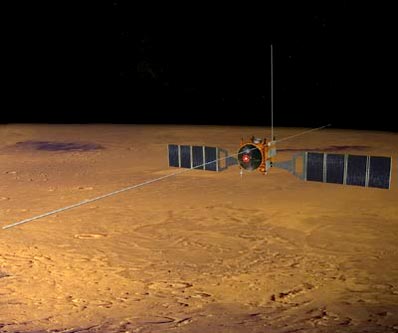
Mars Express in orbit around the Red Planet. Credit: NASA
 
The Mars Express mission not only marks a significant scientific milestone, but it also solidifies a number of technologies the probe shares with other upcoming European missions. Most notably is the closeness between it and the Rosetta comet-chaser due to launch in February. About 80 percent of the hardware on the spacecraft is common to both missions.

In addition, ESA officials this year gave final approval to the Venus Express mission, which uses the same bus design as Mars Express. It is scheduled for launch aboard a Soyuz rocket in November 2005.

Europe's space science program is ramping up to an ambitious pace of missions in the future, with six projects awaiting launch through 2007. Ten more are being studied for future implementation.

Mars Express is the continent's first mission to visit the Red Planet, and also the first to orbit another body in the solar system.

"It is a very important day for all of the European citizens out there who have contributed to this, through their taxation, and who should be sharing with us the joy we feel at being, finally, at Mars," Southwood said early Thursday.

Soviet Space
For the first time ever available in the West. Rocket & Space Corporation Energia: a complete pictorial history of the Soviet/Russian Space Program from 1946 to the present day all in full color. Available from our store.
 Choose your store:
U.S. - U.K. - E.U. - Worldwide

Viking patch
This embroidered mission patch celebrates NASA's Viking Project which reached the Red Planet in 1976.
 Choose your store:
U.S. - U.K. - E.U. - Worldwide

Apollo 7 DVD
For 11 days the crew of Apollo 7 fought colds while they put the Apollo spacecraft through a workout, establishing confidence in the machine what would lead directly to the bold decision to send Apollo 8 to the moon just 2 months later.
 Choose your store:
U.S. - U.K. - E.U. - Worldwide

Gemini 12
Gemini 12: The NASA Mission Reports covers the voyage of James Lovell and Buzz Aldrin that capped the Gemini program's efforts to prove the technologies and techniques that would be needed for the Apollo Moon landings. Includes CD-ROM.
 Choose your store:
U.S. - U.K. - E.U. - Worldwide

Get e-mail updates
Sign up for our NewsAlert service and have the latest news in astronomy and space e-mailed direct to your desktop (privacy note: your e-mail address will not be used for any other purpose).
Enter your e-mail address:

Expedition 20
The official embroidered patch for the International Space Station Expedition 20 crew is now available from our stores.
 U.S. STORE
 WORLDWIDE STORE

Current Shuttle Mission Patch
The official embroidered patch for shuttle Atlantis' flight to deliver critical spare equipment to the space station.
 U.S. STORE
 WORLDWIDE STORE


Ares Patch
The Ares Project will develop two new rockets to launch astronauts back to the Moon under NASA's Vision for Exploration. The Ares 1 will employ a single space shuttle solid rocket booster to loft the Orion crew capsule. The gigantic Ares 5 will haul the equipment and cargo needed for such lunar voyages. This is the Ares emblem.
 U.S. STORE


One Giant Leap
Hosted by Corbin Bernsen, this award winning documentary marks the 50th anniversary of the U.S. space agency and features exclusive interviews with veteran astronauts.
 U.S. STORE
 WORLDWIDE STORE

Expedition 21
The official embroidered patch for the International Space Station Expedition 21 crew is now available from our stores.
 U.S. STORE
 WORLDWIDE STORE

Columbia Report
A reproduction of the official accident investigation report into the loss of the space shuttle Columbia and its crew of seven.
 Choose your store:
U.S. - U.K. - E.U. - Worldwide

Mars Panorama

DISCOUNTED! This 360 degree image was taken by the Mars Pathfinder, which landed on the Red Planet in July 1997. The Sojourner Rover is visible in the image.
 Choose your store:
U.S.

Apollo 11 Mission Report
Apollo 11 - The NASA Mission Reports Vol. 3 is the first comprehensive study of man's first mission to another world is revealed in all of its startling complexity. Includes DVD!
 Choose your store:
U.S. - U.K. - E.U. - Worldwide

Rocket DVD
If you've ever watched a launch from Kennedy Space Center, Cape Canaveral, Vandenberg Air Force Base or even Kodiak Island Alaska, there's no better way to describe what you witnessed than with this DVD.
 Choose your store:
U.S. - U.K. - E.U. - Worldwide

Soviet Space
For the first time ever available in the West. Rocket & Space Corporation Energia: a complete pictorial history of the Soviet/Russian Space Program from 1946 to the present day all in full color. Available from our store.
 Choose your store:
U.S. - U.K. - E.U. - Worldwide

Viking patch
This embroidered mission patch celebrates NASA's Viking Project which reached the Red Planet in 1976.
 Choose your store:
U.S. - U.K. - E.U. - Worldwide

Apollo 7 DVD
For 11 days the crew of Apollo 7 fought colds while they put the Apollo spacecraft through a workout, establishing confidence in the machine what would lead directly to the bold decision to send Apollo 8 to the moon just 2 months later.
 Choose your store:
U.S. - U.K. - E.U. - Worldwide

Gemini 12
Gemini 12: The NASA Mission Reports covers the voyage of James Lovell and Buzz Aldrin that capped the Gemini program's efforts to prove the technologies and techniques that would be needed for the Apollo Moon landings. Includes CD-ROM.
 Choose your store:
U.S. - U.K. - E.U. - Worldwide

Columbia Report
The official accident investigation report into the loss of the space shuttle Columbia and its crew of seven. Includes CD-ROM.
 Choose your store:
U.S.

INDEX | PLUS | NEWS ARCHIVE | LAUNCH SCHEDULE
ASTRONOMY NOW | STORE

ADVERTISE

© 2009 Spaceflight Now Inc.