|
|
||
|
|
||
|
Astro-E to usher in golden era of X-ray astronomy NASA NEWS RELEASE and SPACEFLIGHT NOW Posted: Feb. 10, 2000
The launch was delayed on Feb. 8 due to high winds and again on Feb. 9 by a tracking station problem. "This new mission allows us to apply a piece of whiz-bang new technology to the exploration of the Universe," said Dr. Alan N. Bunner, Science Director of NASA's Structure and Evolution of the Universe program. The new instrument is the X-ray Spectrometer (XRS), developed jointly by NASA's Goddard Space Flight Center, Greenbelt, MD, and Japan's Institute of Space and Astronautical Science (ISAS). The XRS measures the heat created by individual X-ray photons, as opposed to converting X-rays to electrical charges and then collecting that charge, which is the mechanism in other X-ray detectors. Using this new technique, it is possible to measure the energies of individual X-rays with a precision approximately 10 times greater than with previous X-ray sensors. To sense the heat of a single photon, however, the XRS detector must be cooled to an extremely low temperature, only 0.060 degrees Kelvin, or about -460 degrees Fahrenheit. This essentially makes the XRS detector the coldest object in space. The absence of all heat, called absolute zero, is 0.0 degree Kelvin; the coldest reaches of space are a balmy three degrees Kelvin. "This increased precision for measuring X-rays should allow fundamental breakthroughs in our understanding of essentially all types of X-ray emitting sources, especially material very close to black holes and the X-ray emitting gas in the vast spaces between the individual galaxies that make up clusters of galaxies," said Dr. Richard Kelley, XRS Principal Investigator at Goddard.
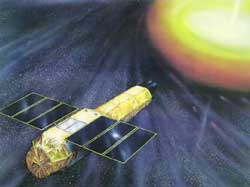
Astro-E's targets include: clusters of galaxies; supermassive black holes; neutron stars; supernova remnants; stellar coronae of stars 10,000-times more active than our Sun; and a study of the history of how chemicals are made throughout the Universe. Astro-E is primarily a spectroscopy mission, which means the satellite's instruments will study the "colors" of X-ray light, much like a prism breaks visible light into the colors of the rainbow. While the recently launched Chandra X-ray Observatory excels in producing X-ray images, Astro-E excels in producing spectra. In this regard, Astro-E complements Chandra, analyzing the light that Chandra sees and determining the temperature, velocity and composition of the gas producing those X-rays. Along with the XRS are four X-ray Imaging Spectrometer (XIS) instruments, a collaboration among Japanese universities and institutions and the Massachusetts Institute of Technology Center for Space Research, and the Hard X-Ray Detector (HXD), built by the University of Tokyo and ISAS. Both the XRS and XIS instruments will analyze X-ray photons focused by individual X-ray telescopes, built at Goddard by a team led by Dr. Peter J. Serlemitsos. The imaging instrument utilizes detectors similar to those flown on ASCA, Astro-E's precursor, yet with twice the collection efficiency at certain X-ray wavelengths. The Hard X-Ray Detector will extend Astro-E's observation ability into the "hard" or higher-energy X-ray wavelengths with the highest sensitivity ever achieved.
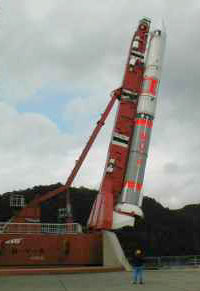
Astro-E will be launched on an M-5 rocket from the Kagoshima Space Center, located on the southern tip of the Japanese island of Kyushu. The observatory's expected mission lifetime is five years (two years for the X-Ray Spectrometer, with the depletion of cryogenic gases). Astro-E will attain a near-Earth circular orbit of approximately 341 miles (550 kilometers). Its payload weighs 3,630 pounds (1,650 kilograms), and measures 20.8 x 17.28 x 6.72 feet (6.5 x 5.4 x 2.1 meters). With its official name to be bestowed after deployment, Astro-E will join the recently launched European X-ray Multi-Mirror Mission and NASA's Chandra X-ray Observatory, ushering in what many experts are calling the decade of X-ray astronomy. Astro-E is the fifth in a series of Japanese satellites devoted to studying celestial X-ray sources. Previous missions are Hakucho, Tenma, Ginga, and ASCA. ASCA, launched Feb. 20, 1993 and formerly known as ASTRO-D, is still active.
|
|
|
|
Flight data file Vehicle: M-5 Payload: Astro-E Launch date: Feb. 10, 2000 Launch time: 0130 GMT (8:30 p.m. EST on 9th) Launch site: Kagoshima Space Center, Japan  Video vault  NASA animation of Astro-E shows the spacecraft orbiting the Earth to observe X-ray sources. NASA animation of Astro-E shows the spacecraft orbiting the Earth to observe X-ray sources.PLAY (199k, 20sec QuickTime file)  Dr. Steven Holt talks about advances in X-ray astronomy with Chandra, the X-ray Multi-Mirror satellite and Astro-E. Dr. Steven Holt talks about advances in X-ray astronomy with Chandra, the X-ray Multi-Mirror satellite and Astro-E.PLAY (219k, 24sec QuickTime file) Explore the Net ISAS - Mission Web site at Japan's Institute of Space and Astronautical Science. Astro-E Learning Center - Background material on the observatory and its mission. LHEA - NASA's Laboratory for High Energy Astrophysics where XRS instrument was built. XIS - MIT home page for the X-ray Imaging Spectrometer instrument. HXD - Tokyo University home page for the Hard X-ray Detector instrument. NewsAlert Sign up for Astronomy Now's NewsAlert service and have the latest news in astronomy and space e-mailed directly to your desktop (free of charge).
|
||||||