Spaceflight Now Home


The Mission


Rocket: Delta 2 (7920)
Payload: Aura
Date: July 15, 2004
Window: 1002 to 1005 GMT (6:02-6:05 a.m. EDT)
Site: SLC-2W, Vandenberg Air Force Base, California
Satellite feed: AMC 9, Transponder 9, C-band

Launch events timeline

Ground track map


The Payload


NASA's environmental spacecraft Aura will study Earth's atmosphere.

Aura objectives

Learn about the instruments


The Launcher


Boeing's workhorse Delta 2 rocket has flown more than 100 times, launching military, scientific and commercial satellites.

Delta 2 fact sheet

Learn about launch site

Archived Delta coverage


NewsAlert


Sign up for our NewsAlert service and have the latest news in astronomy and space e-mailed direct to your desktop.

Enter your e-mail address:

Privacy note: your e-mail address will not be used for any other purpose.


BY JUSTIN RAY

Follow the countdown and launch of the Boeing Delta 2 rocket with NASA's Earth Observing System satellite Aura. Reload this page for the very latest on the mission.

Spaceflight Now Plus
Additional coverage for subscribers:
VIDEO: THE DELTA ROCKET LAUNCHES AURA QT
VIDEO: AURA IS DEPLOYED FROM THE DELTA ROCKET QT
VIDEO: POST-FLIGHT INTERVIEW WITH NASA LAUNCH DIRECTOR QT

VIDEO: WEDNESDAY'S LAUNCH ATTEMPT IS SCRUBBED QT
VIDEO: LAUNCH DIRECTOR EXPLAINS WEDNESDAY'S PROBLEMS QT
VIDEO: TUESDAY'S LAUNCH ATTEMPT IS SCRUBBED QT
VIDEO: AURA'S LAUNCH CAMPAIGN SHOWN WITH NARRATION QT
VIDEO: DELTA 2 ROCKET IS ASSEMBLED ON THE LAUNCH PAD QT
VIDEO: MOBILE SERVICE TOWER IS ROLLED BACK MONDAY EVENING QT
VIDEO: ANIMATION SHOWS DELTA LAUNCHING AURA INTO ORBIT QT
VIDEO: AURA SCIENTIST EXPLAINS WHAT MISSION AIMS TO DO QT
VIDEO: WATCH FRIDAY'S PRE-LAUNCH NEWS CONFERENCE QT
VIDEO: ANIMATION OF AURA STUDYING THE ATMOSPHERE QT
VIDEO: FLASHBACK TO THE AQUA LAUNCH IN 2002 QT
SUBSCRIBE NOW

THURSDAY, JULY 15, 2004

A school bus-sized space observatory that will monitor the health of Earth's atmosphere in unprecedented detail rocketed into polar orbit today, finally darting away from its California launch pad atop a Boeing Delta 2 booster after several frustrating delays. Read our full story.

1120 GMT (7:20 a.m. EDT)

"I guess the third time was the charm for Aura," NASA launch director Chuck Dovale says.

"We worked through a couple of hard days and unfortunately couldn't get off the ground the last few days. But the team stuck together and worked a lot of issues, actually, in the last week. This one provided tough to get off.

"We actually worked a little bit toward the end of the count. It was a quiet count up until the last 30 or 45 minutes. Then we started working three or four problems all in parallel. But the team did an excellent job and pulled together. We were able to close those issues out, launched right on time and things have progressed well."

Dovale said early indications show everything went well during launch, delivering Aura into the correct orbit.

"So we wish the Aura team well."

1114 GMT (7:14 a.m. EDT)

Ground controllers have established contact with the Aura spacecraft. The satellite's health following the ascent into orbit will be analyzed this morning.

1106 GMT (7:06 a.m. EDT)

T+plus 64 minutes, 3 seconds. SPACECRAFT SEPARATION! NASA's Earth Observing System satellite Aura has been released from the second stage, completing this morning's launch and the 114th flight of a Boeing Delta 2 rocket.

This is the 59th straight success for the Delta 2 and the 112th overall since the rocket began flying in 1989.

The next Delta launch is scheduled for August 2 from Cape Canaveral, Florida.

1105 GMT (7:05 a.m. EDT)

T+plus 63 minutes. The deployment of Aura from the Delta rocket is a two-step process. It begins with firing the clamp band. A 30-second period passes to allow the shock to subside from the band release. Then, the secondary latches holding the satellite to the second stage are opened and stage backs away from Aura.

1102 GMT (7:02 a.m. EDT)

T+plus 60 minutes. The second stage is now maneuvering to the spacecraft separation orientation.

1100 GMT (7:00 a.m. EDT)

T+plus 58 minutes, 45 seconds. The second stage engine has ignited for a 16-second firing to propel the Aura spacecraft into a near-circular polar orbit.

1058 GMT (6:58 a.m. EDT)

T+plus 56 minutes. Standing by for ignition of the second stage in about two minutes.

1050 GMT (6:50 a.m. EDT)

T+plus 48 minutes. As the rocket coasts in this parking orbit, the second stage performs a "BBQ roll" maneuver to keep the thermal conditions on the vehicle equal. This maneuver was scheduled to start at T+plus 18 minutes, 20 seconds and conclude at T+plus 52 minutes, 50 seconds. Since the Delta 2 rocket is not within range of any data relay station, this could not be confirmed in real-time.

At T+plus 53 minutes, the rocket is programmed to begin orienting itself into the proper position for engine ignition. This maneuver will take about three minutes to complete.

1044 GMT (6:44 a.m. EDT)

T+plus 42 minutes, 30 seconds. The Malindi station is expected to acquire the rocket's signal about 10 minutes from now. The Delta rocket is currently coasting in the temporary parking orbit awaiting restart of its second stage engine to raise the orbit for deployment of Aura this morning.

1040 GMT (6:40 a.m. EDT)

T+plus 38 minutes. The next firing by the Delta rocket's second stage is coming up in 20 minutes. Just prior to ignition, the Malindi, Kenya ground station should begin tracking the vehicle. Malindi will provide live confirmation of the second stage burn and release of the Aura satellite.

1032 GMT (6:32 a.m. EDT)

T+plus 30 minutes. The track in which the rocket is following in today's launch can be seen here. The maps show over what part of Earth that launch events occur and the coverage zones for the tracking stations and P-3 aircraft.

1022 GMT (6:22 a.m. EDT)

T+plus 20 minutes. The rocket is coasting until the second stage restarts at T+plus 58 minutes for a brief firing to raise and circularize the orbit. Deployment of Aura from the launch vehicle is expected 64 minutes after liftoff.

1017 GMT (6:17 a.m. EDT)

T+plus 15 minutes. The official Range liftoff time was 1001:59.344 GMT.

1016 GMT (6:16 a.m. EDT)

T+plus 14 minutes. The rocket has passed out of range from the P-3 aircraft. This creates a data blackout until the vehicle soars above a tracking station in Kenya about 40 minutes from now.

1014 GMT (6:14 a.m. EDT)

T+plus 12 minutes, 45 seconds. The rocket has successfully achieved a good parking orbit with an apogee of 373.26 miles, perigee of 100.0 miles and inclination of 98.20 degrees.

1013 GMT (6:13 a.m. EDT)

T+plus 11 minutes, 15 seconds. SECO 1. The second stage engine has shut down to complete the first of two firings to deliver Aura into the proper polar orbit today.

1012 GMT (6:12 a.m. EDT)

T+plus 10 minutes, 25 seconds. The Delta 2 rocket is 101 miles in altitude, 1,322 miles downrange from the launch pad, traveling at 16,000 mph.

1011 GMT (6:11 a.m. EDT)

T+plus 9 minutes, 30 seconds. Less than two minutes remain in this initial firing by the second stage to reach a temporary parking orbit around Earth. No problems have been reported in the launch.

1010 GMT (6:10 a.m. EDT)

T+plus 8 minutes, 30 seconds. The second stage engine is still firing properly.

1010 GMT (6:10 a.m. EDT)

T+plus 8 minutes. The Navy P-3 aircraft stationed over the Pacific Ocean has acquired the rocket's signal to receive live telemetry. The data relay plane will transmit the information back to Vandenberg.

1009 GMT (6:09 a.m. EDT)

T+plus 7 minutes, 30 seconds. The Delta 2 rocket is 100 miles in altitude, 755 miles downrange from the launch pad, traveling at 13,400 mph.

1008 GMT (6:08 a.m. EDT)

T+plus 6 minutes, 20 seconds. Second stage engine performance reported normal.

1006 GMT (6:06 a.m. EDT)

T+plus 4 minutes, 47 seconds. The rocket's nose cone enclosing the Aura satellite has been jettisoned. It is no longer needed to protect the spacecraft.

1006 GMT (6:06 a.m. EDT)

T+plus 4 minutes, 36 seconds. The Delta's second stage engine has ignited!

1006 GMT (6:06 a.m. EDT)

T+plus 4 minutes, 32 seconds. MECO. The first stage main engine cutoff confirmed, and the spent stage has been jettisoned.

1005 GMT (6:05 a.m. EDT)

T+plus 3 minutes, 50 seconds. The Delta 2 rocket is 49 miles in altitude, 134 miles downrange from the launch pad, traveling at 8,400 mph.

1005 GMT (6:05 a.m. EDT)

T+plus 3 minutes. The Delta 2 rocket is 37 miles in altitude, 55 miles downrange from the launch pad, traveling at 5,200 mph.

1004 GMT (6:04 a.m. EDT)

T+plus 2 minutes, 18 seconds. The three air-start solid rocket boosters have burned out and separated. The rocket continues its trek to orbit on the power of the first stage liquid-fueled main engine.

1004 GMT (6:04 a.m. EDT)

T+plus 2 minutes. The Delta 2 rocket is 20 miles in altitude and traveling at 3,100 mph.

1003 GMT (6:03 a.m. EDT)

T+plus 1 minute, 30 seconds. The ground-lit boosters have jettisoned from the first stage. They remained attached until the rocket cleared off-shore oil rigs.

1003 GMT (6:03 a.m. EDT)

T+plus 1 minute, 10 seconds. All six ground-start solid rocket boosters have burned out. The three remaining motors strapped to first stage have ignited to continue assisting the rocket's RS-27A main engine on the climb to space.

1002 GMT (6:02 a.m. EDT)

T+plus 56 seconds. The rocket has climbed through the area of maximum aerodynamic pressure. Speed is over 1,000 mph.

1002 GMT (6:02 a.m. EDT)

T+plus 15 seconds. The rocket has roared off the Space Launch Complex-2 West pad at Vandenberg Air Force Base.

1002 GMT (6:02 a.m. EDT)

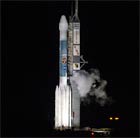
LIFTOFF! Liftoff of the Boeing Delta 2 rocket and NASA's Aura atmospheric research satellite on a mission to examine the air we breathe.

1001 GMT (6:01 a.m. EDT)

T-minus 30 seconds.

The launch ignition sequence will begin at T-minus 2 seconds when a Boeing engineer triggers the engine start switch. The process begins with ignition of the two vernier engines and first stage main engine start. The six ground-lit solid rocket motors then light at T-0 for liftoff.

1001 GMT (6:01 a.m. EDT)

T-minus 1 minute. The Range has given its final clear-to-launch.

The Delta 2 rocket's second stage hydraulic pump has gone to internal power after its pressures were verified acceptable.

1000 GMT (6:00 a.m. EDT)

T-minus 80 seconds. LOX topping to 100 percent is underway.

1000 GMT (6:00 a.m. EDT)

T-minus 2 minutes. The first stage liquid oxygen vents are now being closed so the LOX tank can be pressurized for launch. Puffs of vapor from a relief valve on the rocket will be seen in the remainder of the countdown as the tank pressure stabilizes.

0959 GMT (5:59 a.m. EDT)

T-minus 2 minutes, 30 seconds. The Aura satellite has been declared "go" for launch.

0959 GMT (5:59 a.m. EDT)

T-minus 3 minutes. The countdown remains on track for liftoff at the opening of today's launch window.

0958 GMT (5:58 a.m. EDT)

T-minus 3 minutes, 45 seconds and counting. The Delta 2 rocket's systems are now transferring to internal power for launch. And the launch pad water system is being enabled.

0958 GMT (5:58 a.m. EDT)

T-minus 4 minutes and counting! Clocks are ticking down the final moments for liftoff of Delta 306 and the Aura atmospheric research satellite. Launch is set for 1001:59 from Vandenberg Air Force Base, California.

0957 GMT (5:57 a.m. EDT)

The "go" has been given to restart the countdown clock in one minute.

0956 GMT (5:56 a.m. EDT)

Now two minutes from resuming the countdown.

0955 GMT (5:55 a.m. EDT)

The Aura spacecraft has transitioned to internal battery power for launch.

0953 GMT (5:53 a.m. EDT)

No problems were reported in the launch team poll. The team members are now receiving final instructions on countdown procedures.

0953 GMT (5:53 a.m. EDT)

The launch team readiness poll is beginning with five minutes remaining in this built-in hold.

0951 GMT (5:51 a.m. EDT)

NASA launch director Chuck Dovale says all issues have been resolved. The Delta rocket, Aura spacecraft and Range are "go" for launch.

"The NASA team is ready for Terminal Countdown," Dovale said.

0947:59 GMT (5:47:59 a.m. EDT)

T-minus 4 minutes and holding. The countdown has entered the final planned hold point for today's launch. During this planned 10-minute hold, final polls will be conducted to ensure everything is in readiness for liftoff.

0946 GMT (5:46 a.m. EDT)

Engineers have successfully resolved the other two problems. The issues have been deemed not to be constraints to flight. So at this point, all systems are now "go" for launch at 1002 GMT.

0944 GMT (5:44 a.m. EDT)

The first stage propellant tank is being pressurized for launch.

0941 GMT (5:41 a.m. EDT)

Technicians say the rocket hydraulic system problem has been cleared. This concern was with a reservoir piston shifting during the engine steering checks. That is a known condition and not a problem for launch, NASA says.

There are still two remaining issues -- a low liquid oxygen accumulator pressure and problems processing the data from weather balloons used to gather upper level wind information.

0938 GMT (5:38 a.m. EDT)

Inhibited checks are now beginning for the Range Safety command destruct receivers that would be used in destroying the Delta rocket should the vehicle veer off course or malfunction during the launch.

0931:59 GMT (5:31:59 a.m. EDT)

T-minus 20 minutes and counting. Clocks are ticking again after the planned 20-minute hold. The countdown will proceed to T-minus 4 minutes where the final hold is scheduled.

There are three problems being discussed -- a low liquid oxygen accumulator pressure, a booster hydraulic piston issue and troubles with the data from a high-altitude wind balloon.

"These issues are in work currently by the technical team," NASA launch director Chuck Dovale says. "Obviously if we can't come to resolution of these issues, we won't continue into the final Terminal Count at T-minus 4 (minutes)."

0928 GMT (5:28 a.m. EDT)

The Boeing launch team was just polled to confirm everyone is "ready" to continue the countdown.

0925 GMT (5:25 a.m. EDT)

NASA launch director Chuck Dovale just provided a status update to his team. He reports there are three issues now being addressed -- two vehicle problems and a concern with high-altitude wind data processing. Dovale then conducted a poll of the space agency's management team to verify readiness to resume the countdown at the end of this hold. The clocks will start ticking again. However, the problems must be resolved over the next half-hour.

0922 GMT (5:22 a.m. EDT)

Now half-way through this built-in hold at T-minus 20 minutes. Once the countdown resumes, clocks will tick down to the T-minus 4 minute mark where a 10-minute hold is planned.

0917 GMT (5:17 a.m. EDT)

Data link checks have been completed.

0916 GMT (5:16 a.m. EDT)

The launch weather officer just provided a briefing to management. All weather rules are currently "go" and expected to remain that way through liftoff at 1002 GMT.

The launch time forecast calls for visibility of a half-mile with fog, clouds at 20,000 feet, winds from the north at 4 to 8 knots and a temperature in the low 50s.

0911:59 GMT (5:11:59 a.m. EDT)

T-minus 20 minutes and holding. A 20-minute built-in hold in the countdown has started. These holds are designed to give the launch team a chance to work any problems or catch up on activities that might be running behind schedule. Engineers will also have time to examine all the data from the just-completed steering tests. But at this point, NASA is not reporting any technical issues.

Launch remains targeted for the precise moment of 1001:59 GMT from Vandenberg Air Force Base, California.

0908 GMT (5:08 a.m. EDT)

The first stage engine steering checks are complete.

0907 GMT (5:07 a.m. EDT)

T-minus 25 minutes and counting. The countdown is nearing a planned 20-minute built-in hold at the T-minus 20 minute mark. Another hold is scheduled at T-minus 4 minutes. Launch is still set to occur at 1002 GMT this morning.

0904 GMT (5:04 a.m. EDT)

The second stage engine slews are complete. First stage tests are starting.

0902 GMT (5:02 a.m. EDT)

With one hour remaining in the countdown to liftoff, the launch team is beginning the "slew" or steering checks of the first and second stage engines. These are gimbal tests of the nozzles on the first stage main engine and twin vernier engines and second stage engine to ensure the rocket will be able to steer itself during launch.

0852 GMT (4:52 a.m. EDT)

Next up in the countdown will be engine steering checks starting about 10 minutes from now.

0843 GMT (4:43 a.m. EDT)

The launch team reports the loading of the Delta 2 rocket's first stage liquid oxygen tank was completed at 0842:05 GMT. The operation took 23 minutes and 51 seconds today. The tank will be replenished through the countdown to replace the super-cold liquid oxygen that naturally boils away.

The rocket is now fully fueled for launch. The vehicle's first stage was successfully loaded with RP-1 kerosene fuel along with the liquid oxygen this morning. The second stage was filled with its storable nitrogen tetroxide and Aerozine 50 fuels last week. The nine strap-on booster rockets are solid-propellant.

0842 GMT (4:42 a.m. EDT)

The Air Force weather team has removed all concerns from the forecast for today's launch opportunity. There is now a 100 percent chance of acceptable conditions at 1002 GMT.

0838 GMT (4:38 a.m. EDT)

Now 20 minutes into the liquid oxygen loading. Once the first stage tank is 95 percent full, the "rapid load" valve will be closed and the slower "fine load" phase will continue to fill the rocket.

0836 GMT (4:36 a.m. EDT)

Work to activate the Delta rocket's guidance system has been completed.

0832 GMT (4:32 a.m. EDT)

Launch is now 90 minutes away. There are no technical issues being addressed with the Delta 2 rocket, Aura spacecraft, Range assets or ground support equipment, and the weather is looking promising for liftoff at 1002 GMT this morning.

0828 GMT (4:28 a.m. EDT)

The outer skin of the first stage is icing over as the liquid oxgen tanking operating passes the 10-minute point. It will take about 25 minutes to fill the rocket.

0818 GMT (4:18 a.m. EDT)

LOX loading begins. Super-cold liquid oxygen is starting to flow into the first stage of the Boeing Delta 2 rocket as the countdown continues for today's 1002 GMT launch.

The liquid oxygen, chilled to Minus-298 degrees F, is being pumped from a launch pad storage tank, through plumbing and into the bottom of the rocket. The LOX and the RP-1 kerosene fuel -- loaded aboard the vehicle earlier this morning -- will be consumed by the first stage main engine.

0812 GMT (4:12 a.m. EDT)

The launch team has been given a "go" to start the preparations for loading the rocket's first stage liquid oxygen tank.

0810 GMT (4:10 a.m. EDT)

The Air Force-controlled Western Range reports that the link checks with the rocket's tracking beacon have been conducted successfully.

0802 GMT (4:02 a.m. EDT)

Hoping the third time is the charm, Boeing and NASA are counting down to the scheduled liftoff this morning of Aura aboard a Delta 2 rocket. Launch is now two hours away.

0745 GMT (3:45 a.m. EDT)

Activities are progressing well this morning for today's launch at 1002 GMT. Loading of the liquid oxygen tank is coming up in about a half-hour.

0723 GMT (3:23 a.m. EDT)

The first stage helium and nitrogen system pressurization has been completed.

Meanwhile, the weather forecast has improved from the outlook issued Wednesday evening. There is now an 80 percent chance of acceptable conditions at launch time.

0707 GMT (3:07 a.m. EDT)

Engineers are starting work to pressurize the helium and nitrogen storage tanks inside the rocket's first and second stages, along with the second stage fuel and oxidizer tanks.

0705 GMT (3:05 a.m. EDT)

Activation of the rocket's guidance control system is starting.

0701:59 GMT (3:01:59 a.m. EDT)

The Terminal Countdown has commenced for today's launch of the Delta 2 rocket and the Aura satellite at 1001:59 GMT from the SLC-2W pad at Vandenberg Air Force Base, California.

The countdown currently stands at T-minus 150 minutes. However, there are a pair of holds -- totaling 30 minutes in duration -- planned at T-minus 20 minutes and T-minus 4 minutes.

0653 GMT (2:53 a.m. EDT)

A poll of the launch team has verified everyone is "ready" to begin Terminal Count.

0647 GMT (2:47 a.m. EDT)

"Man stations for Terminal Count." The launch team members have been instructed to take positions at their consoles. A readiness poll will be performed in a few minutes to verify everyone is prepared to resume the countdown at the end of this scheduled hold at 0701:59 GMT.

0619 GMT (2:19 a.m. EDT)

The launch pad has been cleared of all workers in preparation for the hazardous operations ahead in this morning's countdown.

0602 GMT (2:02 a.m. EDT)

T-minus 150 minutes and holding. The countdown has stopped for a pre-planned 60-minute built-in hold. Two more holds are scheduled into the count at T-minus 20 minutes and T-minus 4 minutes. Liftoff remains set for 1002 GMT today.

0526 GMT (1:26 a.m. EDT)

The Delta 2 rocket's first stage propellant tank is now fully filled for today's launch. The tank was loaded with a highly refined kerosene, called RP-1, during a 19-minute, 19-second process that concluded at 0525:55 GMT.

The first stage liquid oxygen will be loaded later in the countdown.

0519 GMT (1:19 a.m. EDT)

First stage fueling continues. Over 7,000 gallons are now aboard the rocket.

The launch team has computed that the full load for the first stage fuel tank is 9,928 gallons. Once the tank is filled to 98 percent, or 9,750 gallons, the "rapid load" valve will be closed and the slower "fine load" phase will continue top off the tank.

0507 GMT (1:07 a.m. EDT)

Fueling is now underway. About 10,000 gallons of a highly refined kerosene propellant, called RP-1, are being pumped into the rocket from a launch pad storage tank.

0500 GMT (1:00 a.m. EDT)

Today's countdown is entering the final five hours to the launch of NASA's Aura atmospheric satellite at Vandenberg. At the Space Launch Complex-2 West pad, workers are beginning work to re-load the Delta 2 rocket's first stage kerosene fuel tank. The tank was drained after Wednesday's scrub.

0410 GMT (12:10 a.m. EDT)

The Navy's P-3 tracking plane will be able to support a launch opportunity this morning, Boeing says. The tropical weather concerns have eased, clearing the way for today's countdown to launch.

0245 GMT (10:45 p.m. EDT Wed.)

This latest shot at launching the Aura satellite is hinging on the Navy P-3 data relay aircraft that is needed to follow the Delta 2 rocket's progress during flight Thursday morning. A tropical weather system west of Mexico could keep the aircraft from reaching its operational location to receive data on the rocket's second stage engine firing. The plane's crew is evaluating the weather in advance of making a "go/no go" decision around 0400 GMT tonight.

WEDNESDAY, JULY 14, 2004
2310 GMT (7:10 p.m. EDT)


A third consecutive try to launch the Aura Earth-observing satellite aboard the Boeing Delta 2 rocket will be made Thursday morning, officials have just decided following a management team meeting. Launch is scheduled for 1002 GMT (6:02 a.m. EDT; 3:02 a.m. PDT) from Vandenberg Air Force Base, California.

Engineers have resolved the second stage battery issue that triggered a cutoff of this morning's countdown.

However, weather at the launch site and off the coast of Mexico remains a concern for Thursday's launch attempt. There is a 40 percent chance that stormy conditions at Vandenberg will prohibit liftoff. In addition, the tropical system called Blas in the Pacific Ocean could pose a problem for the downrange rocket-tracking aircraft. A final decision whether to dispatch the P-3 aircraft will be made later tonight.

Launch weather officer Capt. Paul Lucyk provides this outlook for the Vandenberg conditions on Thursday:

"Vandenberg remains under the influence of high pressure centered near the Four-Corners area. This continues to drive tropical moisture into the desert southwest and extends a ridge into southern California. Over the next 24-36 hours, the ridge migrates northward allowing the tropical moisture to push further into California, bringing a concern for daytime convective activity and overnight debris clouds. It also presents a concern for thick clouds and a very slight concern for anvil clouds, all of which are triggered lightning constraints. We still expect to see the marine layer Thursday, but visibility should be slightly better as more unstable air moves in from the southeast."

The launch time forecast calls for stratus clouds at 800 feet with 8/8ths sky coverage and tops at 2,000 feet, altostratus clouds at 15,000 feet with 4/8ths sky coverage and tops at 18,000 feet, cirrus clouds at 20,000 feet with 3/8ths sky coverage and tops at 23,000 feet, visibility of 3-to-5 miles with mist, northerly winds from 330 to 030 degrees at 5 to 10 knots and a temperature between 53 and 57 degrees F.

1255 GMT (8:55 a.m. EDT)

Senior mission managers will meet again at 2200 GMT (6 p.m. EDT) today to decide if another attempt can be made Thursday to launch NASA's Aura spacecraft from Vandenberg Air Force Base, California.

Officials are wrestling with the technical issue that scrubbed this morning's countdown -- low power-level readings on the Boeing Delta 2 rocket's second stage battery. The problem was discovered as the rocket was switching to internal power less than four minutes before liftoff, forcing a launch team member to stop the clock.

"It was not expected, so he properly called the hold," NASA launch director Chuck Dovale said.

"We need to resolve that issue before we continue with another attempt," Dovale said. "Optimistically, we are setting up for a 24-hour (recycle) in the event we can resolve that issue quickly."

Also, tropical weather over the Pacific Ocean off the coast of Mexico could impact a tracking aircraft that receives data from the rocket during launch. Officials are monitoring the forecast to determine if the plane can be safely deployed.

Once the Delta flies out of view of the communication network at Vandenberg Air Force Base, the P-3 aircraft is needed to monitor the second stage engine firing that puts the rocket into orbit. NASA requires the aircraft be available during launch. Without it, the Delta won't be permitted to fly.

A NASA spokeswoman says if the launch does not occur Thursday, the flight would be delayed until Saturday so that Aura's batteries can be recharged. A backup launch opportunity would be available on Sunday morning, if needed.

Looking even further into the future, Vandenberg Air Force Base has a pair of missile test launches planned next week. The Air Force-controlled Western Range can support only one launch at a time, with days in between spent reconfiguring tracking and communications systems. A scheduling dilemma would be created if Aura remains Earth-bound beyond this weekend.

Aura has seen several launch dates come and go. It was originally supposed to launch June 19, but the mission was delayed to July 8 so workers could replace a leaky valve on the rocket's second stage. A further slip to July 10 was ordered to check for suspect computer chips on the satellite. The July 10 launch target was pushed back one-day so engineers could review paperwork to determine if faulty transistors were installed in the satellite after an industry-wide alert was issued. Officials scrapped the July 11 attempt to fix a misaligned ordnance separation connector on the rocket's nose cone, delaying launch two days. The July 13 countdown was scrubbed a half-hour before liftoff due to concerns with the spacecraft's data recorder. Then today's countdown was aborted by the second stage battery issue.

Read our earlier status center coverage.

Ares 1-X Patch
The official embroidered patch for the Ares 1-X rocket test flight, is available for purchase.
 U.S. STORE
 WORLDWIDE STORE

Apollo Collage
This beautiful one piece set features the Apollo program emblem surrounded by the individual mission logos.
 U.S. STORE

Expedition 21
The official embroidered patch for the International Space Station Expedition 21 crew is now available from our stores.
 U.S. STORE
 WORLDWIDE STORE

Hubble Patch
The official embroidered patch for mission STS-125, the space shuttle's last planned service call to the Hubble Space Telescope, is available for purchase.
 U.S. STORE
 WORLDWIDE STORE

INDEX | PLUS | NEWS ARCHIVE | LAUNCH SCHEDULE
ASTRONOMY NOW | STORE

ADVERTISE

© 2009 Spaceflight Now Inc.