Spaceflight Now +
|
|
|
|
|
Premium video content for our Spaceflight Now Plus subscribers.
The Discovery crew
 The seven astronauts to fly the return to flight space shuttle mission hold a news conference at the Kennedy Space Center runway Jan. 7 to talk about delivery of the external tank, tile/RCC repair options and other issues. (44min 24sec file) The seven astronauts to fly the return to flight space shuttle mission hold a news conference at the Kennedy Space Center runway Jan. 7 to talk about delivery of the external tank, tile/RCC repair options and other issues. (44min 24sec file)
 Play video: Play video:
Dial-up | Broadband
Shuttle news conference
 Senior space shuttle program officials hold a news conference at Kennedy Space Center on Jan. 6 following delivery of the redesigned external fuel tank to be used on the return-to-flight launch. (51min 47sec file) Senior space shuttle program officials hold a news conference at Kennedy Space Center on Jan. 6 following delivery of the redesigned external fuel tank to be used on the return-to-flight launch. (51min 47sec file)
Play video:
Dial-up | Broadband
Download audio:
For iPod
External tank arrives
 The external tank for space shuttle Discovery's return-to-flight launch arrives at Kennedy Space Center. The tank is offloaded from the barge and moved into the Vehicle Assembly Building. (3min 15sec file) The external tank for space shuttle Discovery's return-to-flight launch arrives at Kennedy Space Center. The tank is offloaded from the barge and moved into the Vehicle Assembly Building. (3min 15sec file)
Play video
Tank leaves New Orleans
 The redesigned external fuel tank to be used on the return-to-flight space shuttle launch is rolled out of the Michoud Assembly Facility and place on a barge for shipment from New Orleans to Kennedy Space Center. (1min 29sec file) The redesigned external fuel tank to be used on the return-to-flight space shuttle launch is rolled out of the Michoud Assembly Facility and place on a barge for shipment from New Orleans to Kennedy Space Center. (1min 29sec file)
Play video
Final touches
 Technicians put the final touches on the Lockheed Martin-built space shuttle external fuel tank in advance of its shipment to the Cape. (1min 44sec file) Technicians put the final touches on the Lockheed Martin-built space shuttle external fuel tank in advance of its shipment to the Cape. (1min 44sec file)
Play video
Mars rover cake
 NASA Administrator Sean O'Keefe is presented with a commemorative birthday cake marking the one-year anniversary of the Mars rover Spirit's landing. (1min 21sec file) NASA Administrator Sean O'Keefe is presented with a commemorative birthday cake marking the one-year anniversary of the Mars rover Spirit's landing. (1min 21sec file)
Play video
Rover news briefing
 On the one-year anniversary of Spirit's landing on Mars, mission officials hold a status news conference on the twin exploration rovers to discuss the latest findings and future plans for the craft. (31min 20sec file) On the one-year anniversary of Spirit's landing on Mars, mission officials hold a status news conference on the twin exploration rovers to discuss the latest findings and future plans for the craft. (31min 20sec file)
Play video
NASA chief speech
 During celebrations marking the Mars rover milestone on Jan. 3, NASA Administrator Sean O'Keefe gave this speech at the Jet Propulsion Laboratory. (10min 20sec file) During celebrations marking the Mars rover milestone on Jan. 3, NASA Administrator Sean O'Keefe gave this speech at the Jet Propulsion Laboratory. (10min 20sec file)
Play video
The Mars rover story
 Storyteller Syd Lieberman presents "Twelve Wheels on Mars" that describes the adventure to build, launch and explore with the Mars rovers Spirit and Opportunity. (54min 57sec file) Storyteller Syd Lieberman presents "Twelve Wheels on Mars" that describes the adventure to build, launch and explore with the Mars rovers Spirit and Opportunity. (54min 57sec file)
Play video
Become a subscriber
More video
|
|
|
|
|
|
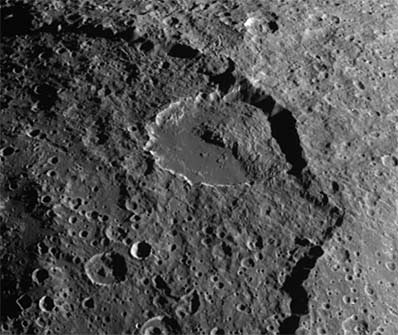
Giant landslide on Iapetus
CASSINI PHOTO RELEASE
Posted: January 9, 2004
A spectacular landslide within the low-brightness region of Iapetus's surface known as Cassini Regio is visible in this image from Cassini. Iapetus is one of the moons of Saturn.
Credit: NASA/JPL/Space Science Institute
Download larger image version here
|
The landslide material appears to have collapsed from a scarp 15 kilometers high (9 miles) that forms the rim of an ancient 600 kilometer (375 mile) impact basin. Unconsolidated rubble from the landslide extends halfway across a conspicuous, 120-kilometer diameter (75-mile) flat-floored impact crater that lies just inside the basin scarp.
Landslides are common geological phenomena on many planetary bodies, including Earth and Mars. The appearance of this landslide on an icy satellite with low-brightness cratered terrain is reminiscent of landslide features that were observed during NASA's Galileo mission on the Jovian satellite Callisto. The fact that the Iapetus landslide traveled many kilometers from the basin scarp could indicate that the surface material is very fine-grained, and perhaps was fluffed by mechanical forces that allowed the landslide debris to flow extended distances.
In this view, north is to the left of the picture and solar illumination is from the bottom of the frame. The image was obtained in visible light with the Cassini spacecraft narrow angle camera on Dec. 31, 2004, at a distance of about 123,400 kilometers (76,677 miles) from Iapetus and at a Sun-Iapetus-spacecraft, or phase, angle of 78 degrees. Resolution achieved in the original image was 740 meters (2,428 feet) per pixel. The image has been contrast-enhanced and magnified by a factor of two to aid visibility.
The Cassini-Huygens mission is a cooperative project of NASA, the European Space Agency and the Italian Space Agency. The Jet Propulsion Laboratory, a division of the California Institute of Technology in Pasadena, manages the mission for NASA's Science Mission Directorate, Washington, D.C. The Cassini orbiter and its two onboard cameras were designed, developed and assembled at JPL. The imaging team is based at the Space Science Institute, Boulder, Colo.
|
|
|
|
|