|
|
|

|
|
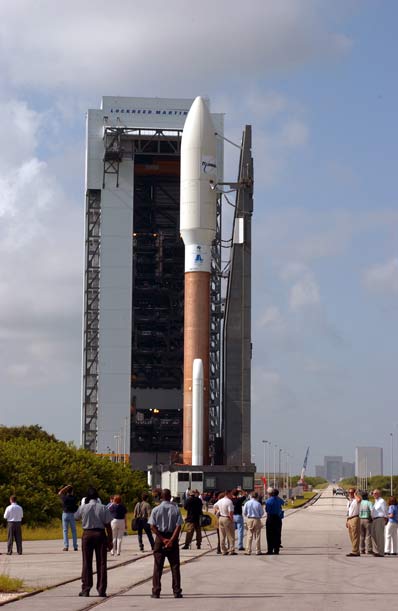
Atlas 5 rocket ready to haul TV satellite into Earth orbit BY JUSTIN RAY SPACEFLIGHT NOW Posted: December 15, 2004 After a hiatus in flights of the new Atlas 5 rocket while Lockheed Martin flew its inventory of older-style boosters, focus returns to the next generation Friday with an early morning launch from Cape Canaveral.
"We can use the entire window, but obviously we are planning to go at the beginning of the window," Atlas launch director Adrian Laffitte said. The weather forecast calls for cloudy skies, breezy winds and chilly temperatures. The only worry for launch -- amounting to a 30 percent chance of breaking the weather rules -- is the cloud cover being too thick for the rocket's safe passage. The Air Force plans to dispatch a weather reconnaissance aircraft to examine the clouds during the countdown. Bolted atop the rocket is the AMERICOM 16 communications spacecraft headed for a highly elliptical geosynchronous transfer orbit where it will be deployed an hour and 49 minutes after liftoff. Later, the AMC 16 satellite will maneuver itself into geostationary orbit and appear parked over the equator at 85 degrees West longitude to be operated by SES AMERICOM of Princeton, New Jersey. It'll be the third AMERICOM satellite launched on Atlas this year following AMC 10 and 11 aboard Atlas 2AS vehicles in February and May. Built by Lockheed Martin using the A2100AX model design, AMC 16 features 12 Ka-band spot beams and 24 Ku-band transponders for broadband communications and television relay services to small roof-top satellite dishes. The primary user of the satellite will be EchoStar's DISH Network direct-to-home entertainment service, which has millions of subcribers across the U.S.
The satellite's twin -- AMC 15 -- was launched in October aboard a Russian Proton booster. SES AMERICOM will operate both under the AMERICOM2Home banner for EchoStar. International Launch Services, which markets Atlas and Proton vehicles, has managed all four AMC satellite deployment missions in 2004. The AMC 16 launch puts the spotlight back on Atlas 5 after a 17-month lull in flights. During that period, Lockheed Martin has successfully flown seven flights of the heritage Atlas 2AS and Atlas 3 vehicles. The Atlas 2 rocket line is now retired and just one Atlas 3 booster remains -- it is awaiting liftoff next month from the Cape. The Atlas 5 family is the future for Lockheed Martin, featuring various configurations to loft a range of different payloads. It was developed under the Air Force's Evolved Expendable Launch Vehicle program with the promise of providing reliable and affordable flights through the next two decades. Three Atlas 5 launches occurred in 2002 and 2003, all successfully carrying commercial satellites. Friday's mission will use the same rocket version flown most recently with a voluminous nose cone and two strap-on solid rocket boosters. The rocket stands full assembled atop its mobile launching platform inside the Vertical Integration Facility at Complex 41. The vehicle spent a couple of days on the launch pad last month undergoing a countdown dress rehearsal before heading back to its 30-story tall hangar. Following much the same pre-launch timeline used in the previous two Atlas 5 missions, the rocket will be transferred to the pad, fueled and then launched in the span of just nine hours. Launch countdown clocks begin ticking at 4:01 p.m. EST (2101 GMT) on Thursday. A weather update for officials is slated for 7:21 p.m. (0021 GMT) to review the forecast for the hours the rocket will be exposed to the elements on the launch pad from rollout through liftoff. A readiness poll of team members will be conducted a few minutes later for a final "go" to roll. Assuming no technical problems are reported and weather is acceptable, the mobile launcher platform is expected to begin the 1,800-foot journey from the Vertical Integration Facility to the pad around 7:31 p.m. EST (0031 GMT).
Powering up the rocket occurs next, followed by the start of guidance system testing. Loading of the first stage with a highly refined kerosene propellant, called RP-1, begins at 10:42 p.m. EST. The next couple of hours will be spent performing routine testing and early preparations for cryogenic fueling. The countdown enters a planned half-hour hold at 2:01 a.m. EST (0701 GMT) at the T-minus 2 hour point. Following the hold, loading of super-cold liquid oxygen into the first stage and filling of the Centaur upper stage with liquid oxygen and liquid hydrogen propellants will commence. A final hold is scheduled at T-minus 4 minutes and should last 10 minutes in duration. The last minutes of the count sees the rocket pressurized, switched to internal battery power and armed. Ignition of the Russian-designed RD-180 main engine occurs in the final three seconds and includes a rapid check of the powerplant's parameters before the twin solid rocket motors are lit to propel the 959,000-pound vehicle into the nighttime sky on the thrust of 31 million horsepower. The Aerojet-built boosters, considered the world's longest single-segment solid rocket motors at 67 feet in length and five feet in diameter, fire for about 90 seconds before using up their propellant. A half-minute after burnout, the spent white casings peel away from the Atlas 5 to fall into the Atlantic.
The RD-180 shuts down at T+plus 4 minutes, 27 seconds, followed six seconds later by jettison of the first stage. The Centaur upper stage with its single Pratt & Whitney RL10 engine then ignites for an 11-minute firing to reach a parking orbit featuring a high point of 2,882 nautical miles, perigee of 90 miles and inclination of 27.20 degrees. The rocket coasts in that orbit for 90 minutes before the cryogenic engine re-starts for a four-minute burn to inject AMC 16 into geosynchronous transfer orbit. The launch concludes at T+plus 1 hour, 48 minutes, 42 seconds with release of the payload into an orbit with a high point of 19,323 nautical miles, low point of 2,591 miles and inclination of 18.02 degrees north and south of equator. If all goes well, it would mark the 74th consecutive successful Atlas launch since 1993. Watch our Mission Status Center page for live updates starting Thursday afternoon with a posting following the pre-launch news conference. And we will provide comprehensive live reports on that page throughout the countdown and launch. |
|
|
|
 |
||||||||||||||||||||||||||||||||||||||||||||||||||||||||||||||||
|
MISSION STATUS CENTER |
||||||||||||||||||||||||||||||||||||||||||||||||||||||||||||||||||||||


 Lockheed Martin's last Atlas 2AS rocket blasts off from Cape Canaveral carrying a classified National Reconnaissance Office spacecraft on August 31. (3min 59sec file)
 The Atlas launch team in the Complex 36 Blockhouse celebrate the history of pad 36A in a post-launch toast. The Atlas 2AS rocket flight was the last to launch from the pad, which entered service in 1962. (2min 09sec file)
 The classified NRO payload is deployed from the Centaur upper stage to successfully complete the launch. (1min 56sec file)