Atlas 5 changes the way rockets are prepared to fly
BY JUSTIN RAY
SPACEFLIGHT NOW

Originally Posted: August 13, 2002

A launch complex that has been around for 40 years is now one of the most modern on the planet after undergoing an overhaul to become the home of Lockheed Martin's Atlas 5 for the new millennium.

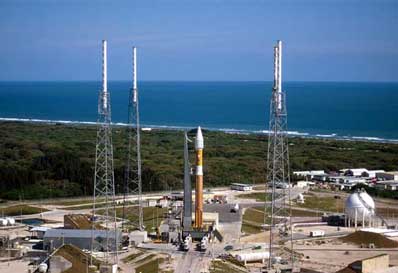
Representing a major change in philosophy for America's rocket industry, Cape Canaveral Air Force Station's Complex 41 has been transformed into the country's first "clean pad."

Atlas 5
The Atlas 5 rocket at the Complex 41 launch pad. Photo: Lockheed Martin
 
Instead of putting rockets together on the launch pad -- a method employed in the U.S. for decades -- Lockheed Martin has constructed a vehicle assembly building where the stages of Atlas 5s are stacked atop a mobile platform. The completed rocket is then rolled to the open-air launch pad a day before liftoff.

"We finally bring launch operations to the 21st Century," said John Karas, Lockheed Martin's vice president for Atlas 5 development. "This is a state-of-the-art launch facility. It really represents a leap forward to the way we process and launch rockets."

The "clean pad" means large launch pad towers are no longer needed. What's more, the concept is supposed to make the turnaround between launches shorter and lessen the problem of bottlenecks experienced on conventional launch pads, which can be tied up for months if one mission has a lengthy delay.

"It's a radically different concept, it's proven itself well and we look forward to launching off our new pad later in the month of August," Karas said.

The ASOC
The nerve center of Complex 41 is the Atlas 5 Spaceflight Operations Center, commonly referred to as the ASOC. The facility combines into one place what previously was spread over a dozen sites.

The building was once used to process solid rocket booster segments of the Titan 4A vehicle, but Lockheed Martin gave the facility a complete facelift and expansion for Atlas 5.

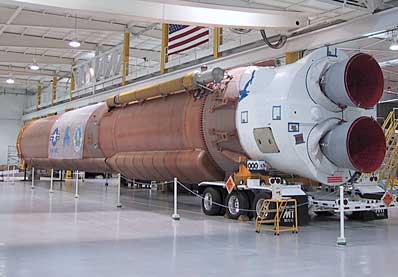
Positioned 4.1 miles from the launch pad, this multi-purpose building is where the Atlas 5 first stage booster and Centaur upper stage are taken immediately after arriving in Florida from the Lockheed Martin manufacturing plant in Denver. The high-bay area allows technicians to perform some powered testing on the stages, and then keep the segments in temporary storage until it's time for them to be moved to the assembly building in preparation for launch. There is enough room for a half-dozen rockets to be stored in the air-conditioned bay.

CCB
The Common Core Booster first stage for the maiden Atlas 5 sits in the ASOC. Photo: Justin Ray/Spaceflight Now
 
The ASOC also houses the futuristic-looking launch control center that brings together under one roof mission officials, the lead engineering team, customers and the technicians actually executing the countdown.

This togetherness is a departure from the current era of Atlas 2 and 3 series rockets at Complex 36, which has the launch team positioned in the blockhouse a few hundred yards from the pads and management located several miles away in the Cape's Hangar AE Mission Directors Center.

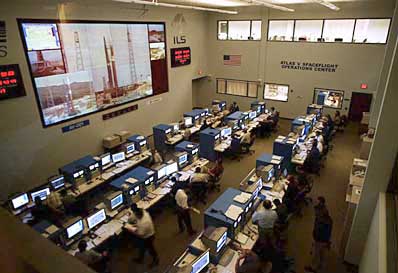
The control center has a stadium design, with 12 primary consoles on the first floor for the launch team. These stations include Launch Conductor Mike Jacobs' console where he will oversee the entire countdown, the assistant launch conductor next to Jacobs, Atlas and Centaur propellant consoles where the fueling operations are monitored, flight control and electrical systems, data and communications, ground electronics, ground software, facility electrical, environmental control, safety and the redline monitor.

ASOC
The launch control center in action during an earlier Atlas 5 countdown dress rehearsal. Photo: Lockheed Martin
 
The first floor also has two rooms to the right of the launch team where the main ground computer network is located and an optional satellite control station is available.

Behind the team, on the second floor, are three rooms that hold the rocket engineering team, the payload customers and the senior launch managers. Separated by glass, the upper floor is where the key decisions to launch will come, passing the "go" from Launch Director Adrian Laffitte in the management room to Launch Conductor Mike Jacobs seated downstairs.

On both sides of the upper floor are two rooms that provide additional seating and observation points for engineers and customers to monitor the countdown and launch.

The front wall of the control center is adorned with clocks, countdown timers, logos and most notably a 360-square foot rear projection video wall to display various launch pad camera views and data charts.

ASOC
A view of the control room's upper floor -- the engineering center on the left, spacecraft room in the middle and mission director's area on the right. Photo: Lockheed Martin
 
Additional small rooms are located adjacent from the control center where support staff can access certain data on computers using "smart cards." The size of credit cards, these are programmed so people can only enter rooms or view information in the computer system that have been deemed acceptable.

Because of the international scope of Atlas 5, including the Russian-made engines and foreign customers, the ASOC has to ensure security and technology export issues aren't compromised.

Companies launching their satellites pay big bucks for the rocket and as such Lockheed Martin and International Launch Services -- the marketer of Atlas -- have created hospitality areas for the customer on all four floors of the ASOC.

Starting with conference rooms on the first floor, VIPs can go the second floor where a suite is located with a full kitchen, and then head to the third floor when you can look out the windows and see the pad and much of the surrounding area. When it's launch time, you head to the fourth floor deck for outdoor viewing.

The VIF
Atlas 5 launches are controlled from the ASOC, but the 293-foot tall Vertical Integration Facility is where the rockets come together. Located 1,800 feet from the pad, this newly built structure features a 60-ton crane that hoists the segments of the Atlas 5 rockets onto the mobile launching platform.

  VIF
The Vertical Integration Facility. Photo: Lockheed Martin
 
Once the stages complete their checkout in the ASOC high bay, they are moved horizontally to the VIF. The Common Core Booster stage goes up first, followed by the interstage cylinder section, the Centaur upper stage and boattail adapter. Later Atlas 5s will also feature strap-on solid rocket motors.

The stacked rocket undergoes more testing before the cargo is delivered to the VIF. The satellite is processed and fueled at a separate site -- either the commercial Astrotech facility 22 miles away near Titusville or at a government site for military and NASA payloads.

The spacecraft is encapsulated in the rocket's nose cone before leaving the processing building for the ride to Complex 41. It is hoisted into the building and mounted atop the vehicle for launch.

An Integrated Systems Test is then performed between the rocket and cargo to confirm the duo is ready for launch. With all systems "go", it's time to roll the launcher to the pad.

Atlas 5
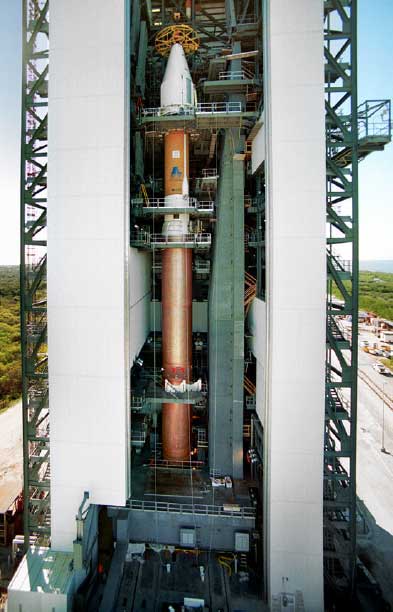
A simulated payload is moved into position for attachment to the Atlas 5 rocket during earlier testing inside the Vertical Integration Facility. Photo: Lockheed Martin
 
The VIF is designed to withstand 140 mile per hour hurricane winds, has seven automated moveable platforms to access various areas of the rocket and features a 41 by 275 foot vertical reinforced fabric door that rolls up for the Atlas 5 stages to be lifted into the building and the completed vehicle to roll out to the pad.

Construction of the VIF began in January 1999. Two hundred truckloads of cement, or 1,800 cubic yards, went into the VIF's foundation, and 3,250 tons of steel were used in the building.

The platform
The 1.4-million pound mobile launching platform is what the Atlas 5 sits upon from the time it is stacked together in the VIF until the main engine is fired at liftoff. Umbilicals feeding fuel, power and all other lines from the ground to the rocket run through the platform.

The platform is 45 feet wide, 55 feet long and 185 feet tall to the top of the mast, which features a wind damper that holds the rocket steady while exposed to the weather on the pad and routes propellant lines to the Centaur and conditioned air to the payload inside the nose cone.

Atlas 5
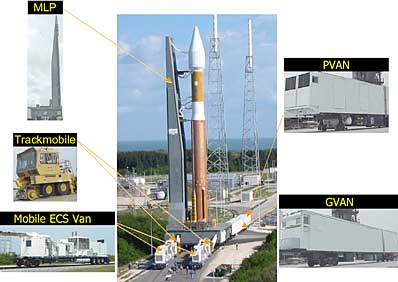
Several vehicles and trailers make up the Atlas 5's convoy during rollout to the launch pad. Photo: Lockheed Martin
 
Two "trackmobiles" transport the rocket the 1,800 feet to the launch pad along railroad tracks. Four mobile vans are attached to the platform, providing ground communications and equipment for the rocket, command and control and the air purge to the satellite.

The rollout takes about a half-hour, reaching a top speed about two miles per hour.

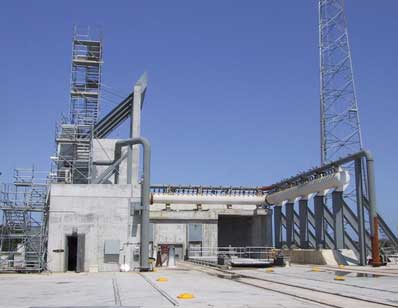
Once at the pad, the platform is lowered and secured on mounts. The PVAN and GVAN -- the payload and rocket ground system vans -- are rolled straight into Pad Equipment Building on the north side of the vehicle, remaining attached and used for the entire countdown. The Pad Equipment Building is sealed, protecting the vans from the blast of launch.

Atlas 5
The view from the south looking at empty launch pad at the Complex 41. The PVAN and GVAN roll into the doorway seen on the far right side of this concrete structure. Photo: Justin Ray/Spaceflight Now
 
The Environmental Control System is switched to pad equipment, allowing the front two mobile ESC vans to disengage and move away. The trackmobiles are also unhooked and rolled to safety.

The pad
Work to build Complex 41 began in 1963. The pad opened for business in 1965, hosting 27 Titan rocket launches through 1999 that sent NASA's Viking landers to Mars, the twin Voyager probes to the solar system's outer planets and various other communications and military satellites into Earth orbit.

  Towers toppled
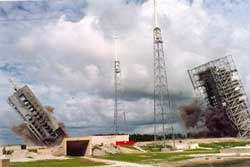
The Titan rocket-era towers are toppled. Photo: Air Force
 
In October 1999, amid much fanfare, the mobile service tower and umbilical tower were explosively toppled to the ground, allowing workers to safely dismantle the structures that Atlas 5 would not need given the "clean pad" concept.

The overhaul of the complex for Atlas 5 was the fourth major launch pad construction job Lockheed Martin had undertaken in recent years. Complex 40 was refurbished for the Titan 4 a decade ago, then the SLC-3 East pad at Vandenberg Air Force Base in California was rebuilt for the Atlas 2 series and Complex 36 was upgraded for the Atlas 3 rocket.

Karas says each pad has inherited the advancements made with the previous refurbishment project.

"So we kind of call it our fourth generation of launch pad. (Complex) 41, right now, is not only the most modern, but also most automated, most redundant, newest concept launch pad in the United States and arguably best in the world."

Pad
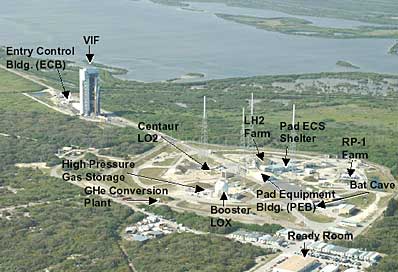
An aerial view of the pad with key features labeled. Photo: Bionetics Photo Services
 
The most visible parts of the pad -- all left over from the Titan program -- are the four lightning protection masts, designed to shield the rocket during Florida's frequent thunderstorms, and the massive flame duct.

There are also four fuel tanks scattered around the pad. The largest is the sphere-shaped 465,000 gallon liquid oxygen tank that holds the super-cold cryogenic for the Atlas first stage. Two 48,000 gallon RP-1 tanks are filled with the highly-refined kerosene fuel, also for the Atlas booster. The Centaur upper stage consumes liquid oxygen and liquid hydrogen, which are stored in separate 28,000 gallon and 48,000 gallon tanks, respectively.

The pad also has a host of gaseous helium and nitrogen storage tanks.

Once the rocket is rolled into position for launch, a hose is connected to pump the RP-1 propellant into the first stage.

The liquid oxygen and liquid hydrogen loading operations occur during the final three hours of the countdown. However, the preparations for the cryo fueling begins shortly after the rollout is completed when automated coupling devices, called autocouplers, are mated from the ground to the mobile launching platform.

The autocouplers center up and engage automatically, and then perform leak checks. The devices are also used for the pneumatics and hydraulic systems.

"That is one of the features that makes the clean pad operation work very well. It is one of the first operations of its kind in the world," Karas said.

The first stage liquid oxygen is fed from an umbilical at the base of the rocket. The Centaur is loaded via lines extending from the umbilical mast of the platform.

Flight data file
Vehicle: Atlas 5 (AV-002)
Payload: Hellas Sat
Launch date: May 13, 2003
Launch window: 5:57-6:31 p.m. EDT (2157-2231 GMT)
Launch site: Complex 41, Cape Canaveral AFS, Florida
Satellite broadcast: Telstar 4, Transponder 11, C-band

Pre-launch briefing
Mission preview - Our story looking at this second Atlas 5 launch.

Weather forecast - The latest forecast for launch day conditions.

Launch hazard area - A map of the restricted area during liftoff.

Ground track - See the trajectory the rocket will follow during its flight.

Orbit insertion - Illustration of Hellas Sat's trek to geostationary orbit.

The rocket - Technical story of the new Atlas 5 rocket family.

Hellas Sat - Learn more about the satellite cargo for this Atlas 5 launch.

Complex 41 - A tour of the Atlas 5 launch site and description of the "clean pad" concept.

Inaugural Atlas 5 - Our coverage of the maiden Atlas 5 flight.

Video coverage - A comprehensive collection of Atlas 5 video clips and launch pad panoramas.

Atlas index - A directory of our previous Atlas launch coverage.


Columbia Report
A reproduction of the official accident investigation report into the loss of the space shuttle Columbia and its crew of seven.
 Choose your store:
U.S. - U.K. - E.U. - Worldwide

Mars Panorama

DISCOUNTED! This 360 degree image was taken by the Mars Pathfinder, which landed on the Red Planet in July 1997. The Sojourner Rover is visible in the image.
 Choose your store:
U.S.

Apollo 11 Mission Report
Apollo 11 - The NASA Mission Reports Vol. 3 is the first comprehensive study of man's first mission to another world is revealed in all of its startling complexity. Includes DVD!
 Choose your store:
U.S. - U.K. - E.U. - Worldwide

Rocket DVD
If you've ever watched a launch from Kennedy Space Center, Cape Canaveral, Vandenberg Air Force Base or even Kodiak Island Alaska, there's no better way to describe what you witnessed than with this DVD.
 Choose your store:
U.S. - U.K. - E.U. - Worldwide

Apollo 11 special patch
Special collectors' patch marking the 35th anniversary of the historic Apollo 11 moon landing is now available.
 Choose your store:
U.S. - U.K. - E.U. - Worldwide

Inside Apollo mission control
An insider's view of how Apollo flight controllers operated and just what they faced when events were crucial.
 Choose your store:
U.S.

The ultimate Apollo 11 DVD
This exceptional chronicle of the historic Apollo 11 lunar landing mission features new digital transfers of film and television coverage unmatched by any other.
 Choose your store:
U.S. - U.K. - E.U. - Worldwide

Next ISS crew
Own a little piece of history with this official patch for the International Space Station's Expedition 11 crew. We'll ship yours today!
 Choose your store:
U.S.

Apollo 11 special patch
Special collectors' patch marking the 35th anniversary of the historic Apollo 11 moon landing is now available.
 Choose your store:
U.S. - U.K.

Current Shuttle Mission Patch
The official embroidered patch for shuttle Atlantis' flight to deliver critical spare equipment to the space station.
 U.S. STORE
 WORLDWIDE STORE

Ares 1-X Patch
The official embroidered patch for the Ares 1-X rocket test flight, is available for purchase.
 U.S. STORE
 WORLDWIDE STORE

Apollo Collage
This beautiful one piece set features the Apollo program emblem surrounded by the individual mission logos.
 U.S. STORE
 WORLDWIDE STORE


Project Orion
The Orion crew exploration vehicle is NASA's first new human spacecraft developed since the space shuttle a quarter-century earlier. The capsule is one of the key elements of returning astronauts to the Moon.
 U.S. STORE


Fallen Heroes Patch Collection
The official patches from Apollo 1, the shuttle Challenger and Columbia crews are available in the store.
 U.S. STORE
 WORLDWIDE STORE

Mission Report
Gemini 7: The NASA Mission Reports covers this 14-day mission by Borman and Lovell as they demonstrated some of the more essential facts of space flight. Includes CD-ROM.
 U.S. STORE
 WORLDWIDE STORE

Get e-mail updates
Sign up for our NewsAlert service and have the latest news in astronomy and space e-mailed direct to your desktop (privacy note: your e-mail address will not be used for any other purpose).
Enter your e-mail address:
MISSION STATUS CENTER

INDEX | PLUS | NEWS ARCHIVE | LAUNCH SCHEDULE
ASTRONOMY NOW | STORE

ADVERTISE

© 2009 Spaceflight Now Inc.