|
|
||
|
|
||
  BY JUSTIN RAY May 24, 2000 -- Follow the countdown and launch of the inaugural Lockheed Martin Atlas 3A rocket with Eutelsat's W4 communications satellite. Reload this page for the very latest on the mission.
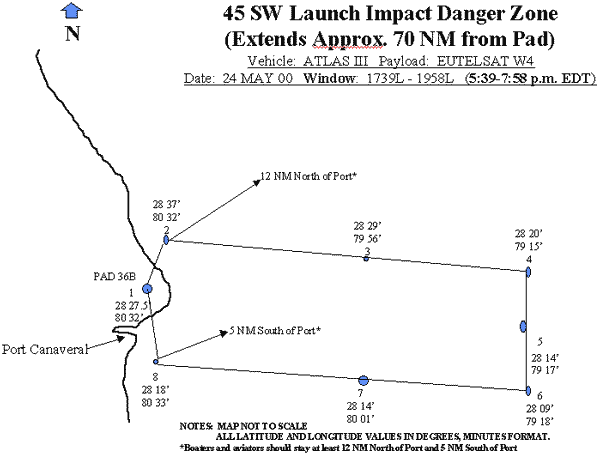
2145 GMT (5:45 p.m. EDT) See a diagram of the restricted waters for launch.
2142 GMT (5:42 p.m. EDT)
2139 GMT (5:39 p.m. EDT)
2138 GMT (5:38 p.m. EDT)
2134 GMT (5:34 p.m. EDT)
2129 GMT (5:29 p.m. EDT)
2124 GMT (5:24 p.m. EDT) The loading of the Atlas booster and Centaur upper stage with super-cold cryogenic propellant is now completed. Given the cold nature of the liquid oxygen and liquid hydrogen, however, the cryogenics naturally boil away during the countdown. As a result, the tanks will be topped off until just minutes prior to liftoff. RP-1 fuel, a highly refined kerosene, was loaded aboard the Atlas stage earlier during a countdown dress rehearsal.
2119 GMT (5:19 p.m. EDT)
2116 GMT (5:16 p.m. EDT)
2110 GMT (5:10 p.m. EDT) The Flight Termination System self-test check was recently completed, with inhibits in place to ensure safety of the Atlas 3A rocket pad pad 36B. The FTS would be used to destroy the rocket should problem occur during the launch. Also, the pogo suppression system at the pad has been readied. The system will be used to dampen the "bounce" of the rocket during engine ignition. And the C-band beacon on the rocket is reported "go" for launch. The beacon will be used by the Eastern Range to track the rocket during flight.
2103 GMT (5:03 p.m. EDT) The report from Lockheed Martin is upper level winds are acceptable for launch today. There was concern earlier about a wind shear between 47,000 and 49,000 feet.
2054 GMT (4:54 p.m. EDT)
2048 GMT (4:48 p.m. EDT)
2043 GMT (4:43 p.m. EDT)
2041 GMT (4:41 p.m. EDT)
2038 GMT (4:38 p.m. EDT)
2035 GMT (4:35 p.m. EDT) Also, topping of the Centaur liquid oxygen tank to flight level has started.
2026 GMT (4:26 p.m. EDT)
2024 GMT (4:24 p.m. EDT) The consensus of engineers is the dropping gaseous nitrogen pressure and supplies at the pad was caused by a computer-monitoring error. That has been fixed. Also, the pad's rocket hold-down cylinder pressure problem was a temperature-related issue and the previously-dropping pressure is expected to stabilize. With the countdown running again, the "go" has been given to start loading liquid oxygen into the Atlas stage. And "chilldown" conditioning of liquid hydrogen propellant feed lines at pad 36B is now starting. This is done to thermally prepare the plumbing before the super-cold cryogenic flows through the pipes and into the rocket. Also at this time, the Complex 36 Blockhouse doors are being sealed, protecting the 120-plus-member launch team. The Blockhouse is located just 1,400 feet away from the Atlas 3A rocket at pad 36B, and serves as the control center for the countdown to launch. On Friday, May 12, Spaceflight Now toured the historic Complex 36 Blockhouse. Now you can step inside through the eyes of our virtual reality camera. (286k QuickTime file).
2020 GMT (4:20 p.m. EDT)
2016 GMT (4:16 p.m. EDT)
2014 GMT (4:14 p.m. EDT)
2012 GMT (4:12 p.m. EDT)
2009 GMT (4:09 p.m. EDT) Meanwhile, the Anomaly Team has started looking at a pressure problem at launch pad 36B. Also, a technician reports another pressure measurement is decreasing, suggesting a regulator problem.
2002 GMT (4:02 p.m. EDT)
1958 GMT (3:58 p.m. EDT)
1949 GMT (3:49 p.m. EDT)
1944 GMT (3:44 p.m. EDT)
1940 GMT (3:40 p.m. EDT)
1939 GMT (3:39 p.m. EDT)
1935 GMT (3:35 p.m. EDT)
1909 GMT (3:09 p.m. EDT) The Air Force has announced two collision avoidance, or COLA, cutouts of today's launch window. Liftoff will be prohibited from 6:35:43 to 6:39:54 p.m. EDT and 6:50:15 to 6:51:05 p.m. EDT to avoid passing too close to another orbiting object. Today's window extends from 5:39 to 7:58 p.m. EDT.
1903 GMT (3:03 p.m. EDT) Countdown clocks are about to enter the T-minus 105 minute hold at 3:09 p.m. EDT. There is nothing amiss today at Cape Canaveral.
1844 GMT (2:44 p.m. EDT)
1839 GMT (2:39 p.m. EDT) The launch team reported preps for the Atlas and Centaur propulsion systems are complete, as were the hydraulic preps for Atlas.
1824 GMT (2:24 p.m. EDT) Countdown clocks will pause twice over the next three hours and 15 minutes in advance of launch. Built-in holds are planned at T-minus 105 for 30 minutes and at T-minus 5 minutes for 15 minutes. At launch pad 36B, access platforms and equipment inside the mobile service tower have been stowed, and technicians are preparing to retracted the structure from around the rocket in about 15 minutes.
1754 GMT (1:54 p.m. EDT) Meanwhile, Range Safety is currently conducting a holdfire test to ensure it could stop the launch moments before liftoff if necessary.
1710 GMT (1:10 p.m. EDT) Over the past two hours or so, internal power tests of the Atlas and Centaur stages were completed, as were the checks of the liquid oxygen and liquid hydrogen systems at pad 36B, the helium purge to Centaur began and the Centaur main engine ignitor was checked. Launch remains scheduled for 5:39 p.m. EDT (2139 GMT), the opening of a two-hour, 19-minute window extending to 7:58 p.m. EDT (2358 GMT).
1530 GMT (11:30 a.m. EDT) The latest weather forecast now indicates a 90 percent chance of favorable conditions, a slight improvement from yesterday's prediction. Launch Weather Officer Jim Sardonia gave this overview this morning: "Very dry conditions will persist today allowing for an excellent opportunity for launch. Winds will be southwesterly and brisk today, preventing an east-coast seabreeze to form until very late in the afternoon if at all. If a seabreeze forms, there will be a slight chance of enhanced cumulus clouds forming along the coast and within 10 nautical miles of SLC 36. Similar conditions are expected Thursday and Friday. The main concern today will be the slight chance of enhanced cumulus clouds within 10 nm of SLC 36 during the launch window."The launch time forecast calls for scattered cumulus clouds at 3,000 feet with 2/8ths sky coverage and broken cirrus clouds at 25,000 feet with 3/8ths sky coverage, visibility of 7 miles, west-southwesterly winds 10 gusting to 18 knots at the pad, a temperature of 78 to 80 degrees F and relative humidity of 80 percent.
TUESDAY, MAY 23, 2000 The countdown will get started Wednesday at 8:49 a.m. EDT as the launch team begins readying the rocket for flight. The vehicle will be powered up and three hours of electrical and mechanical checks should get underway. The Integrated Launch Operations -- the final portion of the countdown in which all members of the launch team participate -- will start at 2:24 p.m. EDT (1824 GMT). Retraction of the mobile service tower from around the rocket is slated for 2:39 p.m. EDT (1839 GMT). Fueling operations will commence at 3:53 p.m. EDT (1953 GMT) with super-cold liquid oxygen flowing into the Centaur upper stage. Loading of liquid oxygen into the Atlas booster stage should start at 4:14 p.m. EDT (2014 GMT). The final segment of fueling will begin at 4:33 p.m. EDT (2033 GMT) when liquid hydrogen is pumped into the Centaur. The Atlas stage was previously fueled with its supply of RP-1 kerosene. Weather forecasters are calling for an 80 percent chance of acceptable conditions. Launch Weather Officer Jim Sardonia gave this overview today: "Expect a slight chance of an isolated rainshower or thunderstorm along the east-coast sea breeze this afternoon. The atmosphere is fairly dry however, so the number of storms will be few and the coverage will be minimal. Expect similar conditions on Wed for the launch countdown, with a slight chance of an isolated rainshower or thunderstorm forming west of CCAFS along the east-coast sea breeze. If a cell forms due west of the Cape, there will be a slight chance of Anvil clouds drifting back east within 10 nautical miles of SLC 36. Winds are expected to be southerly and light on Wednesday. The launch time forecast calls for scattered cumulus clouds at 3,000 feet with 2/8ths sky coverage, scattered altocumulus clouds at 10,000 feet with 3/8ths sky coverage and broken cirrus clouds at 25,000 feet with 5/8ths sky coverage, visibility of 7 miles, southerly winds 10 gusting to 16 knots at the pad, a temperature of 76 to 78 degrees F, relative humidity of 80 percent and isolated rainshowers and thunderstorms in the interior portions of Florida. Should the launch be delayed for some reason, there is a 90 percent chance of good conditions on Thursday with the concern being rainshowers and thunderstorms in the area. On Friday, there is an 80 percent of acceptable weather due to the same threat. We will provide extensive coverage of the launch with our Mission Status Center reports and a live streaming video broadcast that will include views from two cameras mounted onboard the rocket.
MONDAY, MAY 22, 2000 "When you started putting all those activities together and the work crews taking a rest, and the weather looked bad for Tuesday, we decided to give everyone a breather," said Adrian Laffitte, Lockheed Martin's director of Atlas launch operations at Cape Canaveral. Liftoff from Cape Canaveral Air Force Station's pad 36B on Wednesday will be possible during a launch window of 5:39 to 7:58 p.m. EDT (2139-2358 GMT). Weather forecasters are calling for an 80 percent chance of favorable weather on Wednesday with the only concern being cloud tops from thunderstorms drifting within 10 miles of the launch pad. Launch Weather Officer Jim Sardonia gives this overview: "With some instability in the area due to the remnants of a cold front in north Florida, expect a slight chance of an isolated rainshower or thunderstorm along the east-coast sea breeze this afternoon and Tuesday afternoon. The atmosphere is fairly dry however, so the number of storms will be few and the coverage will be minimal. Expect similar conditions on Wed for the launch countdown, with a slight chance of an isolated rainshower or thunderstorm forming west of CCAFS along the east-coast sea breeze. If a cell forms due west of the Cape, there will be a slight chance of Anvil clouds drifting back east within 10 nautical miles of SLC 36. Winds are expected to be southeasterly and light on Wednesday.The launch time forecast calls for scattered cumulus at 3,000 feet, altocumulus clouds scattered at 10,000 feet and broken cirrus clouds at 25,000 feet, visibility of 7 miles, southeasterly winds 10 gusting to 16 knots at the pad, a temperature of 76 to 78 degrees F, relative humidity of 80 percent and isolated rainshowers and thunderstorms in the interior portions of Florida. Should the launch be delayed to Thursday for some reason, the forecast indicates a 70 percent of good conditions with the concern being rainshowers and thunderstorms in the area. On Friday, there is the same threat but an 80 percent chance of launching. Saturday's launch attempt, the fourth conducted since last Monday, was spoiled when over 70 boats strayed into the restricted danger zone off the coast of Cape Canaveral, delaying the liftoff until the final minute of the launch window. A last-minute computer glitch then halted the countdown at T-minus 2 minutes, 15 seconds, causing the launch to be automatically scrubbed for the day. The computer error was solved within 18 minutes and another shot at launching the rocket could have been made on Saturday had it not been for the boats, which were part of a celebrity fishing tournament. After the postponement, a worn out gasket in a liquid oxygen topping valve caused a leak as the super-cold oxidizer was being drained from the Atlas booster stage. Officials opted to let the oxygen naturally boil off over night, with the tank dropping from 52 percent to 8 percent, Laffitte said. On Sunday, technicians returned to pad 36B and replaced the faulty gasket, allowing the launch team to properly "de-tank" the remaining 8 percent. Today, engineers are systematically going through the batteries aboard the rocket for replacement. Some of the batteries are reaching the end of their life, and fresh ones will permit additional launch attempts if needed. In addition, the troublesome liquid oxygen dump valve at the pad is being replaced. This is the valve that created delays last Wednesday and again on Saturday while the launch team was trying to fuel the rocket. The valve was not closing properly on those attempts. The Atlas 3 has experienced four unsuccessful countdowns with a variety of technical and weather problems to blame. Before Saturday's bizarre countdown, Monday's attempt was called off because of a faulty Range tracking radar in Bermuda; Tuesday saw unacceptable high altitude winds; and Wednesday's effort got to T-minus 29 seconds before a computer timing error aborted the count. "It is a little bit frustrating but on the other hand we are a totally dedicated team and we are working through the problems," Laffitte said. "This is sort of expected with a new vehicle. But we still have our sense of humor."
1545 GMT (11:45 a.m. EDT) Wednesday's launch window will extend from 5:39 to 7:58 p.m. EDT (2139-2358 GMT).
SUNDAY, MAY 21, 2000 The gasket is part of the liquid oxygen topping check valve inside the pad's plumbing. The gasket created a problem Saturday night in which liquid oxygen could not be drained properly from the Atlas booster stage. An alternate "de-tanking" method was employed but the rocket was not completed drained of fuel until around 12 noon EDT today, nearly 16 hours after the launch attempt was scrubbed, a Lockheed Martin spokeswoman said. Technicians plan to replace the gasket, the spokeswoman reported, to get the valve working correctly in preparation for another launch attempt on Tuesday -- the fifth for the first Atlas 3A rocket. If officials approve a Tuesday shot, the liftoff will be possible during a window of 5:38 to 7:58 p.m. EDT (2138-2358 GMT). The launch team will also get some time to rest before starting the next countdown early Tuesday morning at 8:48 a.m. EDT.
1510 GMT (11:10 a.m. EDT) Further details are expected to be released this afternoon, and we will update this page as soon as possible. Tuesday's window extends from 5:38 to 7:58 p.m. EDT (2138-2358 GMT). Saturday's launch try -- the fourth this week -- was scrubbed after virtually the entire window was used up waiting for the Range to clear nearly 70 boats from the restricted danger zone in the Atlantic Ocean. Then a last-minute computer error message cropped up as the launch team prepared the Russian-made RD-180 engine for ignition. Read our full story.
0401 GMT (12:01 a.m. EDT) Meanwhile, Launch Weather Officer Jim Sardonia reports there is a 40 percent chance thunderstorm anvil clouds will be a problem on Sunday courtesy of disturbed weather in Western Florida. Sardonia gave this forecast Saturday night: "A significant cold front is expected to move into the eastern Gulf of Mexico on Sunday producing strong thunderstorms just west of Tampa, Florida. These thunderstorms are expected to produce a broad band of Anvil clouds that could reach within 10 nautical miles of SLC 36 by the beginning of the launch window.Sunday's launch time forecast calls for scattered cumulus at 3,000 feet, altocumulus clouds broken at 10,000 feet and broken cirrus clouds at 25,000 feet, visibility of 7 miles, southeasterly winds 10 gusting to 20 knots at the pad, a temperature of 76 to 78 degrees F, relative humidity of 80 percent and anvil clouds -- the tops of thunderstorms -- in the vicinity. If the launch is delayed to Monday, there is a 70 percent chance of bad weather due to rainshowers and thunderstorms over Cape Canaveral.
0027 GMT (8:27 p.m. EDT)
0007 GMT (8:07 p.m. EDT) Officials are tentatively preparing for another launch attempt on Sunday afternoon -- the fifth for the maiden Atlas 3A rocket. However, a Sunday try is pending resolution of the engine issue. Sunday's window extends from 5:38 to 7:57 p.m. EDT (2138-2357 GMT). Generally favorable weather conditions are forecast. At pad 36B, the liquid oxygen and liquid hydrogen supplies are being drained from tanks inside the Atlas and Centaur stages. The rocket will be safed tonight and the mobile service tower rolled back into position to shield the vehicle. We will update this page as more information becomes available.
0000 GMT (8:00 p.m. EDT)
SATURDAY, May 20, 2000 Tonight's launch was delayed 2 1/2 hours because of over 70 boats strayed into the restricted danger area beneath the rocket's flight path in the waters off the coast of Cape Canaveral. The Coast Guard was able to clear the boats at the last minute, but the delay used up all the launch window.
2354 GMT (7:54 p.m. EDT)
2354 GMT (7:54 p.m. EDT)
2353 GMT (7:53 p.m. EDT)
2352 GMT (7:52 p.m. EDT)
2351 GMT (7:51 p.m. EDT)
2350 GMT (7:50 p.m. EDT)
2349 GMT (7:49 p.m. EDT)
2347 GMT (7:47 p.m. EDT)
2343 GMT (7:43 p.m. EDT)
2337 GMT (7:37 p.m. EDT) There were reported to be upwards of 73 boats or more in the launch danger area off the coast of Cape Canaveral today as part of an annual fishing tournament. The boats need to be cleared from the area for their own safety in case the rocket explodes during the early portions of flight.
2334 GMT (7:34 p.m. EDT)
2331 GMT (7:31 p.m. EDT) Should the Range not be cleared by close of the window, launch will be postponed until Sunday. The weather forecast for tomorrow indicates a 70 percent chance of acceptable conditions during a window of 5:38 to 7:57 p.m. EDT.
2325 GMT (7:25 p.m. EDT)
2320 GMT (7:20 p.m. EDT) This is the fourth attempt to launch the first Atlas 3 rocket. The first try on Monday was scrubbed due to a different Range problem -- a faulty tracking radar in Bermuda. Tuesday saw unacceptable high altitude wind shears. The countdown made it to T-minus 29 seconds on Wednesday before a computer timing error aborted the attempt. Lockheed Martin then had to wait until after the space shuttle Atlantis launched from nearby Kennedy Space Center on Friday morning before rescheduling the Atlas 3 flight.
2314 GMT (7:14 p.m. EDT)
2306 GMT (7:06 p.m. EDT) Organizers of the fishing event say they informed the participants of the launch and where not to stray. The Air Force says the tournament was supposed to end over three hours ago.
2257 GMT (6:57 p.m. EDT) Here is the latest report from the U.S. Air Force and Range via a spokeswoman: The 73-boat number is based on the number of participants from the fishing tournament that have not reported back to Port Canaveral. Exactly how many boats are actually inside the restricted area off Cape Canaveral is not known, the Air Force says, pointing out there are too many to count. The boats are scattered from just off the coastline to 40 miles east of Cape. Some are cluster 20 miles out. The Air Force says that it did not believe the fishing tournament -- the Cal Dixon Offshore Classic -- would cause a problem today because the event was scheduled to conclude at 4 p.m. EDT, or 90 minutes before launch time. But dozens of boats remain at sea on this beautiful Saturday afternoon and evening.
2243 GMT (6:43 p.m. EDT) The U.S. Air Force-run Range says that it did not believe the fishing tournament would cause a problem today because the event was scheduled to conclude at 4 p.m. EDT with a weigh-in at Port Canaveral. However, there is obviously a great deal of boats still in the Atlantic Ocean and have not returned to Port Canaveral. Launch is currently scheduled for no sooner than 7:08 p.m. EDT (2308 GMT).
2234 GMT (6:34 p.m. EDT) There is a fishing tournament underway this Saturday afternoon. The Coast Guard continues its efforts to contact 40 boats and chase them from the restricted area so the Atlas rocket can be cleared for launch.
2228 GMT (6:28 p.m. EDT)
2214 GMT (6:14 p.m. EDT) Officials say there is a fishing tournament underway today, of which these boats are part. The Atlas 3A rocket remains fueled and ready at pad 36B, just waiting for the countdown to resume from T-minus 5 minutes.
2209 GMT (6:09 p.m. EDT) Meanwhile, there are 40 boats in a separate zone where Range Safety limits the number to 15. So the boats are being contacted and told to leave. Launch is still scheduled for 6:28 p.m. EDT, but may be delayed again given this Range problem.
2202 GMT (6:02 p.m. EDT) There is a fishing tournament underway this afternoon that is creating this problem. The RD-180 fuel-fill sequence in which RP-1 kerosene fuel is released from its storage tank into the Atlas rocket to flow in the engine remains on hold. This procedure, conducted to ready the engine for ignition, won't be performed until 11 minutes before liftoff. Also, the Eutelsat W4 satellite remains on external ground power.
2158 GMT (5:58 p.m. EDT) The launch team has until 7:57 p.m. EDT to get the Atlas 3A rocket off the ground tonight.
2150 GMT (5:50 p.m. EDT)
2143 GMT (5:43 p.m. EDT) There are no technical problems being reported and weather conditions are perfect for this Saturday afternoon launch of the first Atlas 3A rocket carrying the Eutelsat W4 communications satellite.
2136 GMT (5:36 p.m. EDT) In addition, this new time is after the COLA, or collision avoidance period, that extends from 5:57:27 to 6:02:07 p.m. EDT to avoid passing too close to the orbiting Russian space station Mir.
2129 GMT (5:29 p.m. EDT)
2128 GMT (5:28 p.m. EDT)
2123 GMT (5:23 p.m. EDT) The loading of the Atlas booster and Centaur upper stage with super-cold cryogenic propellant is now completed. Given the cold nature of the liquid oxygen and liquid hydrogen, however, the cryogenics naturally boil away during the countdown. As a result, the tanks will be topped off until just minutes prior to liftoff. RP-1 fuel, a highly refined kerosene, was loaded aboard the Atlas stage earlier during a countdown dress rehearsal.
2118 GMT (5:18 p.m. EDT)
2114 GMT (5:14 p.m. EDT) The launch time forecast calls for just a few thin clouds, southeasterly winds and a temperature around 78 degrees F. Given the very dry conditions at Cape Canaveral, Sardonia says there is a chance of brush fires around the pad after launch today.
2109 GMT (5:09 p.m. EDT) Also, the pogo suppression system at the pad has been readied. The system will be used to dampen the "bounce" of the rocket during engine ignition. And the C-band beacon on the rocket is reported "go" for launch. The beacon will be used by the Eastern Range to track the rocket during flight.
2059 GMT (4:59 p.m. EDT)
2056 GMT (4:56 p.m. EDT)
2054 GMT (4:54 p.m. EDT)
2050 GMT (4:50 p.m. EDT) Again, the new launch time is 5:48 p.m. EDT (2148 GMT).
2045 GMT (4:45 p.m. EDT)
2040 GMT (4:40 p.m. EDT) Also, topping of the Centaur liquid oxygen tank from 98 percent to flight level has started.
2038 GMT (4:38 p.m. EDT) Otherwise, there have not been any other significant problems to report and weather conditions are beautiful this afternoon here at Cape Canaveral.
2035 GMT (4:35 p.m. EDT)
2033 GMT (4:33 p.m. EDT)
2032 GMT (4:32 p.m. EDT)
2028 GMT (4:28 p.m. EDT)
2023 GMT (4:23 p.m. EDT)
2021 GMT (4:21 p.m. EDT)
2013 GMT (4:13 p.m. EDT)
2009 GMT (4:09 p.m. EDT)
2008 GMT (4:08 p.m. EDT)
2006 GMT (4:06 p.m. EDT)
2002 GMT (4:02 p.m. EDT) Also at this time, the Complex 36 Blockhouse doors are being sealed, protecting the 120-plus-member launch team. The Blockhouse is located just 1,400 feet away from the Atlas 3A rocket at pad 36B, and serves as the control center for the countdown to launch. Last Friday, Spaceflight Now toured the historic Complex 36 Blockhouse. Now you can step inside through the eyes of our virtual reality camera. (286k QuickTime file).
2000 GMT (4:00 p.m. EDT)
1954 GMT (3:54 p.m. EDT)
1947 GMT (3:47 p.m. EDT)
1943 GMT (3:43 p.m. EDT)
1939 GMT (3:39 p.m. EDT)
1938 GMT (3:38 p.m. EDT)
1934 GMT (3:34 p.m. EDT)
1908 GMT (3:08 p.m. EDT)
1907 GMT (3:07 p.m. EDT)
1903 GMT (3:03 p.m. EDT)
1855 GMT (2:55 p.m. EDT)
1845 GMT (2:45 p.m. EDT)
1838 GMT (2:38 p.m. EDT) The launch team reported preps for the Atlas and Centaur propulsion systems are complete, as were the hydraulic preps for Atlas.
1826 GMT (2:26 p.m. EDT)
1823 GMT (2:23 p.m. EDT)
1750 GMT (1:50 p.m. EDT)
1730 GMT (1:30 p.m. EDT)
1600 GMT (12:00 p.m. EDT)
0401 GMT (12:01 a.m. EDT) Weather forecasters are calling for better than a 90 percent chance of acceptable conditions. Launch Weather Officer Jim Sardonia gave this overview on Friday: "Strong high pressure will continue to dominate the local area bringing ideal conditions for launch on Saturday afternoon/evening. Since surface winds are expected to be more southeasterly, the 29 knot wind constraint will apply on Saturday. Peak winds may reach 22 knots during the afternoon hours. The only slight concern is for isolated enhanced cumulus clouds moving within 10 nautical miles of SLC 36 on Saturday. These clouds, however, will be short-lived and move rapidly through the Cape if they form. Conditions gradually deteriorate each day in the event of a 24 or 48 hour delay." The launch time forecast on Saturday calls for scattered cumulus clouds at 3,000 feet, visibility of 7 miles, southeast winds 10 gusting to 20 knots at the pad, a temperature of 76 to 78 degrees F and relative humidity of 70 percent. Should the launch be delayed for some reason, there is a 70 percent chance of good conditions on Sunday with the concern being thunderstorm anvil clouds moving within 10 miles of the pad from the west. On Monday, there is just a 30 percent of acceptable weather due to rainshowers and thunderstorms. Countdown clocks will begin ticking on Saturday morning at 8:48 a.m. EDT as the launch team beginning readying the rocket for flight. The vehicle will be powered up and three hours of electrical and mechanical checks should get underway. The Integrated Launch Operations -- the final portion of the countdown in which all members of the launch team participate -- will start at 2:23 p.m. EDT (1823 GMT). Retraction of the mobile service tower from around the rocket is slated for 2:38 p.m. EDT. Fueling operations will commence at 3:52 p.m. EDT (1952 GMT) with super-cold liquid oxygen flowing into the Centaur upper stage. Loading of liquid oxygen into the Atlas booster stage should start at 4:13 p.m. EDT (2013 GMT). The final segment of fueling will begin at 4:32 p.m. EDT (2032 GMT) when liquid hydrogen is pumped into the Centaur. The Atlas stage was previously fueled with its supply of RP-1 kerosene. The computer timing error experienced during the most recent launch attempt on Wednesday has been fixed, officials reported Friday. The problem occurred because the timing was off between the hardware-driven countdown sequencer and the software of the launch-controlling computer. Sensing the timing error, the launch computer aborted the countdown at T-minus 29 seconds. The glitch was recreated during software testing on Thursday and a procedural change was put into place to ensure the problem does not reoccur on Saturday. The fix was successfully tested in Lockheed Martin's software verification lab. "We are absolutely ready to go," said Julie Andrews, spokeswoman for International Launch Services, the joint U.S.-Russian venture that markets the Atlas and Proton rocket fleets. "We are pumped." Monday's launch attempt was called off due to a faulty Range tracking radar in Bermuda and Tuesday saw unacceptable high altitude winds. The Atlas 3A rocket will place Eutelsat's W4 communications satellite into orbit during its debut launch.
FRIDAY, MAY 19, 2000 Officials say the technical problem that scrubbed Wednesday's Atlas 3 countdown at T-minus 29 seconds has been corrected. The Atlas launch team will have two-hours and 19 minutes to get the rocket airborne Saturday during a window running from 5:38 to 7:57 p.m. EDT (2138-2357 GMT). The weather forecast is promising.
THURSDAY, MAY 18, 2000 However, a Saturday liftoff is dependent upon Friday's sunrise launch of space shuttle Atlantis from nearby Kennedy Space Center. Both the Atlas and Atlantis require safety, communications and tracking services from the Air Force-run Eastern Range at the Cape. The Range can only support one launch ever 24 hours, needing the time between to rest its systems. If Atlantis launches as planned on Friday at 6:12 a.m. EDT, then the Atlas 3A will receive Range support on Saturday evening. But if the shuttle is delayed for some reason, NASA has reserved the Range for backup launch attempts on Saturday and Sunday morning. "We will be ready to launch as soon as the shuttle goes," said Julie Andrews, spokeswoman for International Launch Services, the joint U.S.-Russian venture that markets the Atlas and Proton rocket fleets. Engineers troubleshooting last night's problem believe a timing error between the countdown sequencer and launch computer was to blame, officials report. A change in procedures has been ordered and testing is underway today in a Lockheed Martin software verification laboratory to ensure the fix will work, and not create a different problem. The testing is expected to be completed later today. The handful of other problems experienced during yesterday's rather bumpy and dramatic countdown were put to rest, including a troublesome liquid oxygen valve at the launch pad and sensor-related glitches with the rocket. Once launched, the Atlas 3A rocket will become the first American booster to be powered to space by a Russian-made engine -- the RD-180. Designated AC-201, the first Atlas 3A shall place the W4 communications satellite into orbit for the European Telecommunications Satellite Organization, or Eutelsat. It will be parked in geostationary orbit 22,300 miles above Earth's equator at 36 degrees East, covering Russia and parts of Africa as part of Eutelsat's ongoing expansion effort. The craft was built by Alcatel Space to provide TV, business communications and Internet services via 31 Ku-band transponders, with 19 dedicated to Russian coverage and 12 to Africa.
WEDNESDAY, MAY 17, 2000 This was the third consecutive postponement for maiden flight of Atlas 3A with the Eutelsat W4 communications satellite. Monday's attempt was called off due to a faulty tracking radar in Bermuda; then by unacceptable wind shear at high altitudes above the launch site on Tuesday. When the next attempt will be made is not yet known. Today was Lockheed Martin's last shot at flying the Atlas 3A before giving way to NASA's efforts to launch space shuttle Atlantis on Friday from nearby Kennedy Space Center. Both launches need support from the U.S. Air Force-run Eastern Range, which provides required safety, communications and tracking services to all Cape rocket flights. The Range needs 24 hours between launches of different vehicles to reset its equipment. If the shuttle is launched on time Friday, the Atlas 3 could be rescheduled for as early as Saturday night. However, that has not been confirmed. The Atlas rocket and its Centaur upper stage will now be drained of its liquid oxygen and liquid hydrogen supplies, the RP-1 fuel injected into the RD-180 engine will be spit out and the vehicle systems safed. A new nine-hour countdown will be conducted for the Atlas 3A when the launch is rescheduled.
2349 GMT (7:49 p.m. EDT)
2347 GMT (7:47 p.m. EDT)
2343 GMT (7:43 p.m. EDT)
2341 GMT (7:41 p.m. EDT)
2339 GMT (7:39 p.m. EDT)
2338 GMT (7:38 p.m. EDT)
2336 GMT (7:36 p.m. EDT)
2335 GMT (7:35 p.m. EDT)
2335 GMT (7:35 p.m. EDT) In the next few seconds the inertial navigation unit's countdown will be started, the liquid hydrogen and liquid oxygen vent valves will be locked for flight and the flight data recorders will be readied.
2335 GMT (7:35 p.m. EDT) In the past minute, the inertial navigation unit was launch enabled, Centaur liquid hydrogen and liquid oxygen tanking was secured, fuel tank pressures stable and the ignition enable switch was closed.
2334 GMT (7:34 p.m. EDT) Shortly, the rocket's inadventant separation destruct safety system will be armed, the Centaur upper stage will go to internal power and the flight termination system will be armed.
2333 GMT (7:33 p.m. EDT)
2332 GMT (7:32 p.m. EDT)
2331 GMT (7:31 p.m. EDT)
2328 GMT (7:28 p.m. EDT)
2326 GMT (7:26 p.m. EDT)
2325 GMT (7:25 p.m. EDT)
2323 GMT (7:23 p.m. EDT)
2321 GMT (7:21 p.m. EDT)
2315 GMT (7:15 p.m. EDT)
2310 GMT (7:10 p.m. EDT) The Range is redeploying the air-scan planes to ensure there are no boats in the danger area off the coast of Cape Canaveral, below the rocket's flight path. There was never confirmation on what the Range problem was earlier.
2307 GMT (7:07 p.m. EDT)
2306 GMT (7:06 p.m. EDT)
2300 GMT (7:00 p.m. EDT) Meanwhile, the RD-180 engine fuel-fill has stopped and the Eutelsat W4 satellite has gone back to external power. Those two countdown steps will have to be redone before liftoff can occur, giving the launch time a few items to deal with once the temperature problem is fixed. Also, there is a collision avoidance period, or COLA, during tonight's window. The COLA will prohibit liftoff from 7:28:04 to 7:32:25 p.m. EDT. Liftoff is currently set for no sooner than 7:22 p.m. EDT. The available launch window extends to 7:57 p.m. EDT.
2258 GMT (6:58 p.m. EDT)
2258 GMT (6:58 p.m. EDT)
2257 GMT (6:57 p.m. EDT)
2257 GMT (6:57 p.m. EDT)
2255 GMT (6:55 p.m. EDT)
2253 GMT (6:53 p.m. EDT)
2251 GMT (6:51 p.m. EDT) The sensor problems with the rocket have been resolved and now only the Range issue stands in the way of liftoff at 7:02 p.m. EDT.
2250 GMT (6:50 p.m. EDT)
2249 GMT (6:49 p.m. EDT)
2243 GMT (6:43 p.m. EDT)
2237 GMT (6:37 p.m. EDT)
2235 GMT (6:35 p.m. EDT) Meanwhile, the Eutelsat W4 satellite atop the Atlas 3 rocket remains on internal power for launch.
2234 GMT (6:34 p.m. EDT)
2233 GMT (6:33 p.m. EDT)
2232 GMT (6:32 p.m. EDT)
2230 GMT (6:30 p.m. EDT)
2222 GMT (6:22 p.m. EDT)
2217 GMT (6:17 p.m. EDT)
2212 GMT (6:12 p.m. EDT) The loading of the Atlas booster and Centaur upper stage with super-cold cryogenic propellant is now completed. Given the cold nature of the liquid oxygen and liquid hydrogen, however, the cryogenics naturally boil away during the countdown. As a result, the tanks will be topped off until just minutes prior to liftoff. RP-1 fuel, a highly refined kerosene, was loaded aboard the Atlas stage earlier during a countdown dress rehearsal.
2207 GMT (6:07 p.m. EDT)
2203 GMT (6:03 p.m. EDT)
2202 GMT (6:02 p.m. EDT)
2159 GMT (5:59 p.m. EDT)
2153 GMT (5:53 p.m. EDT)
2151 GMT (5:51 p.m. EDT)
2137 GMT (5:37 p.m. EDT) Liquid oxygen tanking for the Atlas stage has started and liquid hydrogen fueling for the Centaur is expected to begin shortly.
2135 GMT (5:35 p.m. EDT)
2132 GMT (5:32 p.m. EDT)
2131 GMT (5:31 p.m. EDT)
2121 GMT (5:21 p.m. EDT) Otherwise, the weather conditions are acceptable and upper level winds are within limits today at Cape Canaveral. Tonight's launch window extends to 7:57 p.m. EDT (2357 GMT).
2112 GMT (5:12 p.m. EDT)
2100 GMT (5:00 p.m. EDT) The countdown remains holding at T-minus 50 minutes and liftoff is not expected before 6:27 p.m. EDT (2227 GMT) today.
2059 GMT (4:59 p.m. EDT)
2051 GMT (4:51 p.m. EDT)
2048 GMT (4:48 p.m. EDT)
2041 GMT (4:41 p.m. EDT)
2034 GMT (4:34 p.m. EDT) At this point, all countdown activities have stopped while the countdown holds at T-minus 50 minutes. This is planned to be a 20-minute hold, likely pushing back liftoff to 5:57 p.m. EDT. However, a change in the launch time has not been confirmed. The Centaur liquid oxygen tank is 95 percent full and maintaining that level, liquid hydrogen chilldown is complete but tanking has not started and liquid oxygen loading operations for the Atlas stage are on hold.
2032 GMT (4:32 p.m. EDT)
2028 GMT (4:28 p.m. EDT)
2019 GMT (4:19 p.m. EDT) The countdown activities had been running a few minutes ahead of schedule this afternoon but this valve problem now has delayed the timeline. If needed, Lockheed Martin has two hours and 20 minutes to get the first Atlas 3A rocket off the ground: 5:37 to 7:57 p.m. EDT (2137-2357 GMT).
2012 GMT (4:12 p.m. EDT)
2008 GMT (4:08 p.m. EDT) We are now further into the countdown than achieved during the first two launch attempts on Monday and Tuesday.
2007 GMT (4:07 p.m. EDT)
2001 GMT (4:01 p.m. EDT) Also at this time, the Complex 36 Blockhouse doors are being sealed, protecting the 120-plus-member launch team. The Blockhouse is located just 1,400 feet away from the Atlas 3A rocket at pad 36B, and serves as the control center for the countdown to launch. Last Friday, Spaceflight Now toured the historic Complex 36 Blockhouse. Now you can step inside through the eyes of our virtual reality camera. (286k QuickTime file).
1958 GMT (3:58 p.m. EDT)
1952 GMT (3:52 p.m. EDT)
1950 GMT (3:50 p.m. EDT)
1946 GMT (3:46 p.m. EDT)
1943 GMT (3:43 p.m. EDT)
1938 GMT (3:38 p.m. EDT)
1937 GMT (3:37 p.m. EDT)
1934 GMT (3:34 p.m. EDT) Countdown clocks are scheduled to resume in about three minutes.
1926 GMT (3:26 p.m. EDT)
1907 GMT (3:07 p.m. EDT) Here is the latest on upper level winds. There are still shears being seen today. At 40,000 feet, winds are about 62 knots, at 43,000 feet they fall to 48 knots, then climb to 68 knots at 45,000, back down to 52 knots at at 48,000 feet and peaking at 82 knots at 52,000 feet before tailing off again. Overall, the winds are better than yesterday and officials remain hopeful conditions will permit an on-time liftoff at 5:37 p.m. EDT (2137 GMT) today.
1905 GMT (3:05 p.m. EDT)
1901 GMT (3:01 p.m. EDT)
1847 GMT (2:47 p.m. EDT)
1837 GMT (2:37 p.m. EDT) The launch team reported preps for the Atlas and Centaur propulsion systems are complete, as were the hydraulic preps for Atlas.
1825 GMT (2:25 p.m. EDT)
1822 GMT (2:22 p.m. EDT) High altitude winds are still being closely watched. Wind data displayed a short time ago indicates the wind shear may be easing.
1817 GMT (2:17 p.m. EDT)
1800 GMT (2:00 p.m. EDT)
1720 GMT (1:20 p.m. EDT)
1540 GMT (11:40 a.m. EDT) A check of the atmosphere a little while ago shows winds peaking to 84 knots at about 39,000 feet, then dropping rapidly to about 48 knots at 46,000 feet and back up to 72 knots at 51,000 feet. A drastic change in the wind speed is a major concern because the rocket could lose control or break apart while flying through such conditions.
1445 GMT (10:45 a.m. EDT) However, preliminary indications show the problematic wind shear between 40,000 and 50,000 feet experienced yesterday is still present today. Air Force weather officials say they hope a high pressure system building into the Central Florida area will help ease the high altitude winds today, allowing the Atlas 3A rocket to be cleared for liftoff to place the Eutelsat W4 communications satellite into Earth orbit. The ground weather forecast is still calling for a 90 percent chance of good conditions today with the only slight concern being winds gusting above the 22-knot limit at pad 36B. Today will be Lockheed Martin's last shot at flying the Atlas 3A before giving way to NASA's efforts to launch space shuttle Atlantis on Friday from nearby Kennedy Space Center. If the Atlas 3 did not fly tonight and shuttle launched on time Friday, the Atlas 3 could be rescheduled for as early as Saturday night, officials say.
TUESDAY, MAY 16, 2000 The winds, which cannot be forecast, were outside of allowable limits all afternoon. With no hope of improved conditions aloft today, the launch was scrubbed. The problem today was wind shears -- dramatic changes in wind speeds at different altitudes. The rocket cannot fly through such conditions safely. The winds today around 40,000 feet are gusting to 70 knots, while falling to 45 knots at 45,000 feet and increasing to near-80 knots at 48,000 feet. The postponement of Atlas 3 for 24 hours automatically delays Thursday's planned launch of space shuttle Atlantis by one day. The reason: the Air Force-controlled Range needs 24 hours between launches of different vehicles to reconfigure communications, tracking and safety systems. Since the Atlas launch is in the late afternoon and Atlantis is flying at sunrise, the 24-hour Range turnaround really becomes two days. Wednesday will be the last try for Lockheed Martin to get the Atlas 3A airborne this week. After Wednesday, whether the rocket is launched or not, the Range will be reconfigured for the space shuttle. Once Atlantis goes or uses up its three tries, then Atlas could be rescheduled. The initial launch attempt of the Atlas 3A rocket was scrapped on Monday evening due to a faulty Range tracking radar in Bermuda. Engineers traced that problem to an input/output card in the system, which was successfully replaced earlier today.
2055 GMT (4:55 p.m. EDT)
2044 GMT (4:44 p.m. EDT)
2038 GMT (4:38 p.m. EDT)
2032 GMT (4:32 p.m. EDT)
2027 GMT (4:27 p.m. EDT)
2018 GMT (4:18 p.m. EDT) Earlier today, the tower was rolled back for launch, but was then returned to the "tangent position" about 40 minutes ago to shield the rocket from the last thunderstorm cell. The tangent position allows the tower to be retracted via remote control later in the countdown, but in the "service position" the ground crew has to be in place to begin moving the tower. This prevents fueling the rocket, and thus reduces Lockheed Martin's options today. A decision on the fate of today's launch attempt is expected within the next hour. Upper level winds are still outside of acceptable limits.
2010 GMT (4:10 p.m. EDT) Countdown clocks are stopped at Cape Canaveral and the rocket has not been fueled. In addition, thunderstorms from the Atlantic Ocean are moving inland and bring rain and gusty winds at the launch pad. Liftoff has been delayed to no sooner than 6:37 p.m. EDT (2237 GMT) today. The available launch window extends to 7:57 p.m. EDT (2357 GMT).
2005 GMT (4:05 p.m. EDT)
2003 GMT (4:03 p.m. EDT)
1947 GMT (3:47 p.m. EDT)
1944 GMT (3:44 p.m. EDT)
1939 GMT (3:39 p.m. EDT)
1935 GMT (3:35 p.m. EDT)
1925 GMT (3:25 p.m. EDT)
1914 GMT (3:14 p.m. EDT) The new launch time is 6:07 p.m. EDT (2207 GMT). This delay will postpone fueling to the rocket this afternoon, something officials want to do. Engineers would rather not load super-cold liquid oxygen and liquid hydrogen into the rocket unless there is a realistic chance the winds will become acceptable later in the day. Today's launch window extends from 5:37 to 7:57 p.m. EDT (2137-2357 GMT).
1911 GMT (3:11 p.m. EDT)
1907 GMT (3:07 p.m. EDT)
1900 GMT (3:00 p.m. EDT) The real concern today, however, is high altitude winds above 40,000 feet where shears are being experienced. Such shears, or significant changes in wind speed, can either break the rocket apart or cause it to loose control. Upper level winds are currently "no go" for launch. At pad 36B, the mobile service tower has been rolled back into the launch position. The fully assembled Atlas 3A rocket is now being seen for the first time. Also, the final alignment of the rocket's inerital navigation unit guidance computer is starting.
1837 GMT (2:37 p.m. EDT) Meanwhile, the latest weather balloon indicates the upper level wind shear between 40,000 and 50,000 feet is worsening. Balloons are launched periodically in the countdown to measuring the changing wind conditions in the atmosphere. That data is then used to generate a steering program for the rocket's guidance computer. The steering program tells the rocket what winds will be experienced. A wind shear, like being seen today, is a drastic change in wind speed at different altitudes. The rocket cannot handle such changes. The latest balloon shows winds around 40,000 feet at gusting to 70 knots, while falling to 45 knots at 45,000 feet and increasing to near-80 knots at 48,000 feet.
1822 GMT (2:22 p.m. EDT) The plan currently calls for the mobile service tower to be retracted from around the rocket in about 15 minutes at pad 36B. Although ground winds are gusty today, they are not forecast above the 29-knot safety limit. Meanwhile, officials are keeping a wary eye on upper level winds which were declared "red" for launch after the first weather balloon data. Officials are debating the possibility of delaying fueling the rocket if the next balloon data still shows unfavorable winds aloft, near the 40,000-foot level.
1818 GMT (2:18 p.m. EDT)
1811 GMT (2:11 p.m. EDT) Meanwhile, there will be a collision avoidance period, or COLA, that will prevent liftoff during a five-minute period during tonight's window of 5:37 to 7:57 p.m. EDT (2137-2357 GMT). The COLA -- for another orbiting object in space -- will extend from 6:54:14 to 6:59:28 p.m. EDT (2254:14-2259:28 GMT).
1802 GMT (2:02 p.m. EDT) Senior officials say they don't want to fuel the rocket unless there is a realistic chance of launching during today's window of 5:37 to 7:57 p.m. EDT. Local weather conditions on the ground are also being watched closely. Today's timeline calls for fueling-related work to begin at 3:37 p.m. EDT when plumbing at the launch pad is thermally conditioned to flow the super-cold liquid oxygen into the Centaur upper stage. If the upper level winds are still questionable at that time, officials could opt to hold the countdown until later into the window.
1745 GMT (1:45 p.m. EDT)
1530 GMT (11:30 a.m. EDT) At this hour, spokespersons for Lockheed Martin and the U.S. Air Force report the radar is still down, though repair efforts are underway. A team of experts has been flown to Bermuda to assist in the work, Air Force spokesman Ken Warren said. Meanwhile, countdown clocks began rolling once again this morning. The next major event will be retraction of the mobile service tower from around the rocket at 2:37 p.m. EDT (1837 GMT) today. During yesterday's countdown, no significant problems were uncovered with the maiden Atlas 3A rocket, said spokeswoman Julie Andrews of International Launch Services, which markets the Atlas for Lockheed Martin. Unlike Monday, weather conditions in Florida are much more stable. There is a 90 percent chance of good weather today.
MONDAY, MAY 15, 2000 The radar, part of the U.S. Air Force's Eastern Range, is used to track the rocket during its flight into space. It is considered a mandatory piece of equipment that must be operating at the time of launch. Range officials at the Cape said the radar had been experiencing problems all afternoon and would not be fixed in time to clear the Atlas 3 for liftoff before the end of the launch window at 7:57 p.m. EDT. The scrub decision was made by Lockheed Martin Launch Director Adrian Laffitte at 5:48 p.m. EDT (2148 GMT). Before the radar began delaying the countdown, Lockheed Martin first had to wait for story weather conditions to move through Cape Canaveral earlier in the afternoon. Workers were forced to depart the seaside pad 36B for a time due to the threat of lightning. Besides gusty winds and rain, lightning, hail and a funnel cloud were reported in the Central Florida area in the early afternoon hours. With technicians off the pad, work to ready to mobile service tower for retraction fell behind schedule. After some quick changes to the countdown, officials got activities back on track to support an on-time launch only to be thwarted by the radar trouble and lingering weather concerns. Despite not launching the Atlas tonight, Lockheed Martin did achieve a first: fueling the rocket with the mobile service tower still shielding the vehicle. This so-called "tanking-in-the-tower" capability allows the launch team to delay rolling back the tower, keeping it in place to protect the rocket from bad weather, while continuing countdown activities otherwise on schedule. About half of the Centaur upper stage's liquid oxygen tank was filled today before the countdown was halted and the launch attempted scrubbed. Lockheed Martin had demonstrated the fueling with the tower in place during recent countdown dress rehearsal tests. The launch team safed the rocket tonight and plans call for the second countdown to begin at 8:47 a.m. EDT (1247 GMT) on Tuesday. Assuming the radar problem can be corrected in time, liftoff will occur at 5:37 p.m. EDT. The launch window extends to 7:57 p.m. EDT (2137-2357 GMT). Launch Weather Officer Jim Sardonia predicts a 90 percent chance weather conditions will be acceptable on Tuesday. "High pressure builds into central Florida on Tuesday producing near ideal conditions for launch. The only concern is for the surface winds at Space Launch Complex 36 peaking above the 22 knot constraint, however the chance of that occurring is minimal." The forecast calls for a few cumulus clouds at 3,000 feet, scattered altocumulus clouds at 10,000 feet, visibility of 7 miles, east-northeasterly winds 12 gusting to 20 knots, a temperature of 77 to 79 degrees F and relative humidity of 65 percent. If the launch does not occur Tuesday, Lockheed Martin can try again on Wednesday with the same 5:37 to 7:57 p.m. EDT window and less than a 10 percent chance of bad weather. Should the Atlas be stalled on Wednesday, officials would have to wait until after NASA launches the space shuttle Atlantis from nearby Kennedy Space Center. Atlantis is currently set for liftoff on Thursday, but if the Atlas is pushed back to Wednesday, the shuttle would automatically slip to Friday. The reason: the Air Force-controlled Range needs 24 hours between launches of different vehicles to reconfigure communications, tracking and safety systems. Since the Atlas launch is in the late afternoon and Atlantis is flying at sunrise, the 24-hour Range turnaround really becomes two days. Once launched the Atlas 3A rocket will embark on a fully-insured mission valued at about $300 million to place Eutelsat's W4 telecommunications satellite into orbit. W4 was built by Alcatel Space in France to relay television and Internet services to Russia and beam TV and business communications to Africa.
MONDAY, MAY 15, 2000 Launch Director Adrian Laffitte has instructed the launch team to prepare for another attempt in 24 hours. Tuesday's launch window extends from 5:37 to 7:57 p.m. EDT (2137-2357 GMT). Weather forecasters are predicting a 90 percent chance of acceptable conditions. At pad 36B, loading of liquid oxygen into the Centaur is being stopped and what cryogenics were pumped aboard will be drained. Tonight the rocket will be safed and readied for another launch attempt tomorrow.
2144 GMT (5:44 p.m. EDT)
2140 GMT (5:40 p.m. EDT)
2136 GMT (5:36 p.m. EDT) At Cape Canaveral, loading of liquid oxygen into the Centaur upper stage has begun with the mobile service tower still around the rocket. This is the first time Lockheed Martin has demonstrated its new "tank-in-the-tower" capability on launch day where the rocket can remain shielded from the weather while the countdown continues on track for liftoff. Tonight's target launch time is now 7:22 p.m. EDT (2322 GMT). The window extend to 7:57 p.m. EDT (2357 GMT). Local weather conditions are also being watched but so far all the launch weather rules are "green".
2134 GMT (5:34 p.m. EDT) Meanwhile, loading of liquid oxygen into the Centaur upper stage started about 30 seconds ago.
2128 GMT (5:28 p.m. EDT) Meanwhile, a "chilldown" procedure has started to thermally condition the liquid oxygen propellants lines at pad 36B in advance of loading the Centaur upper stage. Chilldown is a process in which a small amount of the super-cold liquid oxygen is released from the pad's storage tank into the feed lines that lead to the rocket.
2123 GMT (5:23 p.m. EDT) Meanwhile, preparations are underway to begin fueling the Atlas and Centaur stages shortly.
2122 GMT (5:22 p.m. EDT)
2120 GMT (5:20 p.m. EDT)
2115 GMT (5:15 p.m. EDT) Word from the Range is the required radar system at the Bermuda tracking station is now working after being down 3 1/2 hours this afternoon. Testing is underway to ensure the radar is free of additional problems.
2114 GMT (5:14 p.m. EDT)
2057 GMT (4:57 p.m. EDT) At Complex 36, fueling operations have not started and the countdown remains holding at T-minus 105 minutes. Weather conditions are currently within limits but thunderstorms to the northwest of the launch pad are expected to cause a problem shortly. Officials remain hopeful conditions will improve by the end of tonight's window.
2042 GMT (4:42 p.m. EDT) Meanwhile, weather conditions at Cape Canaveral Air Force Station are still being watched closely with clouds, lightning and winds of concern.
2033 GMT (4:33 p.m. EDT) The latest report from the Range is troubleshooting efforts are continuing at the Bermuda tracking station where a radar system required for launch is currently down. Personnel at Bermuda called upon engineering support from NASA's Wallops Flight Facility to attempt to correct the problem. The team decided to turn the radar and computer system off to allow it to cool. It is now being rebooted and results are expected to be known in about 7 minutes. If unsuccessful, the Air Force says it does not know when the radar could be fixed.
2025 GMT (4:25 p.m. EDT) In the Complex 36 Blockhouse, the launch team is being treated with views from the onboard camera mounted to the side of the Atlas 3A rocket. The camera will provide live views during the rocket's thunderous climb away from Earth. Another camera is mounted on the bottom of the Centaur stage to show separation of the Atlas booster stage and deployment of the Centaur's engine nozzle.
2003 GMT (4:03 p.m. EDT) The U.S. Air Force Range continues working a problem with a faulty radar system at a tracking station in Bermuda. The radar must be functioning properly before the launch of the Atlas 3A can occur. Troubleshooting has been underway for over 2 1/2 hours and no root cause of the problem has been found, officials just reported. The Bermuda staff has called upon engineering assistance from NASA's Wallops Flight Facility tracking station in Virginia. There is no estimation on how long it might take to get the radar working again.
1945 GMT (3:45 p.m. EDT) Sardonia's opinion given and accepted by launch officials is to leave the mobile service tower in position to protect the Atlas 3A rocket this afternoon, meaning the rocket will be fueled with the tower in place. "I recommended to Lockheed Martin we proceed with the tanking in the tower option. (Weather) is just really unstable today." If a thunderstorm cell were to move close to the pad, winds as high as 50 knots could be experienced. Lockheed Martin has tested this "tanking-in-the-tower" method before but has never exercised the option on launch day. Once the weather threat passes, the tower can be pulled back by remote control as close as 20 minutes before liftoff. At launch pad 36B, the mobile service tower has been moved to the "tangent" position -- a tiny distance away from its closed position around the rocket. In this temporary point, the rocket is still shielded from the weather while allowing ground crews to retract the tower later in the countdown via remote control. Overall, there is a 60 percent chance weather will delay the launch at the start of today's 2-hour, 20-minute window. The main concerns are thunderstorm-related clouds and winds gusting as high as 24 knots, above the 22-knot limit. Conditions are expected to improve by the end of the window with a 40 percent chance of weather being unacceptable.
1934 GMT (3:34 p.m. EDT)
1932 GMT (3:32 p.m. EDT) Launch Weather Officer Jim Sardonia reports the surface field mills should return to a "go" status shortly, making all weather criteria "green" for launch. However, that will be short-lived because anvil clouds are approaching and will move within 10 miles of the pad, violating the Anvil Cloud Rule. In addition, the Air Force reports troubleshooting is continuing at the Bermuda tracking station where a Range radar system is down. That radar must be working in order for the launch to occur today. The Range says technicians have been working on the problem for two hours now.
1926 GMT (3:26 p.m. EDT) Meanwhile, roadblocks are being established at pad 36B in preparation for fueling the rocket beginning later this hour.
1914 GMT (3:14 p.m. EDT)
1904 GMT (3:04 p.m. EDT)
1902 GMT (3:02 p.m. EDT)
1856 GMT (2:56 p.m. EDT)
1845 GMT (2:45 p.m. EDT)
1841 GMT (2:41 p.m. EDT)
1837 GMT (2:37 p.m. EDT) Meanwhile, the Air Force reports a required radar tracking system on the island of Bermuda has gone down. There is no estimate how long it will take to correct the problem.
1826 GMT (2:26 p.m. EDT) Officials are planning to use up the schedule hold time built into the countdown at T-minus 105 minutes to keep liftoff on track for 5:37 p.m. EDT (2137 GMT) today.
1822 GMT (2:22 p.m. EDT)
1820 GMT (2:20 p.m. EDT)
1745 GMT (1:45 p.m. EDT) Typically, the tower is rolled back by technicians about three hours before liftoff. But given the bad weather today, officials could decide to leave the tower in place and continue the countdown otherwise on schedule to keep the rocket protected from the weather without delaying the launch time significantly. The MST would then be retracted via remote control, potentially as close as 20 minutes before launch. Over the past two hours or so, internal power tests of the Atlas and Centaur stages were completed, as were the checks of the liquid oxygen and liquid hydrogen systems at pad 36B, the helium purge to Centaur began, the Centaur main engine ignitor was checked, Range Safety conducted a holdfire test to ensure it could stop the launch moments before liftoff if necessary and the countdown clocks were switched from local time to the countdown sequencer time.
1530 GMT (11:30 a.m. EDT) Countdown clocks began rolling at 8:47 a.m. EDT (1247 GMT) this morning towards today's scheduled 5:37 p.m. EDT (2137 GMT) launch. The launch team will have until 7:57 p.m. EDT (2357 GMT) to get the Atlas 3 off the ground. Standard pre-launch activities are being performed this morning at pad 36B with the rocket still enclosed within the protective mobile service tower. The structure is slated to be rolled away for launch at 2:37 p.m. EDT. However, stormy weather in Central Florida today may cause officials to leave the rocket inside the tower until much closer to launch. Thunderstorms and lightning are possible in the local Cape area today because the atmosphere is unstable in advance of an approaching cold front. If officials elect to delay retraction of the tower, the launch team will continue with countdown activities including fueling the rocket with super-cold liquid oxygen and liquid hydrogen. Although Lockheed Martin has never fueled an Atlas on launch day with the tower still in place, the so-called "tanking-in-the-tower" method has been demonstrated safely in recent tests. This new option allows officials to ensure the rocket is protected from the weather while keeping the countdown otherwise on schedule. The tower is rolled back by remote control, possibly as late as 20 minutes before liftoff during the planned hold point at T-minus 5 minutes. Overall, there is a 60 percent chance weather will be acceptable for launch sometime today during the 2-hour, 20-minute window. Conditions are expected to be better in the later stages of the window. "We have several significant weather concerns later this afternoon and this evening," said Air Force Launch Weather Jim Sardonia said this morning. Forecasters are predicting an East Coast Seabreeze to develop and push inland. By 1 or 2 p.m. EDT, thunderstorms are expected to fire up from the seabreeze from heating of the land along Interstate 95 -- the north-south roadway located just inland from the Atlantic Ocean. The tops of those thunderstorms, called anvils clouds, are then predicted to drift eastward toward Cape Canaveral and the beaches. Launch rules state such electrically-charged clouds cannot be located within 10 nautical miles of the rocket's flight path. Also, meteorologists are concerned cumulus clouds could developed right over the Cape, creating a separate problem if those clouds violate other launch weather criteria. "We are expecting the weather to improve as that weak front is expected to slowly drift to the south and stabilize the atmosphere as we go on into the evening. The biggest concern will be during tower roll and tanking operations that we could have thunderstorms or rainshowers in the area and could under some of our lightning advisors at the Cape." Fueling operations are scheduled to begin at 3:51 p.m. EDT (1951 GMT). Meanwhile, 750 guests are in town to watch the historic launch. The spectators range from family members of the local launch team, to Lockheed Martin workers from around the country who paid their way to Florida, to guests invited by Lockheed Martin and International Launch Services including current and potential customers of Atlas 3, a Russian delegation here to see the flight of the RD-180 engine powering Atlas and dignitaries from Europe, Africa and Russia as part of the Eutelsat contingent.
SUNDAY, MAY 14, 2000 Monday's countdown will begin at 8:47 a.m. EDT (1247 GMT). Soon thereafter, the rocket will be powered up and final pre-launch preparations will start. Retraction of the mobile service tower at pad 36B, exposing the fully assembled rocket for the first time, is slated to occur at 2:37 p.m. EDT (1837 GMT). Fueling operations will commence at 3:51 p.m. EDT (1951 GMT) with super-cold liquid oxygen flowing into the Centaur upper stage. Loading of liquid oxygen into the Atlas booster stage should start at 4:12 p.m. EDT (2012 GMT). The final segment of the fueling operation will begin at 4:31 p.m. EDT (2031 GMT) when liquid hydrogen is pumped into the Centaur. The Atlas stage was previously fueled with its supply of RP-1 kerosene. The launch team will have two hours and 20 minutes in which to get the rocket airborne on Monday or else wait until Tuesday or Wednesday. Lockheed Martin has reserved all three days on the Eastern Range. The launch window remains unchanged for the three attempts: 5:37 to 7:57 p.m. EDT (2137-2357 GMT). Air Force weather forecasters are still calling for a 60 percent chance of acceptable conditions. The main concerns will be electrically-charged clouds over the launch site and gusty ground-level winds exceeding the 22-knot limit. We will provide extensive coverage of Monday's launch with our Mission Status Center reports and a live streaming video broadcast that will include views from two cameras mounted onboard the rocket.
SATURDAY, MAY 13, 2000 Be sure to read our complete pre-launch story about the upcoming history-making liftoff -- the first time an American rocket will be powered to space by a Russian-made engine. The weather forecast for Monday still indicates a 60 percent chance of acceptable conditions. There is a 40 percent chance electrically-charged clouds and gusting ground winds will delay the liftoff. Launch Weather Officer Jim Sardonia gaves this overview on Saturday morning: "Expect fair weather today as high pressure remains anchored over Florida. A weak cold front is expected to move through the Florida peninsula on Sunday increasing the chance of scattered rainshowers and isolated thunderstorms late Sunday and Monday. This frontal boundary may stall out near central Florida or just to our south on Monday, increasing the instability in our area. This may produce enhanced cumulus clouds locally, along with scattered afternoon rainshowers and isolated thunderstorms along the weakening frontal boundary. There will be increased concern locally if the front stalls out directly overhead or just to our north. The main concerns on launch day include the chance of enhanced cumulus clouds and isolated thunderstorms producing Anvil clouds that may move into our area. (Cumulus Cloud Rule, Anvil Cloud Rule). Peak surface winds may also approach the 22 knot wind onstraint on Monday afternoon. The launch time forecast calls for cumulus clouds scattered at 3,000 feet, altocumulus clous scattered at 10,000 feet and a broken level of cirrus clouds at 28,000 feet, visibility of 7 miles, northeasterly winds 12 gusting to 22 knots, temperature between 76 and 78 degrees F, relative humidity of 75 percent and chance of scattered rainshowers and isolated thunderstorms along that frontal boundary.
FRIDAY, MAY 12, 2000 Lockheed Martin's inaugural Atlas 3A rocket is slated for launch at 5:37 p.m. EDT (2137 GMT) from pad 36B. The launch window will extend to 7:57 p.m. EDT (2357 GMT). The flight is the culmination of a $300 million effort by Lockheed Martin that began in 1993 to develop the Atlas 3 rocket. It should take the rocket just under 29 minutes to deliver the W4 satellite into the planned geosynchronous transfer orbit for the European Telecommunications Satellite Organization. Eutelsat also used the first Atlas 2 rocket when it debuted back in 1991. W4 is designed to beam direct-to-home digital television programming and Internet services to Russia and digital pay TV and business communications to sub-Saharan Africa. Alcatel Space of France built W4. Weather forecasters are predicting a 60 percent chance of acceptable conditions on Monday. Air Force meteorologists are concerned about cumulus and anvil clouds that might drift too close to the rocket's flight path. Such electrically-charged clouds could cause the to rocket to generate a fatal bolt of lightning. Gusty ground winds at the launch pad will also be watched. Launch Weather Officer Jim Sardonia gives this overview: "Expect fair weather through Saturday as high pressure remains anchored over Florida in the next few days. A weak cold front is expected to move through the Florida peninsula on Sunday increasing the chance of scattered rainshowers and isolated thunderstorms late Sunday and Monday. This frontal boundary may stall out near central Florida or just to our south on Monday, increasing the instability in our area. This may produce enhanced cumulus clouds locally, along with scattered afternoon rainshowers and isolated thunderstorms along the weakening frontal boundary. There will be increased concern locally if the front stalls out directly overhead or just to our north. The main concerns on launch day include the chance of enhanced cumulus clouds and isolated thunderstorms producing Anvil clouds that may move into our area. (Cumulus Cloud Rule, Anvil Cloud Rule). Peak surface winds may also approach the 22 knot wind constraint on Monday afternoon." The launch time forecast calls for cumulus clouds scattered at 3,000 feet, altocumulus clous scattered at 10,000 feet and a broken level of cirrus clouds at 28,000 feet, visibility of 7 miles, northeasterly winds 12 gusting to 22 knots, temperature between 76 and 78 degrees F, relative humidity of 75 percent and chance of scattered rainshowers and isolated thunderstorms along that frontal boundary. Should the launch be delayed for some reason, conditions are expected to improve to a 90 percent chance of meeting the weather rules on Tuesday and better than 90 percent on Wednesday. The launch window on both evenings will extend from 5:37 to 7:57 p.m. EDT. Lockheed Martin has waited almost a year to launch its new Atlas 3 rocket, which will serve as an evolutionary step to the next-generation Atlas 5 fleet of vehicles. A summer 1998 launch date was scrapped when the original customer for the maiden Atlas 3 -- Loral Space and Communications -- decided to against using the unproven rocket at the last minute. At the time, the Atlas fleet was grounded due to concerns with its upper stage engine. The Atlas 3 rocket had to be removed from the launch pad and placed into storage until Eutelsat stepped forward and bought the inaugural Atlas 3 ride. The Atlas 3A to be flown on Monday and the later Atlas 3B to debut next year are more powerful than the earlier Atlas 2-series of rockets, thus are able to carry heavier cargoes into space. They gain the extra power from the Russian-designed and -built RD-180 engine that will launch the rocket off the seaside pad and toward space. Never before has Russian engine technology been used by a American rocket. The RD-180 was developed by NPO Energomash of Khimky, Russia, building upon the proven heritage of the RD-170 powerplant incorporated into Russia's Energia-Buran space shuttle, the Energia-M and Ukrainian Zenit rockets. Pratt & Whitney Space Propulsion of West Palm Beach, Florida, financed the near-$100 million engine development for the Atlas 3 program. Both companies are equal partners of RD AMROSS, the joint venture to market, sell and distribute the RD-180 engines. "This is a very special occasion for us," said John Karas, a senior Lockheed Martin official who helped develop the Atlas 3. "It isn't every day that you get to go field a brand new rocket with such historical significance as this." We will provide extensive coverage of Monday's launch with our Mission Status Center reports and a live streaming video broadcast that will include views from two cameras mounted onboard the rocket.
|
|
|
|
Snapshot The Atlas 3A rocket sits atop pad 36B on Monday afternoon before the scrub.  Flight data file Vehicle: Atlas 3A (AC-201) Payload: Eutelsat's W4 Launch date: May 16, 2000 Launch window: 2137-2357 GMT (5:37-7:57 p.m. EDT) Launch site: SLC-36B, Cape Canaveral, Fla. Pre-launch briefing Launch preview - Read our story for a complete preview of the first Atlas 3A launch. Launch timeline - Chart with times and descriptions of events to occur during the launch. Atlas 3A vehicle data - Overview of the rocket that will launch W4 into space. The RD-180 - Facts and figures about the Russian-built engine to power Atlas 3. Eutelsat W4 - Description of the satellite to be launched on AC-201. Launch windows - Available windows for future launch dates of AC-201. Video vault  Watch the planned sequence of events as the inaugural Atlas 3A rocket carries the Eutelsat W4 telecommunications satellite into orbit.
PLAY (775k, 2min 39sec QuickTime file)  Lockheed Martin's John Karas explains how the Atlas 3A will accelerate from Earth much faster than previous Atlas rockets.
PLAY (230k, 1min 30sec QuickTime file)  Learn about the engines and stages of the Lockheed Martin Atlas 3A rocket that will launch the Eutelsat W4 satellite.
PLAY (342k, 49sec QuickTime file)  The Russian RD-180 engine is test fired at NASA's Marshall Space Flight Center to prepare for use aboard the Atlas 3 rocket.
PLAY (155k, 23sec QuickTime file)  The first Lockheed Martin Atlas 3A rocket is assembled at Cape Canaveral's pad 36Bfor the inaugural launch.
PLAY (500k, 1min 16sec QuickTime file)  Eutelsat's W4 telecommunications satellite undergoes final pre-launch processing work in Florida.
PLAY (331k, 50sec QuickTime file) Download QuickTime 4 software to view this file. Inside the blockhouse  Step inside the historic Complex 36 Blockhouse where the 120 members of the launch team control every countdown and liftoff of Atlas rockets from Cape Canaveral. VIEW (286k QuickTime file) Download QuickTime 4 software to view this file. Explore the Net International Launch Services - Lockheed Martin-led consortium which globally markets the U.S. Atlas and Russian Proton rockets. Lockheed Martin Astronautics - U.S. company which builds and launches the Atlas family of rockets. Eutelsat - European Telecommunications Satellite Organization will operate W4. Alcatel Space - European company that built the Eutelsat W4 satellite. 3rd SLS - U.S. Air Force Space Launch Squadron responsible for the Atlas at Cape Canaveral.
|