Spaceflight Now Home


The Mission


Rocket: Ariane 5GS
Payloads: Insat 4A and MSG 2
Date: December 21, 2005
Window: 2233-2301 GMT (5:33-6:01 p.m. EST)
Site: ELA-3, Kourou, French Guiana


Spaceflight Now +


Premium video content for our Spaceflight Now Plus subscribers.

Science of New Horizons
The first robotic space mission to visit the distant planet Pluto and frozen objects in the Kuiper Belt is explained by the project's managers and scientists in this NASA news conference from the agency's Washington headquarters on Dec. 19.

 Dial-up | Broadband

Shuttle program update
Bill Gerstenmaier, NASA associate administrator for space operations, discusses the latest space shuttle program news, including the decision to remove the PAL foam ramp from future external fuel tanks, during this December 15 teleconference with reporters.

 QuickTime | For iPod

Remembering Gemini 6
The Gemini 6 mission launched from the Cape at 8:37 a.m. December 15, 1965 to rendezvous with the orbiting Gemini 7 spacecraft. The rendezvous occurred and Gemini 6 safely returned to Earth.

 Play video

New views of icy moons
NASA's Cassini spacecraft orbiting Saturn is wrapping up a phenomenally successful year of observing the mysterious icy moons, including Enceladus, Dione, Rhea, Hyperion and Iapetus.

 Play video

First ISS spacewalkers
Mission Control remembers the spacewalking efforts by astronaut Jerry Ross and Jim Newman from this week in 1998. The duo worked to connect the first two pieces of the International Space Station -- the Russian-made Zarya control module and the U.S Unity node.

 Play video

Mars rover panoramas
New panoramas from NASA's long-lasting Mars Exploration Rovers show the view from the Columbia Hills where Spirit continues its adventure and the strange landscape at Meridiani Planum where Opportunity is driving southward.

 Spirit | Opportunity

Hubble Space Telescope
Scientists marvel at the achievements made by the orbiting Hubble Space Telescope in this produced movie looking at the crown jewel observatory that has served as our window on the universe.

 Play video

Become a subscriber
More video


BY SPACEFLIGHT NOW

Follow the launch of Arianespace's Ariane 5 rocket carrying the Insat 4A and MSG 2 spacecraft. Reload this page for the latest on the mission.

WEDNESDAY, DECEMBER 21, 2005
2314 GMT (6:14 p.m. EST)


Arianespace chief executive officer Jean-Yves LeGall says today's launch has been a success. It is Ariane 5's fifth flight of the year and 11th success in a row.

2309 GMT (6:09 p.m. EST)

Plus+36 minutes, 35 seconds. SPACECRAFT SEPARATION! The MSG 2 weather satellite has been released from the Ariane 5 rocket's upper stage, completing tonight's launch.

The satellite is the second in a series of four spacecraft that comprise the Meteosat Second Generation family that will provide continuity to European meteorologists throughout the coming decade.

2307 GMT (6:07 p.m. EST)

Plus+34 minutes, 30 seconds. Roughly two minutes from release of MSG 2. Altitude is 3,179 km, velocity is 7.59 km/sec.

2306 GMT (6:06 p.m. EST)

Plus+33 minutes, 30 seconds. Altitude is 2,950 km, velocity is 7.73 km/sec.

2305 GMT (6:05 p.m. EST)

Plus+32 minutes, 30 seconds. The barrel-like Sylda structure has been jettisoned. This exposes the MSG 2 satellite still riding the upper stage.

2304 GMT (6:04 p.m. EST)

Plus+31 minutes. In about a minute, the "Sylda" payload adapter between Insat and the MSG 2 satellite will be jettisoned.

2302 GMT (6:02 p.m. EST)

Plus+29 minutes, 12 seconds. SPACECRAFT SEPARATION! The Insat 4A spacecraft has been released from the Ariane 5 rocket's upper stage.

Built by the Indian Space Research Organization, Insat 4A will be added to the nation's communications and broadcasting fleet to increase the capacity of the system. Its 12 Ku-band transponders will work primarily to deliver direct-to-home services to customers scattered across India, a market that has been exploding in growth through the past few years. An additional 12 C-band transponders will serve other users in a swath covering all of southern Asia.

2300 GMT (6:00 p.m. EST)

Plus+27 minutes, 35 seconds. The upper stage is orienting itself to the proper attitude for release of Insat. Altitude is 1,715 km, velocity is 8.52 km/sec.

2259 GMT (5:59 p.m. EST)

Plus+26 minutes, 52 seconds. The upper stage has shut down to complete powered flight for the launch. Deployment of the first payload is coming up in about two minutes.

2259 GMT (5:59 p.m. EST)

Plus+26 minutes. Altitude is 1,444 km, velocity is 8.58 km/sec.

2258 GMT (5:58 p.m. EST)

Plus+25 minutes. Less than two minutes until burnout of the upper stage. Altitude is 1,287 km, velocity is 8.53 km/sec.

2257 GMT (5:57 p.m. EST)

Plus+24 minutes. Altitude is 1,129 km, velocity is 8.47 km/sec.

2256 GMT (5:56 p.m. EST)

Plus+23 minutes. Altitude is 1,006 km, velocity is 8.43 km/sec.

2255 GMT (5:55 p.m. EST)

Plus+22 minutes. Altitude is 891 km, velocity is 8.38 km/sec.

2254 GMT (5:54 p.m. EST)

Plus+21 minutes. No problems being reported with the upper stage engine firing. Altitude is 785 km, velocity is 8.34 km/sec.

2253 GMT (5:53 p.m. EST)

Plus+20 minutes. Altitude is 682 km, velocity is 8.29 km/sec.

2252 GMT (5:52 p.m. EST)

Plus+19 minutes. Altitude is 600 km, velocity is 8.24 km/sec.

2251 GMT (5:51 p.m. EST)

Plus+18 minutes. Altitude is 523 km, velocity is 8.19 km/sec.

2250 GMT (5:50 p.m. EST)

Plus+17 minutes. The upper stage has another 10 minutes in this firing. Altitude is 454 km, velocity is 8.14 km/sec.

2249 GMT (5:49 p.m. EST)

Plus+16 minutes. Altitude is 393 km, velocity is 8.08 km/sec.

2248 GMT (5:48 p.m. EST)

Plus+15 minutes, 15 seconds. Altitude is 352 km, velocity is 8.04 km/sec.

2247 GMT (5:47 p.m. EST)

Plus+14 minutes. Altitude is 292 km, velocity is 7.97 km/sec.

2245 GMT (5:45 p.m. EST)

Plus+12 minutes, 45 seconds. Altitude is 241 km, velocity is 7.89 km/sec.

2244 GMT (5:44 p.m. EST)

Plus+11 minutes, 45 seconds. Altitude is 206 km, velocity is 7.8 km/sec.

2244 GMT (5:44 p.m. EST)

Plus+11 minutes. Altitude is 182 km, velocity is 7.7 km/sec.

2243 GMT (5:43 p.m. EST)

Plus+10 minutes, 2 seconds. The upper stage of Ariane 5G -- the storable propellant stage -- has ignited for its long-duration burn.

2242 GMT (5:42 p.m. EST)

Plus+9 minutes, 55 seconds. The main cryogenic stage's Vulcain engine has cut off and the spent stage has separated. It will fall back into the atmosphere prior to completing an orbit of Earth.

2242 GMT (5:42 p.m. EST)

Plus+9 minutes, 30 seconds. Altitude is being gained again. The rocket is 140 km above Earth, velocity is 7.4 km/sec.

2242 GMT (5:42 p.m. EST)

Plus+9 minutes. Coming up on main stage shutdown in about one minute. Altitude is 133 km, velocity is 6.6 km/sec.

2241 GMT (5:41 p.m. EST)

Plus+8 minutes. The main stage engine continues to fire. Altitude is 134 km, velocity is 5.4 km/sec.

2240 GMT (5:40 p.m. EST)

Plus+7 minutes. Altitude is 140 km, velocity is 4.5 km/sec.

2239 GMT (5:39 p.m. EST)

Plus+6 minutes. Altitude is 143 km, velocity is 3.8 km/sec. The rocket is flying through the portion of flight in which its trajectory levels out in order to gain speed.

2238 GMT (5:38 p.m. EST)

Plus+5 minutes. Altitude is 138 km, velocity is 3.15 km/sec.

2237 GMT (5:37 p.m. EST)

Plus+4 minutes, 15 seconds. Altitude is 128 km, velocity is 2.77 km/sec.

2236 GMT (5:36 p.m. EST)

Plus+3 minutes, 28 seconds. Arianespace says the protective payload fairing enclosing the satellites has been separated from the Ariane 5.

2236 GMT (5:36 p.m. EST)

Plus+3 minutes. Altitude is 92 km, velocity is 2.29 km/sec.

2235 GMT (5:35 p.m. EST)

Plus+2 minutes, 28 seconds. The solid rocket boosters have been jettisoned from the Ariane 5 rocket's core stage. The liquid-fueled Vulcain 1 main engine continues to fire to propel the vehicle and its satellite payload to space.

2234 GMT (5:34 p.m. EST)

Plus+1 minute, 30 seconds. About one minute left in the burn by the solid rocket boosters. The boosters are providing 90 percent of the liftoff thrust. Altitude now 24.7 km.

2234 GMT (5:34 p.m. EST)

Plus+60 seconds. The vehicle is on the proper trajectory as it rides the power of the twin solid rocket boosters and main stage liquid-fueled engine.

2233 GMT (5:33 p.m. EST)

Plus+30 seconds. Rocket has completed its pitch and roll maneuvers as it heads eastward from the South American coast.

2233 GMT (5:33 p.m. EST)

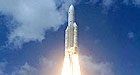
LIFTOFF! Liftoff of the 25th Ariane 5 rocket!

2232 GMT (5:32 p.m. EST)

Minus-40 seconds. The vehicle is switching to internal power.

2232 GMT (5:32 p.m. EST)

Minus-1 minute. A fast-paced series of events leading to launch will begin at Minus-37 seconds when the automated ignition sequence is started. The water suppression system at the launch pad will start at Minus-30 seconds. At Minus-22 seconds, overall control will be given to the onboard computer. The Vulcain main engine will be readied for ignition with hydrogen chilldown starting at Minus-18 seconds. The residual hydrogen burn flares will fire beneath the Vulcain engine at Minus-6 seconds to burn away any free hydrogen gas. At Minus-3 seconds, onboard systems take over and the two inertial guidance systems go to flight mode. Vulcain main engine ignition occurs at Minus-0 seconds with checkout between Plus+4 and 7 seconds. If there are no problems found, the solid rocket boosters are ignited at Plus+7.0 seconds for liftoff at Plus+7.3 seconds.

2231 GMT (5:31 p.m. EST)

Minus-2 minutes. The Vulcain 1 main engine supply valves are being opened. Also, the ground valves for engine chilldown are being closed.

2230 GMT (5:30 p.m. EST)

Minus-3 minutes. The scheduled launch time has been loaded into the rocket's main computer system. The main stage tank pressures should now be at flight level.

2229 GMT (5:29 p.m. EST)

Minus-4 minutes. Pressurization is now underway for the main cryogenic stage's liquid oxygen and hydrogen tanks. Also, final pyrotechnic arming is starting.

2228 GMT (5:28 p.m. EST)

Minus-5 minutes and counting. Status panels in the control center are green, indicating all systems remain "go" for liftoff today.

2227 GMT (5:27 p.m. EST)

Minus-6 minutes and counting. Liquid hydrogen and liquid oxygen supplies of the main cryogenic stage are being verified at flight level. Also, the pyrotechnic line safety barriers are being armed.

2226 GMT (5:26 p.m. EST)

Minus-7 minutes and counting. The Synchronized Sequence has started. Computers are now in control of this final segment of the launch countdown to prepare the rocket and ground systems for liftoff. There are two computers running the countdown -- one aboard the Ariane 5 and a redundant one at the ELA-3 launch complex.

2223 GMT (5:23 p.m. EST)

Minus-10 minutes and counting.

2219 GMT (5:19 p.m. EST)

Minus-14 minutes and counting. Arianespace is set to launch the Ariane 5 rocket with two satellite payloads at 2233 GMT today. All systems are reported "go" for liftoff at this time.

WEDNESDAY, DECEMBER 21, 2005

Two satellites are poised to be shot into space by an Ariane 5 rocket today from a South American spaceport to begin missions supporting Indian telecommunications operators and European weather forecasters.

Liftoff of the 25th Ariane 5 rocket is set for 2233 GMT (5:33 p.m. EST) from the ELA-3 launch pad at the Guiana Space Center in Kourou, French Guiana, at the opening of a 28-minute launch window. The Ariane 5GS booster will deliver the Insat 4A and MSG 2 spacecraft to a geostationary transfer orbit stretching from a low point of 385 miles to a high point of over 22,300 miles with an inclination of four degrees.

Built by the Indian Space Research Organization, Insat 4A will be added to the nation's communications and broadcasting fleet to increase the capacity of the system - the largest of its kind throughout Asia and the Pacific. Its 12 Ku-band transponders will work primarily to deliver direct-to-home services to customers scattered across India, a market that has been exploding in growth through the past few years. An additional 12 C-band transponders will serve other users in a swath covering all of southern Asia.

After deployment from the Ariane 5 upper stage, the 6,800-pound Insat 4A will use its kick motor to gradually circularize its orbit at a geostationary altitude of around 22,300 miles, while also decreasing inclination to hug the equator. The craft will be guided into a permanent location at 83 degrees East longitude, and its two solar arrays will be extended to span over 50 feet tip-to-tip as it embarks on its 12-year mission.

Below Insat 4A and inside the Sylda 5 payload adapter during the ascent to orbit will be the 4,484-pound MSG 2 weather satellite, the second in a series of four spacecraft that comprise the Meteosat Second Generation family that will provide continuity to European meteorologists throughout the coming decade. MSG 2 was manufactured by a contracting team led by Alcatel Alenia Space.

Once in its operational position in geostationary orbit parked above the intersection of the equator and prime meridian, data from MSG 2 will be delivered directly to ground terminals for use by both research meteorologists and daily weather forecasters to input into scientific studies and forecast models. The craft's imager features twelve channels ranging from visible to infrared wavelengths. Pictures can be snapped at regular 15-minute intervals, or around twice as fast as possible with satellites from the earlier series.

Preparations for today's launch - the 169th in Ariane program history - officially began on June 21 with the arrival of MSG 2 in Kourou from its European factory. A string of delays with the Insat 4A payload caused Arianespace's manifest to be shuffled, so the campaign did not begin in earnest until the end of October, when Insat 4A touched down in French Guiana.

Assembly of the Ariane 5 rocket commenced on November 17 when workers hoisted the cryogenic first stage atop its mobile launch table. The twin solid rocket boosters were positioned alongside the first stage on the following two days, and connections between the three components were made on November 21. The storable propellant upper stage and vehicle equipment bay containing the command and control systems were attached to the top of the first stage on November 23. Meanwhile, Insat 4A and MSG 2 were loaded with their chemical maneuvering fuel beginning on November 22 and November 29, respectively.

The nearly-complete Ariane 5 was rolled from its launcher integration building to the final assembly building on December 7, where it would receive its two passengers. Insat 4A was integrated on the Sylda 5 dual payload adapter on December 10, while MSG 2 was placed directly on the rocket on December 13. The Sylda 5 and Insat 4A were then attached to the booster the next day.

Work to fuel the Ariane 5 upper stage was completed over two days ending last Friday, and most activities were suspended over the weekend. Senior managers convened on Monday in the traditional launch readiness review, which concluded with a formal “go” for launch. Workers in the final assembly building armed pyrotechnic devices and made final closeouts to the vehicle before the rocket rolled on dual rail lines to the launch zone on Tuesday.

Looking ahead to today's events, the final countdown will get underway at 1103 GMT (6:03 a.m. EST). Controllers will perform a check of the launcher's electrical systems at 1503 GMT (10:03 a.m. EST), followed by the start of filling operations for the first stage's load of liquid oxygen and liquid hydrogen at 1643 GMT (11:43 a.m. EST). Chilldown conditioning of the first stage Vulcain main engine will begin at 1913 GMT (2:13 p.m. EST). A final check of connections between the Ariane 5 and ground-based telemetry, tracking, and command systems is planned for 2123 GMT (4:23 p.m. EST). As the last few minutes in the countdown tick away, all major events will be controlled by computers in the synchronized sequence. When the countdown reaches zero, the Vulcain engine will come to life, followed seven seconds later by the ignition of the solid rocket boosters and liftoff.

As the Ariane 5 rocket ascends away from the South American coast, it will roll on an easterly course before dropping its twin solid rocket boosters two minutes, 20 seconds after launch. The protective payload fairing will be jettisoned about one minute later.

The launcher's first stage will drain its fuel tanks shortly before the flight hits the ten-minute mark, and separation will occur just seconds later. The hypergolic upper stage will continue the push toward orbit with a marathon 17-minute burn. After shutdown of the second stage, thrusters will re-orient the vehicle for the release of Insat 4A and MSG 2, which are slated for T+29 minutes, 5 seconds, and T+36 minutes, 44 seconds, respectively.

Check this page during the launch of Arianespace Flight 169 for updates on the progress of the mission.

Copyright 2005 SpaceflightNow.com, all rights reserved.


Apollo Collage
This beautiful one piece set features the Apollo program emblem surrounded by the individual mission logos.
 U.S. STORE

STS-127 Patch
The official embroidered patch for shuttle Endeavour's flight to finish building Japanese section of the space station.
 U.S. STORE
 WORLDWIDE STORE


Hubble Patch
The official embroidered patch for mission STS-125, the space shuttle's last planned service call to the Hubble Space Telescope, is available for purchase.
 U.S. STORE
 WORLDWIDE STORE

Project Orion
The Orion crew exploration vehicle is NASA's first new human spacecraft developed since the space shuttle a quarter-century earlier. The capsule is one of the key elements of returning astronauts to the Moon.
 U.S. STORE


Fallen Heroes Patch Collection
The official patches from Apollo 1, the shuttle Challenger and Columbia crews are available in the store.
 U.S. STORE
 WORLDWIDE STORE

Ares 1-X Patch
The official embroidered patch for the Ares 1-X rocket test flight, is available for purchase.
 U.S. STORE
 WORLDWIDE STORE

Apollo Collage
This beautiful one piece set features the Apollo program emblem surrounded by the individual mission logos.
 U.S. STORE

Expedition 21
The official embroidered patch for the International Space Station Expedition 21 crew is now available from our stores.
 U.S. STORE
 WORLDWIDE STORE

Hubble Patch
The official embroidered patch for mission STS-125, the space shuttle's last planned service call to the Hubble Space Telescope, is available for purchase.
 U.S. STORE
 WORLDWIDE STORE

INDEX | PLUS | NEWS ARCHIVE | LAUNCH SCHEDULE
ASTRONOMY NOW | STORE

ADVERTISE

© 2009 Spaceflight Now Inc.