Spaceflight Now Home


The Mission


Rocket: Ariane 5G
Payload: Syracuse 3A & Galaxy 15
Date: October 13, 2005
Window: 2232-2356 GMT (6:32-7:56 p.m. EDT)
Site: ELA-3, Kourou, French Guiana
Broadcast: SBS-6, Transponder 13, Ku-Band


Spaceflight Now +


Premium video content for our Spaceflight Now Plus subscribers.

Life on the station
NASA astronauts Bill McArthur and John Phillips chat with Associated Press space reporter Marcia Dunn about life aboard the International Space Station in this live space-to-Earth interview from the Destiny laboratory module on October 5.

 Dial-up | Broadband

West Coast Delta 4
In preparation for the West Coast launch of Boeing's next-generation Delta 4 rocket, the two-stage vehicle is rolled out of its horizontal hangar and driven to the Space Launch Complex-6 pad for erection. The nose cone for the NRO payload is then brought to the pad.

 Play video

West Coast shuttle
Boeing's Delta 4 rocket pad at Vandenberg Air Force Base was renovated in recent years, transforming Space Launch Complex-6 from the West Coast space shuttle launch site into a facility for the next-generation unmanned booster. This collection of footage shows the 1985 launch pad test using NASA's orbiter Enterprise.

 Full coverage

Become a subscriber
More video


NewsAlert


Sign up for our NewsAlert service and have the latest news in astronomy and space e-mailed direct to your desktop.

Enter your e-mail address:

Privacy note: your e-mail address will not be used for any other purpose.


BY SPACEFLIGHT NOW

Follow the launch of Arianespace's Ariane 5 rocket carrying the French Syracuse 3A military communications satellite and the U.S. Galaxy 15 cable television spacecraft. Reload this page for the latest on the mission.

2312 GMT (7:12 p.m. EDT)

Arianespace confirms today's launch has been successful. "We have two new birds around Earth," an Arianespace commentator says.

2309 GMT (7:09 p.m. EDT)

Plus+37 minutes, 12 seconds. SPACECRAFT SEPARATION! PanAmSat's commercial Galaxy 15 broadcast spacecraft to relay cable television across the U.S. has been released from the Ariane 5 rocket's upper stage, completing today's launch.

2307 GMT (7:07 p.m. EDT)

Plus+35 minutes. Deployment of Galaxy 15 is coming up in about two minutes.

2304 GMT (7:04 p.m. EDT)

Plus+32 minutes, 40 seconds. The barrel-like Sylda structure that has enclosed the Galaxy 15 satellite during launch was just jettisoned. Syracuse was mounted atop the Sylda, allowing Ariane 5 to carry two satellites on one launch.

2301 GMT (7:01 p.m. EDT)

Plus+29 minutes, 45 seconds. SPACECRAFT SEPARATION! The French Syracuse 3A military communications satellite has been released from the Ariane 5 rocket's upper stage.

2259 GMT (6:59 p.m. EDT)

Plus+27 minutes. The upper stage has shut down to complete powered flight for the launch. Standing by for deployment of the first payload.

2258 GMT (6:58 p.m. EDT)

Plus+26 minutes. Altitude has surpassed 1,400 km.

2255 GMT (6:55 p.m. EDT)

Plus+23 minutes. Altitude is 1,000 km, velocity is 8.4 km/sec.

2254 GMT (6:54 p.m. EDT)

Plus+22 minutes, 15 seconds. Altitude is 900 km.

2252 GMT (6:52 p.m. EDT)

Plus+20 minutes, 30 seconds. Ariane is now 700 km above Earth and still climbing with its dual-satellite payload.

2251 GMT (6:51 p.m. EDT)

Plus+19 minutes. Arianespace has not reported any problems during today's launch.

2249 GMT (6:49 p.m. EDT)

Plus+17 minutes. The upper stage has just under 10 minutes remaining in this firing.

2247 GMT (6:47 p.m. EDT)

Plus+15 minutes. Velocity has reached 8 km/sec.

2246 GMT (6:46 p.m. EDT)

Plus+14 minutes. Ariane 5 is passing an altitude of 300 km.

2243 GMT (6:43 p.m. EDT)

Plus+11 minutes. The vehicle is climbing again. Altitude is 177 km, velocity is 7.7 km/sec.

2242 GMT (6:42 p.m. EDT)

Plus+10 minutes, 15 seconds. The upper stage of Ariane 5G -- the storable propellant stage -- has ignited for its long-duration burn.

2242 GMT (6:42 p.m. EDT)

Plus+10 minutes, 8 seconds. The main cryogenic stage's Vulcain engine has cut off and the spent stage has separated. It will fall back into the atmosphere prior to completing an orbit of Earth.

2241 GMT (6:41 p.m. EDT)

Plus+9 minutes. Coming up on main stage shutdown in less than one minute. Altitude is 135 km, velocity is 6 km/sec.

2240 GMT (6:40 p.m. EDT)

Plus+8 minutes, 30 seconds. Velocity is 5.7 km/sec. The main stage engine continues to fire.

2239 GMT (6:39 p.m. EDT)

Plus+7 minutes. The rocket is flying through the portion of flight in which its trajectory levels out in order to gain speed.

2236 GMT (6:36 p.m. EDT)

Plus+4 minutes. Altitude is 131 km, velocity is 2.4 km/sec.

2235 GMT (6:35 p.m. EDT)

Plus+3 minutes, 30 seconds. Arianespace says the protective payload fairing enclosing the satellite has been separated from the Ariane 5.

2234 GMT (6:34 p.m. EDT)

Plus+2 minutes, 23 seconds. The solid rocket boosters have been jettisoned from the Ariane 5 rocket's core stage. The liquid-fueled Vulcain 1 main engine continues to fire to propel the vehicle and its satellite payload to space.

2233 GMT (6:33 p.m. EDT)

Plus+1 minute, 30 seconds. About one minute left in the burn by the solid rocket boosters. The boosters are providing 90 percent of the liftoff thrust.

2233 GMT (6:33 p.m. EDT)

Plus+60 seconds. The vehicle is on the proper trajectory as it rides the power of the twin solid rocket boosters and main stage liquid-fueled engine.

2232 GMT (6:32 p.m. EDT)

Plus+30 seconds. Rocket has completed its pitch and roll maneuvers as it heads eastward from the South American coast.

2232 GMT (6:32 p.m. EDT)

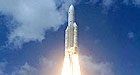
LIFTOFF! Liftoff of the Arianespace Ariane 5 rocket launching a pair of communications satellites!

2231 GMT (6:31 p.m. EDT)

Minus-40 seconds. The vehicle is switching to internal power.

2231 GMT (6:31 p.m. EDT)

Minus-1 minute. A fast-paced series of events leading to launch will begin at Minus-37 seconds when the automated ignition sequence is started. The water suppression system at the launch pad will start at Minus-30 seconds. At Minus-22 seconds, overall control will be given to the onboard computer. The Vulcain main engine will be readied for ignition with hydrogen chilldown starting at Minus-18 seconds. The residual hydrogen burn flares will fire beneath the Vulcain engine at Minus-6 seconds to burn away any free hydrogen gas. At Minus-3 seconds, onboard systems take over and the two inertial guidance systems go to flight mode. Vulcain main engine ignition occurs at Minus-0 seconds with checkout between Plus+4 and 7 seconds. If there are no problems found, the solid rocket boosters are ignited at Plus+7.0 seconds for liftoff at Plus+7.3 seconds.

2230 GMT (6:30 p.m. EDT)

Minus-2 minutes. The Vulcain 1 main engine supply valves are being opened. Also, the ground valves for engine chilldown are being closed.

2229 GMT (6:29 p.m. EDT)

Minus-3 minutes. The scheduled launch time has been loaded into the rocket's main computer system. The main stage tank pressures should now be at flight level.

2228 GMT (6:28 p.m. EDT)

Minus-4 minutes. Pressurization is now underway for the main cryogenic stage's liquid oxygen and hydrogen tanks. Also, final pyrotechnic arming is starting.

2227 GMT (6:27 p.m. EDT)

Minus-5 minutes and counting. Status panels in the control center are green, indicating all systems are "go" for liftoff today.

The Synchronized Sequence is underway. Computers are now in control of this final segment of the launch countdown to prepare the rocket and ground systems for liftoff. There are two computers running the countdown -- one aboard the Ariane 5 and a redundant one at the ELA-3 launch complex.

2226 GMT (6:26 p.m. EDT)

The launch appears to be continuing on schedule, after some Arianespace broadcast problems tonight.

THURSDAY, OCTOBER 13, 2005

An Ariane 5 rocket is set for launch later today carrying the French Syracuse 3A military communications satellite and PanAmSat's commercial Galaxy 15 broadcast spacecraft to relay cable television across the U.S.

Liftoff from the jungle pad in Kourou, French Guiana, will be possible between 2232 and 2356 GMT (6:32-7:56 p.m. EDT).

This will be the third Ariane 5 of 2005.

The final countdown began this morning at the Launch-Minus 11 hour, 30 minute mark. That was followed by a check of electrical systems. Fueling of the first stage with its super-cold load of liquid hydrogen and liquid oxygen was set to commence in the final five hours before liftoff time.

The countdown will enter the synchronized launch sequence about seven minutes prior to launch. Next will be a fast-paced series of automated events transitioning the rocket and payload to internal power, pressurizing fuel tanks, and taking systems to flight mode. The Vulcain engine will come to life, followed by ignition of the solid rocket boosters and liftoff.

The twin boosters will burn for 2 minutes, 18 seconds, and the payload fairing will be released 3 minutes, 8 seconds after launch. The cryogenic first stage will exhaust its propellant resources almost 10 minutes into the flight. After separation, the storable propellant upper stage will ignite to begin its lengthy 17-minute burn to finish the Ariane 5's ascent.

Syracuse 3A deployment is set for 29 minutes, 28 seconds after liftoff, followed about 10 minutes later by release of Galaxy 15.

Watch this page for live updates during the launch.

Copyright 2005 SpaceflightNow.com, all rights reserved.


Current Shuttle Mission Patch
The official embroidered patch for shuttle Atlantis' flight to deliver critical spare equipment to the space station.
 U.S. STORE
 WORLDWIDE STORE

Ares 1-X Patch
The official embroidered patch for the Ares 1-X rocket test flight, is available for purchase.
 U.S. STORE
 WORLDWIDE STORE

Apollo Collage
This beautiful one piece set features the Apollo program emblem surrounded by the individual mission logos.
 U.S. STORE
 WORLDWIDE STORE


Project Orion
The Orion crew exploration vehicle is NASA's first new human spacecraft developed since the space shuttle a quarter-century earlier. The capsule is one of the key elements of returning astronauts to the Moon.
 U.S. STORE


Fallen Heroes Patch Collection
The official patches from Apollo 1, the shuttle Challenger and Columbia crews are available in the store.
 U.S. STORE
 WORLDWIDE STORE

Ares 1-X Patch
The official embroidered patch for the Ares 1-X rocket test flight, is available for purchase.
 U.S. STORE
 WORLDWIDE STORE

Apollo Collage
This beautiful one piece set features the Apollo program emblem surrounded by the individual mission logos.
 U.S. STORE

Expedition 21
The official embroidered patch for the International Space Station Expedition 21 crew is now available from our stores.
 U.S. STORE
 WORLDWIDE STORE

Hubble Patch
The official embroidered patch for mission STS-125, the space shuttle's last planned service call to the Hubble Space Telescope, is available for purchase.
 U.S. STORE
 WORLDWIDE STORE

INDEX | PLUS | NEWS ARCHIVE | LAUNCH SCHEDULE
ASTRONOMY NOW | STORE

ADVERTISE

© 2009 Spaceflight Now Inc.